On my post for July 22nd about the banned posters advertising the London Dungeon's new exhibition about the reign of Mary Tudor, I discussed the inappropriateness of the posters both as works of art (for young children) and in terms of them grossly distorting and trivialising the reality of Queen Mary's reign.
It has been subtly brought to my attention by a very dear friend that seeking to turn the religious policies of Mary Tudor's government into a commercialised horror show is not only unhelpful in trying to correctly understand Mary's reign, but - far more importantly - it is also hideously disrespectful to her government's 283 victims, all of whom died in agony. I made no mention of these 283 people, who were executed for their religious beliefs in England between 1554 and 1558. I should have.
I agree with my friend that the distance of 500 years does not mean that these people's deaths can now be treated as a grotesque form of a circus and that as a place where terrible cruelty and tragedy occurred, the London Dungeons should instead be seeking to capitalise on that, rather than turn their venue into a macabre fairground attraction.
Showing posts with label Inquisition. Show all posts
Showing posts with label Inquisition. Show all posts
Saturday, 31 July 2010


Thursday, 22 July 2010
Controversy over banned "Bloody Mary" poster
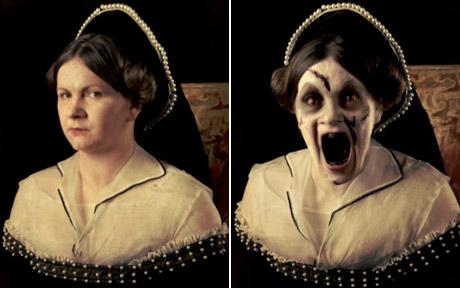
A lurid and frightening poster advertising the London Dungeons' forthcoming exhibition on the religious persecutions during the reign of Queen Mary I (r. 1553 - 1558) has been banned in London, after parents complained it was frightening their children. Understandably. Mary, who was the only child of Henry VIII and his first wife, Katherine of Aragon, earned the nickname "Bloody Mary" in the years after her reign, thanks to her government's systematic persecution of Protestant-Christians and religious dissenters.
The poster (above), which shows the 16th-century monarch transformed into a hideous zombie, plays to the old and inaccurate idea of Mary as being a psychotic and evil woman and it has understandably raised the heckles of not only the angry mothers of London, but also the biographers and historians who have recently been working on re-assessing Queen Mary's life and legacy.
I have an uneasy relationship with Catholic revisionism about this period in English history and this poster highlights the reasons why. On the one hand, it is both tasteless and absurd to have Queen Mary displayed as demonic zombie and it is a very good thing that historians are objecting to it. Recent work by people like Linda Porter, David Loades and Anna Whitelock have finally helped put Mary in her proper historical context: she ruled in an age when religious persecutions were the norm. Through their work, these excellent writers are finally beginning to make headway in persuading the reading public that Queen Mary was not so much evil as essentially misguided, as well as being highly capable in other areas of her life and reign.
However, the post on historian Stephanie A. Mann's excellent blog Supremacy and Survival about the poster controversy, raises why I am also uneasy about it. The noted historian, Leanda de Lisle, defends Queen Mary: -
“It really is an example of England’s knee-jerk anti-Catholicism and how our history of the Tudor period has been distorted by post-Reformation propaganda. What about Elizabeth? People may be aware of the executions of Catholics, but there were many more people. After the 1569 northern rebellion, Elizabeth ordered that a man was to be hung in every village associated with the rebellions. It was on a similar scale to her father."
Elizabeth ruled for forty-five years, compared to Mary's five, but de Lisle's point is a thoughtful one and a sensitively made one. However, in other arenas, the policy of trying to tear down Lady Jane Grey or Elizabeth I's historical reputation in order to rehabilitate Mary's is indicative of a worrying trend in English revisionist histories. Catholicism's past mistakes are now judged as products of a turbulent century; Protestantism's as the systematic cultural rape of Albion.

The portrait which inspired the poster: the real Queen Mary Tudor, painted by Antonio Mor, towards the end of her life (c. 1557)
Tuesday, 6 July 2010
July 6th, 1535: The Execution of Sir Thomas More

Today marks the anniversary of the beheading of Sir Thomas More (above), the former confidante and adviser of King Henry VIII of England. More, who had provided the eulogy at the funeral of Henry's mother, Elizabeth of York, in 1503, had served as Lord Chancellor from 1529 to 1532, during which time he became increasingly uncomfortable at his master's ecclesiastical policies. He resigned, but was eventually executed for treason three years later.
Canonised by the Roman Catholic Church in 1935, modern perceptions of Sir Thomas vary - at a recent debate on the role of the Catholic Church in history, the British man of letters, Stephen Fry, thundered at Catholic MP and apologist, Ann Widdecombe, that it was a matter almost obscene that somehow like More should be venerated as a saint, particularly as the patron of private conscience, given his treatment of heretics during his time as Lord Chancellor. Widdecombe defended More's canonisation and something of the differing reactions to him can be reflected in cinematic portrayals of him - be it the hagiographic A Man For All Seasons, the intensely critical God's Outlaw or the more balanced characterisation by Jeremy Notham in The Tudors. As with so many of his contemporaries, what we know (or, rather, think we know) about Sir Thomas is based on hearsay or particularly resilient legends. Chief amongst the more nonsensical stories told about him is the idea that he personally tortured the heretics captured with a cat o' nine tails or that he championed Katherine of Aragon and refused to accept Anne Boleyn as the new queen. In fact, perhaps to his credit, More was one of the few people who personally admired Katherine but didn't see her cause and that of the Catholic Church in England as symbiotic. At the time of Anne's Coronation, the man who would be a saint, wrote: -
"So am I he among his Grace's other faithful subjects, his Highness being in possession of his marriage and this noble woman really anointed queen, neither murmur at it nor dispute upon it, nor never did nor will, but without any other manner meddling of the matter among his other faithful subjects, faithfully pray to God for his Grace and hers both long to live and well, and their noble issue too, in such wise as may be to the pleasure of God, honour and surety to themselves, rest, peace, wealth and profit unto this noble realm."
A legal defense of Sir Thomas is mounted by the excellent blogger, Claire Ridgway, here.
Saturday, 19 June 2010
The Burning of the Fair Gospeller

Claire at The Anne Boleyn Files gives a fantastic, if grotesque, account of the horrible and hideous death of Anne Askew, a young Protestant convert savagely tortured and then executed for her beliefs during the last years of the already-bloody reign of King Henry VIII. Whatever one might think of Anne Askew's beliefs, there can be no real doubting her incredible bravery.
To quote Claire: -
"There is no doubt that Anne Askew was a martyr and an incredible woman. She was just 25 years old when she died but what an amazing life she had led. In an age where women were supposed to be submissive, and have no voice or opinions of their own, she was an outspoken preacher and died for her faith, remaining true to her friends and beliefs, whatever the cost. I admire her."
Read the full article here.
Subscribe to:
Posts (Atom)