Showing posts with label Marie-Antoinette. Show all posts

Monday, 29 December 2014

My Top 10 Books of 2014


Good evening!

This was a great year for books, I think. The year started of well for fans of the sixteenth century with Lauren Mackay's fantastic biography of the diplomat Eustace Chapuys, which I reviewed and loved. If you're interested in the Tudor court or in the world of diplomacy, do pick up a copy. Since then, I've brought these books to New Haven, Oxford, London, Portballintrae and Gloucestershire with me and they have been great company. I'm currently working my way through two books that I hoped to finish before the end of the year - The Six Wives and Many Mistresses of Henry VIII by Amy Licence and The Medieval Housewife and other women of the Middle Ages by Toni Mount, both of which I'll post more about in the new year. From Inside the Tudor Court on, here are my ten favourite reads of 2014, in order of publication.

1. Finding Camlann by Sean Pidgeon (novel) (published by W. W. Norton & Company)  This novel reads as a love letter to Oxford no less effusive than Brideshead Revisited, but in this case the story of an archaeologist on the quest for the historical origins of the legend of King Arthur allows the story to lovingly evoke the one side of Oxford life that Brideshead tried to avoid at all costs - actual academics. Long and haunting descriptions of the British countryside and a crackling dynamic between the archaeologist and an employee at the Oxford English Dictionary make this a short but cerebral novel that I absolutely loved. It had me hooked, I stayed up to finish it and I hope we'll see more from Sean Pidgeon in 2015. (Full review to follow)

2. Four Sisters: The Lost Lives of the Romanov Grand Duchesses by Helen Rappaport (non-fiction) (published by Macmillan) I thought Helen Rappaport's Ekaterinburg, about the weeks preceding the murder of the Romanov family in 1918, was a triumph of a book and while the decision to write the first full-length biography of Nicholas II's daughters meant that Four Sisters lacked the dramatic intensity of her earlier work, Rappaport managed to produce a deeply moving and painstakingly researched account of the Grand Duchesses Olga, Tatiana, Maria and Anastasia. Their childish quarrels, the friends they made when they volunteered as nurses during the Great War, the Grand Duchess Olga's deep love for a wounded soldier and the twilight of Imperial Russia intersect to produce an intimate account of four too-short lives.

3. George Boleyn: Tudor Poet, Courtier and Diplomat by Clare Cherry and Claire Ridgway (non-fiction) (published by Made Global) One of three of Henry VIII's brothers-in-law to end his life beneath the headsman's axe, George Boleyn was no saint and no prude, either. But he emerges from the pages of Clare Cherry and Claire Ridgway's biography as a committed and talented young man with a sincere passion for the Protestant faith. Cherry and Ridgway know their subject and his world, and they use that knowledge to lift him from the shadow thrown by his famous sister, rehabilitating him while never failing to remind us of the grizzly world in which he lived and died. 

4. How to Ruin a Queen: Marie Antoinette, the Stolen Diamonds and the Scandal that Shook the French Throne by Jonathan Beckman (non-fiction) (published by John Murray) I don't know what it is about the Affair of the Necklace, but it seems to produce more than its fair share of historical works that could also be praised for their literary merits. In 1942, the Hungarian-Jewish writer Antal Szerb produced a book called The Queen's Necklace which, if you can find it, cannot come any more highly recommended. It is utterly beautiful. Likewise, Jonathan Beckman's account of one of the greatest jewellery heists in history is written in such a delicious style that, if edible, it would produce moomoo-necessitating levels of obesity. It was a joy to read this book and Beckman works through the initiators, and victims, of the Affair with consummate skill. Like Szerb's book, and Antonia Fraser's biography, it left me feeling even more sorry for poor Marie-Antoinette, but it also managed to delve deeper than before into the murky personality of the Comtesse de la Motte and it's the inescapable whiff of that dreadful woman that lingered long after I finished reading. 

5. The Creeper by Emerald Fennell (novel) (published by Bloomsbury) I bought this sequel to Shiverton Hall because the author is a good friend of mine and because I thoroughly enjoyed the first book in the series. On a side note, I have such a low threshold for any kind of horror that if Emerald does ever turn her hand to writing that genre for adults, you will find me manfully dousing myself in water from Lourdes and using rosaries like lassos. But I digress. This creepy and intrigue-laden ghost story at a ghoulish English boarding school is perfect for children or for those of us who have never been able to see the clock turn to 3 a.m. again without silent tears courtesy of The Exorcism of Emily Rose. 

6. Empress Dowager Cixi: The Concubine Who Launched Modern China by Jung Chang (non-fiction) (published by Vintage) Chairman Mao's biographer returns with this compelling and page-turning life of the notorious "Dragon Empress" who presided over the waning years of the Chinese monarchy. Cixi's insatiable ambition, murderous self-promotion and pathological meddling usually cause bile to mix with ink in the historian's pen, but Chang offers up enough of the Empress's virtues, namely her hard-headed pragmatism, her charisma and her impressive list of political victories to balance the scales. 

7. The Paradise Tree by Elena Maria Vidal (novel) (published by CreateSpace) Like Finding Camlann, this is a cerebral book with a love of nature underpinning its dialogue. Here, it's a defence of Catholicism and the experience of Irish immigrants as they set out for a new life in Canada and the United States during the reign of Queen Victoria. The grasp of Irish colloquialisms  is impressive, as is the way Irish words peppered conversation even before the Gaelic Revival at the end of the century led, irony of ironies, by the privileged offspring of the Protestant Ascendancy. A love of domesticity, quotes from the Bible and Irish folk songs to start each chapter, and a pretty heartbreaking subplot about how far one character will go to prosper in their new homeland made The Paradise Tree a thought-provoking read. (Full review to follow)

8. Eleanor of Castile: The Shadow Queen by Sara Cockerill (non-fiction) (published by Amberley) Proof that biographies of medieval personalities don't have to succumb to flights of fantasy, The Shadow Queen was a wonderful read about a supreme multi-tasker. Businesswoman, landlady, princess, politician, adviser, wife, mother and patron of the arts, Eleanor of Castile also managed to keep the royalist home fires burning during the Second Barons' War. Like the indomitable Hapsburg Empress Maria Teresa five centuries later, Eleanor didn't seem to find being nearly-constantly pregnant a deterrent. The invasion of Wales and the Diaspora are also dealt with. I would say that The Shadow Queen deserves to be considered the definitive biography of its subject.

9. Edward II: The Unconventional King by Kathryn Warner (non-fiction) (published by Amberley) Sympathetic without being sentimental, The Unconventional King is as much a warning against trusting in the power of repetition as it is a biography of a monarch whose disastrous reign ended in his deposition and mysterious disappearance. Warner uses every contemporary source available to her to prove that nearly every popular image of King Edward II is totally unfounded - the effeminate appearance, the domestic cruelty, the cowardice, the alleged illegitimacy of his eldest child and the grotesque cameo of a red hot poker in his final moments. They're all bunkum. She's also refreshingly frank about what his bisexuality, to use a word familiar to us but alien to him, and lays out the evidence to support her view that his relationship with Piers Gaveston, Earl of Cornwall was probably a romantic one. Gutsy, outgoing, strong, handsome and with a flair for bonhomie, Edward II has clearly caught Kathryn Warner's interest and she's repaid him with a stellar and brutally honest account of his life. 

10. Midnight at the Pera Palace: The Birth of Modern Istanbul by Charles King (non-fiction) (published by W. W. Norton & Company) It is hard to put into words how much I enjoyed Midnight at the Pera Palace. A social history of the city of Istanbul from the end of the First World War to the aftermath of the Second, the narrative is framed around a hotel that was built to attract a European clientele. Fantastically written, perfectly structured and with a cast of hundreds of men and women who visited the hotel from the fall of the Ottoman sultanate through the tortured birth of the Turkish republic, Midnight at the Pera Palace is a grand story of humanity. It is modern history at its finest. I could not put it down and I plan to visit the city next year. 

Friday, 5 December 2014

The ghosts of Versailles

Stephanie Dale as Marie-Antoinette (seating) with Rebecca Lenaghan as Gabrielle de Polignac

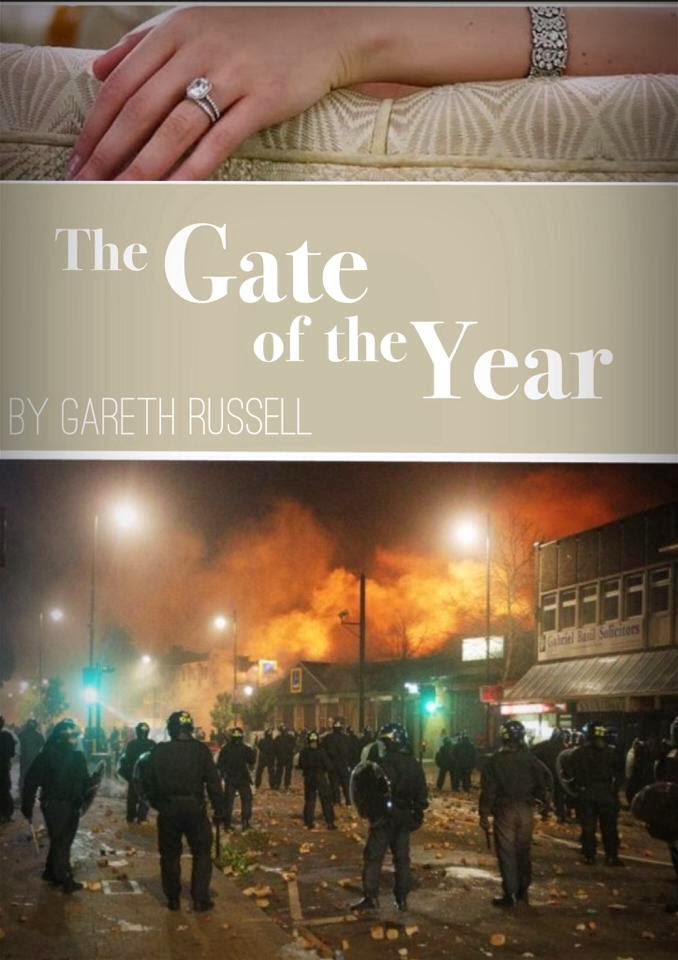
This December, I have been working on a revival of my play The Gate of the Year, the storyline of which is based on the outbreak of the French Revolution. Beginning with the final Christmas at Versailles in 1788 and moving on to three weeks after the fall of the Bastille in 1789, the play updates to the story to a modern setting - although, with its preoccupation with gender, status and etiquette, it's not quite modern in the way we would identify it. Cailum Carragher, who plays the Minister of Police, describes it as adrift "in time and place" - a far more lovely way to put it, I suppose.

Lifting characters who lived and died in the fading decades of the eighteenth century to set them adrift in the choppy currents of an imagined twentieth was not, strange to say, a particularly difficult process, but it was fascinating. I think I shall leave them, temporarily, with great reluctance. They have a way of settling under your skin, by leaping out to you across the centuries - they are so vivid, so relatable, I think, even in their oddity. There is something tangible about them; it's hard not to feel drawn toward them. Stephanie Dale, who plays Marie-Antoinette, and who has recently finished filming for the BBC series The Sparticle Mystery, reflects, "I am sympathetic towards her because of what she has had to endure emotionally. Growing up, her life was supposed to have been perfect and she had a terrible time with the press. One of my favourite lines is 'it was not a complete pleasure to live out the greatest fairy tale of the century.' Marie Antoinette has been hurt by publicity and she knew what people expected of her and her marriage, but she is also extremely strong for having the ability to endure it. The amount she takes on emotionally and physically in the course of this play is quite extensive and for this reason I admire her." As Marie-Antoinette hurtles towards a fate she would never have chosen for herself there is, to me anyway, something magnificent about the way she decides "not to go quietly into the night." In Stephanie's words, "She has chosen her destiny and chosen to take action which is an extremely admirable part of her personality."

Mercedes Sharma, who plays another female icon of the revolutionary era, liberal republicanism's "angel of assassination" Charlotte Corday, is another actress playing someone who goes down the rabbit hole as the Revolution engulfs them all. Throughout the rehearsal process, Mercedes has always maintained that her character is one of the most identifiable for modern audiences. "Having gotten to know the characters I still think they are the most relatable," she says. "I believe that convincing yourself that things happen for the greater good (something that Marat does throughout) is part of human nature. Charlotte is like all young people with a passion for something, her passion and dreams just happen to turn into her own personal living hell."

Daniel Kelly as Jean-Paul Marat and Mercedes Sharma as Charlotte Corday
In this re-imagined world of The Gate of the Year, Corday actually knows her victim, Jean-Paul Marat, in a friendship where her idealism contrasts with his hard-nosed, brutal pragmatism. However, Mercedes is more ambivalent about Charlotte Corday than the real Corday's nineteenth century admirers were. She's not so sure that anyone emerges from the revolutionary period completely untainted: "At the start of the play I think Charlotte's willingness to throw herself into the revolutionary world, whether she truly understands what she is getting into or not, almost inspires Marat to become the monster we know him to be by the end. Both need each others' approval but in all honesty I don't think either of them realise that until it tears them apart."

Grappling with personal and moral ambiguities is what makes this story so appealing to me as a writer and Tom Flight, who returns to the role of France's doomed King Louis XVI articulates this well when reflecting on his character's dire reputation as a failed monarch who helped grease the slippery slope to chaos. "I think the reason why he is often thought of as weak and pathetic is because Louis suffered from incredible self-doubt in his ability to rule which lead to uncertainty in decision making. This makes Louis easy to mock as it goes against the traditional ideas of a strong monarch. But in The Gate of the Year, you see the complexity of the decisions that Louis faced and how he was caught between the deep-seated traditions of the Aristocracy and the blazing rage of the revolutionaries. One of my favourite lines in the play is when Marie-Antoinette says of Louis “He chose being kind over being good.” Louis tried until the end to do the right thing, but the consequences of his decisions were horrific. I actually believe Louis was a better King than most. But," he concedes, "he was perhaps the wrong monarch at the wrong time."

Both Stephanie and Tom interpreted the marriage of Louis XVI and Marie-Antoinette much more favourably than most portrayals of them. Marie-Antoinette has been played on screen by actresses like Norma Shearer (who was nominated for an Oscar for the role in 1938), Jane Seymour, Joely Richardson, Kirsten Dunst and Diane Kruger, but in many, particularly in the 1938 role, Louis is played as a kind-hearted dunce, almost a caricature. Stephanie sees Marie-Antoinette as "unquestionably faithful" to her husband (rumours dogged the Queen, then and later, that she had an affair with the handsome Swedish soldier, Count Axel von Fersen, but I agree with writers like Jonathan Beckman and Elena Maria Vidal that there is no evidence to support that she was ever unfaithful to her husband). Of their marriage, Tom, who read the historian Vincent Cronin's account of the royal marriage, reflects, "I believe they loved each other unquestionably. Through being forced into a politically motivated arranged marriage a unique bond between them was formed. Louis also never had mistresses (unlike many of his predecessors) and his faithfulness shows a commitment and devotion to the marriage that was rare in Versailles. I believe their marriage was a happy and loving one, and Stephanie Dale’s wonderful performance as Marie-Antoinette sublimely captures the shock and torment as the fairy-tale turns into a nightmare."

Robert Morley and an Oscar-nominated Norma Shearer as Louis and his wife in 1938's Marie Antoinette
The story of the fall of the French monarchy is a grand political drama and a complex series of personal tragedies and triumphs. Tom Flight's favourite moment in the play takes place as the monarchy enters its endgame. "My favourite moment to perform is Act II, Scene VIII (photo below) between Louis and [his younger brother] Charles, performed by the outstanding David Paulin," he told me. "An empire has fallen, but in this scene the emotions of the situation are played out in a sibling squabble. I believe Louis always felt in the shadow of his younger brother, even that he was perhaps more suited to being King, and it is quite heart-breaking the way he admits his failure to his brother. Charles also has bitter regret he couldn’t do more for his country which, in part, was due to Louis’s decisions, and he can’t help but kick Louis while he’s at his lowest. But the scene remains a moment between two brothers. Despite the violent anger and high emotion neither can get away from the indelible nature of family and brotherhood."


Shimmering just beyond our reach, the "crucible of our modernity", the ghosts of Versailles, those who lived in it and those who destroyed it, present an eerily modern set of possibilities to depict, not so much a world in its twilight, as a timeless tale of human greatness, weakness, cruelty, wisdom, folly and hope.
 
Photographs by Ella McMaster.

Friday, 14 March 2014

Emma Taylor talks about Marie-Antoinette and "The Gate of the Year"

"I would rather die bravely than live without honour": Emma Taylor as Marie-Antoinette in Act II of The Gate of the Year

After playing Imogen Dawson, the flamboyant party girl in Popular and The Immaculate Deception, Emma Taylor played France's doomed and iconic queen, Marie-Antoinette, in my new play The Gate of the Year, the story of the events of 1789 updated to the modern day. In the second of the cast's interviews about their characters and the show, Emma talks about her role and why it meant so much to her.

Emma, tell us a bit about the Marie-Antoinette we encounter in “The Gate of the Year”?
The Marie-Antoinette we encounter in The Gate of the Year is a very different person to the image most people have, of the frivolous young queen lying around in her jewels, drinking and gambling her nights away. She is a mother, a wife, and a very dedicated Queen. She is just beginning to develop into the strong, decisive woman we see by the end of the Revolution, and she's incredibly observant, charming and accommodating. Marie-Antoinette is such a well-known character in history, and yet I feel as if so much of her true personality has been completely passed over in so many aspects – but I think The Gate of the Year really gives her back that respect, presenting her not as a villain and or the triumphing heroine, but as an extraordinary woman who lived, breathed and loved the same as any other.

Sunday, 2 March 2014

"The Gate of the Year"


This week, my newest play The Gate of the Year is premiering in the Belvoir Players' Studio in south Belfast. The Gate of the Year imagines the events of the French Revolution from a few months before the famous attack on the Bastille fortress until a few days before the fall of the palace in October, as if they had taken place in the modern-day. It focuses on the high court nobility, led by the King's youngest brother the Duke of Artois (played by Belfast actor David Paulin) and his friend, the elegant but manipulative Duchesse de Polignac (played by Rebecca Lenaghan), as they struggle against the growing forces of the revolution. It also contains the storyline of the notorious journalist Jean-Paul Marat (Conor Doran) and the young idealistic republican Charlotte Corday (Nuala Davies).

One of the joys of writing The Gate of the Year after writing the story of the actual events of the French Revolution, The Audacity of Ideas, a few years ago, is to re-imagine the events and personalities to fit with a more modern setting. Marie-Antoinette, played here by the wonderful Emma Taylor who played Imogen in both stage versions of Popular, was seen by many as the inventor of what later came to be called haute couture, by public fascination with her soon turned ugly and in this alternate reality, she becomes the victim of invasive and crushing media attention. Trying to keep the ghosts of Grace Kelly and Princess Diana at bay was tricky, but luckily Marie-Antoinette's own involvement, last-minute, in the politics of the French monarchy meant her story took on a very different hue regardless of her modern-day similarities.

History, I think, has eternal themes and balancing those with the characters of those who lived and died in the 1790s has been a hugely rewarding experience and one of the highlights of any challenge I have faced as a writer thus far. In this world, The Marriage of Figaro controversy becomes about the same-sex marriage debate and Marie-Antoinette complains of the paparazzi, but words like "recession" and "hunger strikers", words that have such an immediate emotional impact on people today, particularly in Northern Ireland, slotted right into the story with surprising ease. 

From left-to-right. In rehearsal for The Gate of the Year, Emma Taylor as Queen Marie-Antoinette, David Paulin as the Duke of Artois and Tom Flight as Louis XVI. 
The French Revolution casts a long shadow over the two centuries that came after it and perhaps the most surprising thing is not how much needed to be changed but how much could remain the same. The events of The Gate of the Year are very different to the chronology of what happened in 1789 - with modern technology, it was impossible to have Louis XVI (Tom Flight) and Marie-Antoinette's eldest son die of tuberculosis as he did in 1789, here, they are the parents of four surviving children - but at the end of it all, I can't help but think that the feeling of what that euphoric and horrific summer must have been like for the people living through it has remained the same.

The Gate of the Year is open to the public at the Belvoir Players' Studio Theatre in Belfast on Friday 7th March at 8 p.m. and Saturday 8th March at 8 p.m. An industry performance is taking place on Thursday 6th. For more information, you can visit the theatre's booking page here. 

Sunday, 8 December 2013

Auditions for "The Gate of the Year"


I am very excited about a performance in February of my new play, The Gate of the Year. If anyone in the Belfast or County Down area is interested in auditioning, the information is below: -

A new play by Gareth Russell, author of Popular and A History of the British Monarchy, is a re-telling of one of the most famous events in history - the French Revolution - told from the point of view of the upper classes, who stood to lose everything as their world shattered around them. 
Set in the modern day, The Gate of the Year imagines the events of the revolution as if they occurred in the twentieth century. Inspired by real events, its characters include the charming and mysterious Queen Marie-Antoinette, the fiery revolutionary Jean Marat, the quiet conservative Marc de Bombelles and the beautiful but unpopular duchess, Gabrielle de Polignac. 

The Gate of the Year will run at the Belvoir Studio in Belfast for three nights from 20th February 2014 and rehearsals will start in January, although they will be flexible due to exam commitments. Auditions will be held on 17th and 20th December, at the Rainbow Factory on College Square North (17th) and Belvoir Players Studio (20th). Audition extracts are now available by contacting popularauditions@yahoo.com. Please contact ASAP to reserve a spot!

Sunday, 25 August 2013

Two reviews from the archives


From the archives of History Today, two reviews of biographies of two of history's unluckiest queens - Anne Boleyn and Marie-Antoinette of France. Dr. Susan Walter Schmid reviews G.W. Bernard's 2010 biography of Boleyn, Fatal Attractions, taking particular issue with Bernard's comparisons between Anne Boleyn and the late Princess Diana and his use of extant translation of Lancelot de Carles's poem about Boleyn's downfall in 1536.
 
One wants to ask immediately: Why would Anne have become an adulteress? In a curiously presentist observation Bernard would have us believe that because of Princess Diana, moderns may not find it so hard to believe a queen would commit adultery (p. 156). Presentism occurs when we allow ourselves to interpret past people or events based only on our modern values and concepts. Granted, it is difficult to avoid; after all, the present is what we know best, but a historian simply must not fall into this trap. What an increasingly unhappy princess in the twentieth century did cannot automatically tell us anything about what a not necessarily unhappy queen in the sixteenth century might have done. Although there were some suggestions that Henry had a mistress while married to Anne, what she might have done in response must be understood in sixteenth-century terms, not those of today.


Meanwhile, John Rogister, author of Louis XV and the Parlement of Paris, 1737 - 1755, offers a generally positive review of Lady Antonia Fraser's 2002 biography of Marie-Antoinette, The Journey.
 
This absorbing and well-illustrated book is full of sharp insights about Marie Antoinette, her relationship with the handsome Swedish nobleman, Count Ferson (her romantic knight), her loyalty to those she loved. Georgiana, the Duchess of Devonshire, gave an apt description of the Queen facing her accusers: how, even when confronted with a disgusting allegation extracted from her impressionable seven-year-old son, ‘her answers, her cleverness and greatness of mind’ shone through.

 
Both reviews contain very good accounts of Anne and Marie-Antoinette's historical significance. The review of Anne Boleyn: Fatal Attractions is accessible here and Marie Antoinette: The Journey's is here.

Sunday, 4 August 2013

The Ring of the Heavens: Marie-Antoinette's jewellery


Tea at Trianon has a profile and link to this beautiful ring, which once belonged to Marie-Antoinette.

Thursday, 29 November 2012

Blues and whites


They're my favourite two colours together. Elena Maria Vidal's blog Tea at Trianon shows some of Marie-Antoinette's favourite combinations.

Monday, 12 November 2012

Director Benoît Jacquet discusses the lesbian undercurrents in "Les adieux à la reine"


The stunning movie Les adieux à la reine, or Farewell, My Queen, in English, has caused quite the stir because it allegedly depicts Marie-Antoinette (Diane Kruger) as being a lesbian or bisexual, who was in love with her gorgeous best friend, the Duchesse de Polignac (above right, played by Virginie Ledoyen.) Told from the point of view of a palace servant in the days immediately after the fall of the Bastille prison, the movie is based on the novel by acclaimed French historian, Professor Chantal Thomas.

In this interview, the movie's director, Benoît Jacquet, discusses the lesbian undercurrent in the movie and how the intense nature of aristocratic friendships in the eighteenth century may have led to confusion over the relationship between Gabrielle and the Queen. Personally, I think the movie's ambiguity is kept quite nicely - although I don't for a moment think there anything even remotely sexual in Marie-Antoinette's relationship with Gabrielle de Polignac. From what I can tell, Jacquet himself does actually believe that it's possible that Marie-Antoinette was a (repressed) lesbian or, at the very least, in love with Gabrielle; whereas the actress who played the Queen, Diane Kruger, does not and believes the story was one of intense, but platonic, love. Either way, Les adieux à la reine is a beautiful movie and Diane Kruger's performance is exceptional, as is her physical resemblance to Marie-Antoinette.


Saturday, 15 September 2012

Is the Palace finally getting sassy with the Press?


It's been a long time since we saw a case of the famous cerca regna tonat that Thomas Wyatt captured with his poetry in the dark days of 1536. But today, for the first time in a long time, the Palace thundered. Saint James's Palace came out all guns blazing about the media's grotesque invasion of the Duchess of Cambridge's privacy, when a trashy French magazine Closer published illicitly-acquired photographs of the princess sunbathing topless whilst on a private holiday with her husband in Provence. The Palace is now taking legal action and the media conglomerate who own the Irish Daily Star, which also published the pictures, have hinted that they will withdraw all their funding from the newspaper - possibly forcing it to go out of circulation. At long last, it seems, hunting season on the House of Windsor is over.

But the question might justifiably be asked - why has it taken the Court so long to fight back against the media's often appalling treatment of the Royal Family? Forget all the ridiculous conspiracy theories about what happened in 1997, the true tragedy of what happened to Princess Diana was that she was chased to her death because the paparazzi wanted a photograph of her with her new boyfriend. The Duchess of York, the Duchess of Cornwall and the Prince of Wales have all found themselves victims of over-intrusive press attention and some of the things said, implied, published or revealed about them were achieved in such patently illegal or prurient ways that any other celebrity or public figure would have responded with a law suit. And yet, for over a century, the royals have done nothing - resulting in the old joke that you can say anything you like about the Royal Family because they're the one set of people who won't sue.


When she was first confronted with evidence of the libelles, the precursors to both pornography magazines and the lower-end tabloids, Marie-Antoinette simply refused to take them seriously. As far as she was concerned, they were nothing but trash written by trash; she failed to realise, until it was too late, the awful damage that these lies had done. That sublime royal self-confidence, and the refusal to acknowledge tawdry and seedy reality, has flowed inexorably from the mirrored halls of Versailles right the way down to the current incumbents of Buckingham Palace. To acknowledge something gives it credibility; therefore the best thing to do is to ignore it. The problem is, though, that it won't go away just because you want it to and, as Marie-Antoinette learned in 1789, when mud is flung, it usually leaves a stain - however undeserved. Whilst you can certainly over-egg the comparisons between Marie-Antoinette and Princess Diana, it's hard not to conclude that one thing they had in common was that they were both harried to their premature deaths by bad publicity. 

The House of Windsor's relationship with the press has never been very good and its strategy for handling its seedier elements has usually been as staggeringly incompetent as poor Marie-Antoinette's was. Royal distrust began in the late nineteenth century, when the aged Queen Victoria came under a barrage of criticism for her refusal to participate more in public life following the death of her husband, Prince Albert. Things took an even bigger nose-dive during the First World, in which a press frenzy endlessly harassed the royals about their German relatives, coerced the King into changing the royals' surname to the English-sounding "Windsor," cast aspersions on the King and Queen's loyalty to the war effort, endlessly criticised the Court  for being too uninspiring and helped panic the King into believing that he could not offer political asylum to his Tsarist relatives in the aftermath of the Russian Revolution - a decision which led to the Romanovs being trapped in Russia, where they were all horribly murdered by Communists in an extra-judicial massacre one year later. When Lady Elizabeth Bowes-Lyon (better known to our generation as the late Queen Elizabeth the Queen Mother) married into the Royal Family in 1923, she pleasantly gave an interview to an enterprising journalist who turned up on the doorstep of her family's London townhouse. The interview was essentially a fluff-piece, which complimented the soon-to-be-princess on her charm, grace and vivacity, but the King was not pleased on principle. He advised Elizabeth never, ever to talk to the press. No good could come of it. She obediently stuck to his advice for the next seventy-nine years of her public career and died as one of the most popular members of the Royal Family in history.

Speculation on Prince Philip's marital fidelity, lurid details of Prince Charles's romantic conversations with Camilla, photographs of the former Duchess of York caught in an indelicate pose with her "financial adviser," unsubstantiated and near-impossible aspersions cast on the paternity of Prince Harry, secret filming of the Countess of Wessex, the recent naked pictures of Prince Harry from a private hotel room in Las Vegas and the bugging of various royal servants, friends and confidantes, have understandably done nothing to assuage the Windsors' fundamental distrust of their country's media. Now, however, the tide seems to have turned - not just within the Palace, but with the wider population, too. There seems to be a general feeling that the tabloids' attitude to the Royal Family is dishonest and mercenary. The only real backlash when the naked photographs of Prince Harry were published earlier this month was against The Sun newspaper that published them. The public's sympathy for Harry, however, has been as nothing compared to the levels of anger being expressed at this week's topless photographs of the Duchess of Cambridge. The fact that British publications are not planning to show the pictures indicates that they know what the likely reaction would be.

On the one hand, this is a perfectly natural moral reaction to a young newlywed's embarrassment at being photographed whilst sunbathing topless, as millions of people do, with her husband. She was not posing, she was not on duty, there was no permission granted and her mortification can be imagined. There's also the fact that Catherine is very popular and people will naturally side with her, because they like her and she seems to be doing a good job. There was no such groundswell of support for the Duchess of York back in 1992. Quite the opposite, in fact. The Palace, like the People, may also have learned a hard lesson from what happened to Princess Diana. At some point, unwarranted intrusions into the Royal Family's day-to-day private lives has to stop, lest it claim another casualty.

But I can't help thinking that part of the reason for the Palace's new-found set of metaphorical cojones may be the Duchess herself. Like the late Queen Mother, who granted one press interview in 1923 and didn't make a habit of it, Catherine Middleton is extremely wary of giving too much away to the Press. Her style of dealing with them is much, much more like the Queen Mother's than it is like Diana's, to whom Catherine is often erroneously compared. Diana thought that she could "work" the Press and establish a mutually-beneficial relationship. It was that crashing miscalculation which led to the last few years of her life becoming  a game of cat-and-mouse misery. In contrast, Catherine gives little away. She doesn't do interviews and she isn't naturally drawn to the centre-stage, like Princess Diana was. Catherine, in a nutshell, does not want to be famous and she doesn't want to be the centre of attention. In many ways, despite her fame, she's the anti-celebrity. And like the late Queen Mother, I sense a commendable hint of steel behind the velvet of Catherine Middleton's smile. She is no doormat. When she was still Prince William's girlfriend, she sued a paparazzo for taking photographs of her without her permission. Very earlier on, she established a no-nonsense policy with the Press and she hasn't abandoned it now that she's married. 

It would be all too easy for Catherine Middleton to do what Marie-Antoinette did in the 1780s - ignore the bad press and just hope it goes away. But Catherine Middleton is not Marie-Antoinette, nor is she Princess Diana. She was not born into royalty and until 2011, she lived most of her life in the "real" world. She knows how much the media matters and she knows how far it will go to get what it wants. There comes a point where even a princess has to say enough; there comes a point in any person's life where rising above things quite simply won't cut it. Perpetually turning the other cheek is for saints; it's not for royalty. Sometimes you have to fight back and that, thank God, is what the House of Windsor is - at last - doing by suing over the smutty, nasty, silly and unnecessary photographs of a young woman sunbathing with her husband.

Tuesday, 26 June 2012

The Ultimate Social Climber?


From the portrait painted by Madame Lebrun, Gabrielle de Polignac gazes out at the world with bambi-eyed complacency. She looks so comfortable in her disarmingly simple white linen gown, there is a little poesy of flowers in her hand and on her head; she wears a wide-rimmed straw hat, like any country housewife. The portrait gives the impression that Lebrun managed to capture the beautiful duchess unexpectedly, on a lazy summer afternoon in the gardens. It has the feel of a photograph, snapped suddenly, capturing and preserving a fleeting moment like a fly caught forever in amber. It all looks so effortless - the governing maxim of Gabrielle de Polignac's social existence.

But, of course, it wasn't effortless. Portrait painting was a lengthy and time-consuming business. Artist and subject must have spent hours negotiating one another's schedule - finding the right outfit, the right style, the right look, the right time of day, the right light and, for Lebrun, the right price. Gabrielle must have known that she was taking a risk by appearing in such a revealing, faux-peasant ensemble. She knew that the more rigidly pious and conservative members of the French court, not to mention the woman-loathing, sexuality-fearing neo-puritans of the French revolutionary emergent "Left", were going to criticise her for appearing in what they saw as such a fundamentally indecent gown. Duchesses were not supposed to be painted looking like shepherdesses - but Gabrielle was indifferent to the criticism of those outside her charmed palace-dwelling clique. Her one nod to conventional portrait etiquette was that she appeared wearing a wig - had she appeared showing her own gorgeous brunette tresses au naturelle, it's likely that her (many) opponents would have had a collective aneurysm. 

So there she stands - two hundred years later - fresh-faced, pretty, elegant, simple. Lebrun, apparently, for what it's worth, didn't like the portrait very much and felt that she had failed to capture the one quality everyone could agree upon about Gabrielle - her beauty.

In his account of the French Revolution, the historian Simon Schama describes this portrait of Marie-Antoinette's favourite friend in her diaphanous shift as the painting of a woman who was "by any standards, strikingly comely ... looking like some freshly harvested and luscious fruit." Perhaps Gabrielle's most unusual feature were her lilac-coloured eyes, but her alabaster skin, youthfulness, pearly straight white teeth and brunette hair also combined to make her a devastatingly beautiful young woman. It was the first thing anyone commented on when describing her and the only thing they all seemed to agree upon. The Duc de Lévis, who didn't particularly like her, said she looked like a Raphaelite Madonna; Marie-Antoinette's chief perfume maker, Fargeon, choked out that Gabrielle's ravishing good looks masked her hateful personality; the first adjective used to describe Gabrielle by another of Marie-Antoinette's ladies-in-waiting was "beautiful", another said "lovely". When Gabrielle lay dying, her own daughter was at pains to stress that her mother's face had remained "beautiful" up to the very moment her life ended. Beauty and the strange affect it has on other people flowed through Gabrielle de Polignac's life, like a silent stream that slowly shaped the course of her destiny. De  Lévis rather nastily remarked that her beauty had ruined her; she had come to rely solely on it and she therefore had no other personality, no other interests, beyond simply being beautiful. Many would have agreed. The fact that her own child seemed preoccupied with stressing their mother's beauty, even in extremis, suggests how frighteningly inextricable it had become to how people, even her close loved ones, perceived her. How she would have coped without her looks, we shall never know. She died before they had begun to fade.

Gabrielle de Polignac was born Gabrielle de Polastron, the daughter of an impoverished family of the French aristocracy. She was married-off, whilst still a teenager, to Jules de Polignac, the son and heir of an equally well-bred and equally down-on-their-luck noble clan. It was a conventionally satisfactory aristocratic marriage - Jules and Gabrielle did not make each other miserable, but nor is there any sign of great love between them. They had four children together - their daughter, Aglaé, and three boys, Armand, Jules and Camille-Henri. Gabrielle's pushy sister-in-law, Diane, was a courtier at Versailles and it was through her that the couple were invited to a new year's party at the palace in the first year of Louis XVI's reign. It was there that Gabrielle was introduced to the new Queen of France, Louis's twenty year-old Austrian wife, Marie-Antoinette. The two women struck up an instant rapport and Marie-Antoinette was fascinated by Gabrielle's unshakable self-confidence, her poise, her charisma and, almost certainly, her other-worldly beauty. Years later, it would be suggested that Marie-Antoinette had a lesbian or bisexual crush on Gabrielle; a version of their relationship that was recently revived in the new French movie Farewell, My Queen where Diane Kruger plays Marie-Antoinette and Virginie Ledoyen plays Gabrielle (below.)


There is nothing to suggest that Gabrielle's relationship with the Queen was a sexual one, or even romantic in the way that we would now understand it. It is by no means impossible, of course, for otherwise-heterosexual people to develop intense 'crushes' on a particularly interesting or attractive individual of the same sex; or for otherwise-homosexual people to do so vice-versa with the opposite sex. Marie-Antoinette's most recent biographer, Lady Antonia Fraser, concludes that, in the early years of their friendship, this is the best way to describe Marie-Antoinette's devotion to Gabrielle. She writes, "None [of their behaviour] corresponded to an active lesbian relationship, if the test of that is physical consummation. But it is plausible to believe that Marie Antoinette was in some romantic sense in love with [Gabrielle] de Polignac (or, in girlish language, had a crush on her), at least in the early years of their relationship." For those familiar with the world of Brideshead Revisited, there was a relationship between the Queen and the Duchess which was not so very different to the one between Charles and Sebastian in Evelyn Waugh's novel. Intense, passionate, almost certainly platonic in the physical sense, but romantic in the emotional sense. To extend the metaphor even further, in Brideshead Revisited Sebastian was the desperately lonely son of an absent marquess and Charles was a middle-class social climber dazzled by Sebastian's wealth and ineffable charm; Marie-Antoinette was the desperately lonely wife of a foreign king, crushed and depressed by the stultifying conservative court etiquette at Versailles, homesick for her sisters and prone to hysterical bouts of crying, shortness of breath and general unhappiness. Gabrielle de Polignac was the impoverished wife of an impoverished aristocrat, who was smart enough to know that friendship with the young queen could  lead directly to the golden fountain of royal favour - i.e. money.

From the moment they met, Gabrielle and Marie-Antoinette were inseparable. Gabrielle was cool, chic and glamorous; unlike everyone else at Versailles, she seemed indifferent to things like money, position, etiquette and power. In reality, there's absolutely no doubt in my mind that Gabrielle de Polignac was anything but indifferent to any of those things. Gabrielle rose quickly in the Queen's favour and in the King's, who, like his wife, found her to be a breath of proverbial fresh air. (There is no truth in the rather ridiculous theory recently put forward that the devoutly Catholic King Louis was sexually interested in Gabrielle himself; Louis XVI had a famously low sex drive and an extremely conservative Christian faith.) Gabrielle became an integral part of the royal couple's lives and, with her, came her family. Gabrielle managed to get them all jobs, pensions, generous salaries, good marriages and positions at court. She became the metaphorical centre of a rather fast, hard-partying clique of young courtiers, socialites and aristocrats who helped alleviate Marie-Antoinette's crushing sense of boredom. As Antonia Fraser writes, Gabrielle helped banish the ennui - "People enjoyed themselves in her company; her manner was gently pleasing and she had a delightful laugh." But, "For one seemingly lacking in avidity, she would amass an amazing amount of positions and rewards for herself, her large family [and] her connections".

One historian, Vincent Cronin, who wrote a dual biography of Louis XVI and Marie-Antoinette, has admittedly sprung to Gabrielle's defence, arguing that it was only natural that the Queen should provide jobs and funds for a down-on-her-luck friend. Furthermore, given that Gabrielle was now expected to host various entertainments and parties because she was living at Versailles, Louis and Marie-Antoinette were "duty-bound" to help her afford it. 

There is some truth in Mr. Cronin's arguments, but the sheer amount of money that poured into Gabrielle's pretty little hands in the 1770s and 1780s went far, far beyond what was either prudent or necessary. Another one of Marie-Antoinette's biographers, Stefan Zweig, was infinitely more critical of "la belle Gabrielle," fulminating in his 1933 biography, "Not even Madame de Maintenon, not even the Pompadour, cost as much as this favourite, this angel with downcast eyes, this modest and gentle Polignac." That, too, is perhaps an exaggeration. Gabrielle de Polignac was no more responsible for damaging the French economy than Marie-Antoinette was. In the grand scheme of things, the amount of money being paid to the Polignacs and their dependents was a drop in the metaphorical ocean compared to the ludicrous sums being spent on frequent (and inevitably failing) recession-busting initiatives, in funding the American revolutionaries' fight against Great Britain or on trying to fix France's federalism-run-amok, creaking, out-of-date taxation system. But you can't get mad at federalism and you can't get mad at long-term socioeconomic trends, either. You can, however, look at the violet-eyed duchess and her Versailles crew and apportion all blame to them. She's visible and she's memorable. Gabrielle de Polignac, to put it mildly, was therefore loathed within a few years of joining Marie-Antoinette's circle.

Within the palace, the reasons for her unpopularity sprang mainly from jealousy. With Gabrielle monopolising Marie-Antoinette's time and affection, no-one else could climb the social ladder and become the Queen's new favourite. Many a failed socialite would utter the cry of the insidious and vile Madame de la Motte, who complained in her memoirs, "To be sure, one could hope for presentation to the Queen only through the Polignac clique, but the Duchess, jealous and fearful of losing the royal favour she monopolised, disdainfully repulsed any outsider who sought so much as a smile or a glance from the Queen... I was outraged by the attitude of this haughty and imperious woman. Well could I remember the Polignacs in Paris when they were impoverished nonentities". Gabrielle therefore became a useful scapegoat for any aristocrat who wanted to say they didn't enjoy the Queen's favour because the Duchess controlled all access to her; not because they themselves were too boring, annoying or unpleasant to actually win Marie-Antoinette's much-coveted friendship. 

Gabrielle also managed to tick people off with her (rare) displays of political sympathies - she was almost alone at Versailles in being pro-British and anti-American and she was rather too fond of drawing-up lists of people like the Duc de Brissac or Baron de Breteuil who had annoyed her. People on that list soon found their social lives at the palace being severely restricted and, in doing so, their opportunities for political advancement correspondingly dwindled. One palace servant likened Gabrielle to a steel dagger in a silken glove; another noted that the sweeter her tone got, the meaner her sentiment was likely to become.

Outside the palace, Gabrielle took the place of the royal mistress in public opinion. The French had a tradition of blaming all the mistakes of their government on the King's mistresses, rather than on the kings themselves. Even today, we have an ugly tendency to get angry when a woman, no matter how capable, seems too close to a powerful man - as poor Hillary Clinton found to her cost during her husband's presidency. However, both Louis XVI and Marie-Antoinette were too clean-living to provide the country with paramours to blame. In Marie-Antoinette's case, anti-monarchists responded by simply making up hundreds of accused lovers - including animals, children and transvestites. They also, increasingly, insisted that she was having affairs with Gabrielle de Polignac and another close friend, the Princesse de Lamballe. Marie-Antoinette, with rather touching innocence, wrote to her mother that she was mainly being criticised in the gutter press for having a taste for lovers and a taste for women. Which rather suggests to me that the sheltered young royal wasn't aware that she was actually being accused of combining the two categories.

As they grew-up, Gabrielle and her queen remained close, but the girlish, co-dependent infatuation of the early days was long gone. They did, occasionally, quarrel. Marie-Antoinette loathed the Comte de Vaudreuil, a pushy military man whom Gabrielle was terribly fond of and who many believed she was having an affair with. The possibility that Gabrielle did have an affair with Vaudreuil cannot be disproved, nor should it be too easily dismissed; although, for what it's worth, my money is that they probably were not lovers. Marie-Antoinette also began to resent Gabrielle's numerous, parasitical relatives and their constant demands for more money and more favour, particularly at a time when the Queen herself was making drastic economies within the royal household. Sensing that time apart might do them good, Gabrielle went on a visit to England, where she stayed at Chatsworth with another close friend, Georgiana, Duchess of Devonshire, whom she had first met at a Belgian spa a few years earlier. By the time she returned, French politics was teetering on the brink of its most epic crisis. Gabrielle hurled herself into supporting the agenda of what we would now recognise as the far-right. The diplomat, Marc de Bombelles, noted that he found her "working hard" with the King's younger brother, the Comte d'Artois, to have the liberal chief minister, Jacques Necker, dismissed from office.

Gabrielle de Polignac died in Austria on 9th December 1793, less than two months after the guillotine claimed the life of Marie-Antoinette. The cause of her death has variably been suggested as heartbreak, cancer or tuberculosis. In the two centuries since her death, historians have generally dealt harshly with her. At a time when many felt the French monarchy was in urgent need of reform, Gabrielle had actively supported the harshest possible measures against reformers and revolutionaries. In an age of great philosophers and the emergence of new political ideologies, the pretty duchess had laughed at intellectuals, mocked politicians and excluded anything too serious or too unpleasant from conversation at Versailles. She came to symbolise the corruption of the ancien regime - a government for blue-bloods, by blue-bloods. She was the last of the royal favourites. As more and more evidence was uncovered that Marie-Antoinette was nothing like the money-burning bimbo of popular legend, it was still possible to hurl all the blame onto Gabrielle de Polignac. Gorgeous, self-centred and wilfully isolated, Gabrielle became the historical poster girl for what had been wrong with a gorgeous, isolated, out-of-touch monarchy. She has, admittedly, had her defenders, too. Apart from Vincent Cronin, there have also been passionate rebuttals of her critics  - beginning, understandably, with her friends and family in the early nineteenth century. Recently, a "trad" Catholic royalist got rather carried away, I'm afraid, and compared her to Saint Nathaniel, which rather seems to be overegging the proverbial pudding.

Gabrielle de Polignac was not a "bad" woman - either by the standards of her own day or, really, by ours. She was a conventionally observant Roman Catholic, she was not promiscuous and she conformed to the general political beliefs of her religion and her class. She was not murderous, nor was she an ideologue. Whilst she was certainly selfish, vain and capable of petty nastiness, she was also gracious, elegant and had moments of great tenderness, as shown by her ability to soothe Marie-Antoinette's intermittent bouts of depression. But apart from the extraordinary times in which she lived and the extraordinary queen whose friendship she won, there is nothing too intrinsically fascinating about Gabrielle de Polignac - beyond two things. The first, as has been mentioned, is her great beauty. Beauty is, in itself, a fascinating topic. Good looks can both improve and bedevil the life of their holder. Beauty, which is good looks magnified, can also cut both ways like a double-handed sword. In Gabrielle's case, it propelled her into the spotlight, but it also led to people instinctively disliking her. Then and now, people don't like someone to "have it all". To be that beautiful, that confident and to have acquired the eighteenth century holy grail of royal patronage was quite simply too much for most of Gabrielle's contemporaries to stomach. 

The second point of interest is her astonishing success. It might seem strange to say that. After all, what did Gabrielle de Polignac really contribute to the world? She had no discernible talents and she produced nothing that impacted on French or European culture; even her letters are few and far between. By our standards, she did nothing except happen to be very rich and very pretty. Furthermore, she ended her life as a refugee from the bloody revolution that had destroyed the world she had grown-up in. But, by the standards of her own era, I do believe firmly that Gabrielle de Polignac not only succeeded but did so spectacularly. To an eighteenth century aristocrat, there were fewer obligations higher than family. Using nothing but her charm and self-belief, Gabrielle de Polignac dragged two families - her own and her husband's - from the genteel poverty that they had languished in for nearly a century. Regardless of the cost to her own personal reputation, she took the Polignac family and skyrocketed them into the upper echelons of the French nobility - a position that they hold to this day. Gabrielle's descendants included future prime ministers, Confederate generals, composers, mathematicians, socialites and royalty. Today, some of her surviving jewels nestle in the collection of the Grimaldi royal family of Monaco - who are also her descendants. She was, quite simply, the most spectacular social climber of her century and the trick behind her success was that she hid it so well. Gabrielle seemed so perfectly well-mannered, so at ease in herself and so completely indifferent to the usual mechanisms of "high society," that for decades after she was dead, she was still held up as the ultimate icon of the old aristocracy's wealth, supreme indifference to the outside world and entrenched privilege. She made it look effortless, just like the supremely affected unaffectedness in the Lebrun portrait of her. No-one ever saw Gabrielle's little feet paddling desperately beneath the water - all they saw was the gorgeously self-confident swan representing "all the glories of those set apart by privilege and wealth, flaunting themselves once more like the last beacon of an expiring world."

Friday, 3 February 2012

Marie-Antoinette and the Affair of the Minuet


Via Tea at Trianon comes an article about an early clash between the 14 year-old Marie-Antoinette and the Versailles court aristocracy over an issue of precedence at the young princess's wedding ball. 

Due to the intrigues of the Austrian ambassador and France's foreign minister, the Duc de Choiseul, a fifteen year-old aristocrat, Anne-Charlotte, Princesse de Lorraine, had been given the right to take the first dance at the ball after the Princes of the Blood. The House of Lorraine, the family of Marie-Antoinette's late father, the Emperor Franz-Stefan, occupied a difficult place in French court etiquette, because of the debate about whether they were members of the native nobility or an independent, foreign dynasty. In any case, the attempt to honour Anne-Charlotte with the first dance after members of the immediate Royal Family ruffled feathers in a way that they could only be ruffled at Versailles. Half the court aristocracy threatened to boycott the ball entirely, much to the distress of the King, who had poured an enormous amount of money into the celebrations for his grandson's marriage to Marie-Antoinette. As far as the courtiers were concerned, Anne-Charlotte de Lorraine's precedence at the ball over them was obnoxious, inappropriate and a sure sign that Marie-Antoinette was arriving to shamelessly promote her family's interests over her husband's. The fact that the bride in question was fourteen years-old and had not yet set foot in France when this matter was decided was of little concern to her new critics. 

For those interested in the historical significance of the so-called "Affair of the Minuet," there is also an excellent article by Professor Thomas E. Kaiser - "Ambiguous Identities: Marie-Antoinette and the House of Lorraine from the Affair of the Minuet to Lambesc's Charge."

Tuesday, 22 November 2011

The kindness of Marie-Antoinette


The site Vive la reine (via Tea at Trianon) reports on one eye-witness account of Marie-Antoinette's compassion towards the less-fortunate. Although it's a side of the Queen almost never reported in modern accounts of her, Marie-Antoinette's kindness and empathy was considered to be one of her most dominant (and endearing) features by her close friends and servants. One of Marie-Antoinette's modern biographers writes, "Marie Antoinette further established her public reputation for sweetness and mercy by stopping her carriage for over an hour to aid an injured postilion. She would not continue until she had established the presence of a surgeon. She then insisted on a stretcher for the injured man ... This behaviour was much acclaimed... When a peasant wine-grower was gored by a stag during the royal hunt, [Marie Antoinette] conveyed the unfortunate man in her own coach, while making arrangements for the family he left behind and for his ruined crops. Wide publicity was given to this scene [and]... For once publicity did not lie. The impulse of compassion was genuine enough and was deeply rooted in Marie Antoinette's character. 'She was so happy at doing good and hated to miss an opportunity to do so,' wrote Madame Campan of a much later occasion when some country people addressed to her a petition on the subject of a predatory game-bird, reserved for the King's sport, which was destroying their crops. Marie Antoinette ordered the bird to be destroyed. Six weeks later, when the arrival of a second petition made her aware that her orders had not been carried out, she was upset and angry... [but] Marie Antoinette's insistence on personal involvement in humanitarian exercises - a tradition in which she had been brought up in Vienna - was privately thought to be rather unnecessary at Versailles."

The illustration above shows Marie-Antoinette with the Bellegarde family, after she secured Monsieur de Bellegarde's liberation from jail after he was imprisoned on unjust charges.
"Marie Antoinette reigned not only by her grace, but by her goodness. … She obtained a new hearing in the case of Messieurs de Bellagarde and de Moustiers, who had been pursued by the spite of the Duc d’Aiguillon; and when their innocence had been established, the two prisoners, set at liberty, came with their wives and children to thank their benefactress, she replied modestly that justice alone had been done, and that one should congratulate her only on the greatest happiness arising from her position - that of being able to lay before the king just claims.
As a token of gratitude, Madame de Bellegarde had a picture painted in which she was represented with her husband kneeling before the queen … the queen was greatly touched, and placed the picture in her apartment." 
-The Life of Marie Antoinette, Volume 1 by Maxime de la Rocherterie

Sunday, 6 November 2011

Not Marie-Antoinette?


Over on Tea at Trianon's new forum, created by Elena Maria Vidal, there has been an ongoing discussion about Marie-Antoinette in art. Although re-labelling and mis-labelling of portraits is a common enough occurrence in sixteenth century history, it's much rarer in the better documented 1700s. However, according to several researchers, one of the most famous portraits of Marie-Antoinette may actually be of someone else.

The portrait (above) hangs in the magnificent Schönbrunn Palace in Vienna, Marie-Antoinette's main childhood home. Traditionally held to be a portrait of Marie-Antoinette painted around the time of her marriage negotiations, the lovely portrait was so famous that it even graced the UK cover of Antonia Fraser's award-winning 2001 biography of her, Marie Antoinette: The Journey. However, since 2008 the Schönbrunn has re-labelled the portrait and claims that is in fact a painting of Marie-Antoinette's elder sister, the Archduchess Maria-Josefa, who died tragically during a smallpox epidemic in 1767 at the age of sixteen.

An article about which Hapsburg sister the portrait represents can be found here.

And the forum's discussion begins here.


Related Posts with Thumbnails