Showing posts with label Movies. Show all posts

Friday, 22 September 2017

"Something Like Summer": Movie review


In 2011, American author Jay Bell released the first novel in what subsequently became a self-published phenomenon, winning fans across the world. Something Like Summer, covering twelve years in the life of Texan high school student Benjamin Bentley, has to date spawned seven sequels and two collections of short stories. (An eighth and final instalment is due later this year.) The latter five novels cover other characters who emerged in the course of Bell’s narrative, while the first three books in the Something Like series focus on Benjamin and the two men in his life – his high school sweetheart, Tim Wyman, and his adult boyfriend, Jace Holden – with Benjamin dodging making a decision like it’s his national sport.

This love triangle resulted in a Twilight-esque division of Team Jace versus Team Tim among book readers, with the notable exception of Jay Bell himself, who has maintained an admirable neutrality in the ensuing Twitter fracas. At this point, for full disclosure, it is incumbent upon me to confess that I chose a team faster than anyone since Marie-Antoinette was asked which side she was rooting for during the French Revolution. Picking Jace is, for me, the kind of spiritual seppuku comparable to saying you’d actually want to be sorted into Hufflepuff. Even as Tim (Ravenclaw, with the occasional errant Slytherin oopsy) merrily tobogganed down the morality slopes in his pursuit to win Benjamin, I continued to cheer him on.

Page-bound civil wars aside, Something Like Summer has now been turned into a movie, adapted by one of its producers, Carlos Pedraza, and currently gathering momentum and garnering applause on the festival circuit in the US. Last week, I had the joy of attending its New England premier at the gorgeous Hanover Theatre in Worcester, Massachusetts. 

One of the great strengths of Bell’s writing is his ability to convey both what we intend through the minutiae of our mannerisms and how that can be misinterpreted. This is particularly obvious in a game of comparisons between Something Like Summer and Something Like Winter, which respectively cover some of the same events from Benjamin’s point of view and Tim’s. Capturing those nuances and the twists within turns of a decade-long love affair were always going to be easier on page than screen. So, it says much for Pedraza’s acumen that he uses musical bridges to convey some of the long-term developments, while also retaining the most memorable moments from the book. (One scene, in which Tim watches Benjamin perform on stage, was like being hit in the gut by the pain all-but bleeding out of Tim’s eyes.) To slim-line the narrative, Pedraza also merges several characters and alters others. In the books, Tim’s girlfriend Krista (played here by Madisyn Lane) is a bob-cut-sporting blonde with the charisma of a cactus. Simpering and irredeemably stupid, Krista is firmly under the thumb of the school’s queen bee and resident fascist with a flip-phone, Stacey Shelley. (Who I thoroughly enjoyed, but that's probably something to bring up with a therapist.) In the movie, Stacey is missing and some of her cutting cruelty is given to Krista. It works, as does the rolling of three characters into the form of the broken yet cruel Bryce (Tristan Decker).


Tim (Davi Santos), Krista (Madisyn Lane) and Bryce (Tristan Decker)


Something also has to be said, in general, for this movie’s casting. Bell’s stories, and his fans, pay a great deal of attention to the physical appearance of the characters. And, here, the three principals are eerily similar to their descriptions in the book. Newcomer Grant Davis as Benjamin nailed the aesthetic, presence, and mannerisms of the lead, particularly in the first half of the movie and it was admirably clear that he had made full use of Bell’s canon in his research. For me personally, some of the later scenes – particularly one in the hospital – perhaps lacked the full emotional punch they had in the books, but you would have to have a heart of stone not to be moved by the sleeve-grabbing of a magnificent Ben Baur as Jace. I know, I know. I’m aware Team Jace will land on me for implying elsewhere that their hero is the personality equivalent of an Advil PM, but even I have to bend the knee to Baur’s superb performance. For one brief and all-too-horrible moment, I wobbled in my entrenched views on Jace the Sky High Snoozefest - and that is a tribute to Baur’s thoughtful, elegant presence.


The supporting cast are generally a treat – Will Shepherd has a great cameo as a student teacher, and Jana Lee Hamblin, Riley Stewart, and Ron Boyd are great as Benjamin’s on-screen family. Pride of place has to go to Ajiona Alexus (right) as his best friend, Allison. Alexus, who has appeared in Empire and as Sheri Holland in the Netflix hit 13 Reasons Why, captures all of Allison’s ferocious intelligence and tenacious loyalty. Allison’s Khaleesi-is-coming-to-Westeros approach to solving Benjamin’s problems was a personal favourite trait of any character in the book and Alexus captures them exquisitely.

At the premier, I met producer Carlos Pedraza and actor Davi Santos, who plays Tim. I felt the need to point this out as a pre-emptive mea culpa because I am so inherently British that even if Santos had displayed the acting ability of a petri dish and Pedraza went rogue at the Q&A by setting fire to the screen and head-butting an audience member, I would have been so shackled to compulsive manners that at the after-party I would simply have smiled politely and thanked them for a wonderful evening. Mercifully, no such subterfuge was required. As you may have deduced from the subtle hints I have peppered throughout this article like a mine-laying U-boat, I prefer Tim to Jace. As Tim, Santos delivers a truly knock-out performance. It looks effortless and that's no small task, given that many of Tim’s actions are, to put it mildly, questionable. At the Q&A afterwards, Santos explained his character as someone who is “a person totally and completely in love” and that’s what drives him. There’s a moment where Tim’s hand reaches up to Benjamin’s shoulder; between them, it is worth more than a monologue.

With its bright, pop dream-coloured cinematography, tight script, beautiful performances and lovely music, Something Like Summer is a wonderful love story and a joyful movie that I will return to again and again. It also drew tears from my friend Ashley, the Lady Stoneheart or Allison Cross of the circle.


Tuesday, 23 September 2014

Sara Cockerill discusses her new biography "Eleanor of Castile: The Shadow Queen"

Hi, Sara, and welcome to the blog.
Congratulations on the publication of your biography of Eleanor of Castile. I'm sure it's a question that you get asked a lot, but to get the ball rolling, could you share with us what it was that attracted you to Eleanor's story in the first place?
Well, I think the story of Eleanor and Edward – the arranged marriage that went so gloriously right – is one which had a certain romantic appeal to me from childhood, fuelled by far too much reading of Strickland, Costain, Plaidy et al.  But the Eleanor in that depiction struck me as sweet but dull, and I certainly had no interest in finding out more about her.  It was later, when I started reading more seriously on Edward’s reign, that the more recent scholarship started to pique my interest.  How did the romantic story of the quiet submissive queen gel with the acquisitive landlord?  If Eleanor was forceful in one direction, did she really have no influence over Edward in other matters?  And Michael Prestwich’s note of the coincidence between the date of Eleanor’s death and the change in the character of Edward’s reign finally made me think that there were too many questions, and no good answers.

2. I wrote about Eleanor while I was studying my masters, but it was in comparison to her mother-in-law, Eleanor of Provence, and focussing on the royal family's interaction with the Jewish population before 1290. Going into it, I expected to find Eleanor extremely unlikable, harsh, greedy and very cold. I ended up finding her more nuanced and sympathetic than her mother-in-law and my own expectations. Was that a process you experienced yourself and how do you think Eleanor acquired such a negative reputation?
I think my introduction to her through her Victorian reputation meant that I had two conflicting pictures of her in my head, rather than one entirely negative one!  What troubled me was that the two versions seemed almost irreconcilable – a problem which I think bothered John Carmi Parsons too.  I did at one point wonder whether the answer was that Eleanor was indeed unlikeable, and Edward’s tributes to her were political rather than personal.  But as you say, once one gets into the evidence it is clear that she really was adored by him – which seems implausible if she was a vile person; and there are numbers of small things which help one to see why.  I think the reason why she has developed this very negative reputation in the academic world is twofold.  Firstly, I suspect there was a reaction to the unsubstantiated hagiographic approach of Strickland et al – and a desire to find a different reality.  But more importantly the documents which survive do tend to assist in that.  What you have of directly contemporaneous comment on Eleanor does tend to be negative, including a number of letters deriving from Eleanor’s business activities which definitely tend to suggest that she was capable of being pretty terrifying, and that her property business was run very hard indeed.  This first person testimony is naturally compelling.  Add to that the results of the inquest on her business, and it is not surprising that the tendency has been to view Eleanor in a negative light.  But, as I’ve mentioned in the book, you have to remember that these are fragments – just because they represent the bulk of the surviving evidence we should not forget that they testify to very isolated incidents, and that Eleanor’s life was made up of very, very much more than this.  The challenge is to try to place these specific pieces of material in context, and evaluate how much weight should be allowed to rest on them - particularly when you see countervailing evidence in the vignettes from the wardrobe records.   Ultimately it seemed to me that the evidence suggests that Eleanor was an extremely tough businesswoman, but very adept at leaving that side of herself in the office.  To friends, family and intimate staff – as well as petitioners or personal acquaintances - she was warm, engaging and very considerate. And to me, that is very credible; I have lots of friends of whom exactly the same could be said.


3. Eleanor is often presented as an indifferent mother to her children; is that fair?
No, it is not.  I do think the evidence suggests fairly strongly that she regarded her marriage as more important than her children – and was much more emotionally invested in it.  But there is plenty of evidence to rebut the charge that she was an indifferent mother. The mere fact of her leaving them behind for two extended periods (Crusade 1270-4 and Gascony 1286-9) does not demonstrate the charge.  She was far from the only royal wife to go on crusade – and in many ways her primary role as childbearer, in a world where children died so very often, would have meant that she was failing in that duty if she took 3½  prime childbearing years off. And the Gascon venture was never meant to last so long.  So those are red herrings. Nor is it fair to criticise her by the yardstick of Eleanor of Provence who was anomalously devoted to her children, staying with them for great portions of the year.  Again, the evidence is there in the details of the wardrobe accounts, and in sidelights from the correspondence.  Eleanor ran a considerable childrens’ establishment, with close attention given to the details of the children’s regime and routine.  She wrote to ask after the children regularly.  She sent thoughtful gifts.  For Alphonso, the child to whom she was perhaps most close, she went to great lengths to commission a simply beautiful psalter, with illustrations that bear the hallmark of her own input.  But to me the most compelling fact is that she ensured that the children’s establishment was moved hundreds of miles to be near to her when she was away travelling for longer than usual.  So in the Welsh years, the children are carted up to Acton Burnell to see their parents, and then off to Bristol for Christmas.  And later they are sent north to Clipstone in Eleanor’s final months to bid her farewell.  In fact there is reason to argue that if Eleanor had been a less concerned mother England might have been spared Edward II!  The second son, Henry, died shortly after being sent for to greet his parents on return from crusade, and to participate in the coronation (in London in mid August – maybe not the greatest decision? …).  Alphonso died not long after a trip north to see his parents during the Welsh campaign.  It was doubtless for these reasons that Eleanor of Provence advised against moving the children north for their final farewell to their mother.

4. This is a game I love to play for something lighter: if a production company came along and wanted to make the dramatised version of your biography, is there any actors you would love to see take on the roles of Edward I and Queen Eleanor? Assume budget is no issue!
I like this game too!  But it is way too difficult.  My husband favours Burton and Taylor, but there are all sorts of problems with that.  Looking into golden era Hollywood I rather like Katherine Hepburn (brainy, feisty, sporty) and Gregory Peck (tall, dark and handsome with a rather Edwardian chin).  But in the current crop of stars my favourites are Rachel Weisz and Daniel Craig – who could bring their own personal chemistry to the roles on top of all their other qualifications.  Particularly, though, I love the idea of book addict Eleanor being played by a Cambridge graduate.  And what is more, Rachel Weisz already knows how to ride a camel for the Crusade section … (How about Robert Downey Jr as Robert Burnell, by the way?).


5. Finally, why will the story of Eleanor of Castile appeal to readers?
How long have you got?  I can bore on about this for hours!  Seriously, while writing the book I have often wondered why such a great story has remained untold, and I lived in terror someone would get there first. There seem to me to be a number of levels on which it should appeal.  Firstly, Eleanor’s is just a fascinating story: exotic childhood, child marriage, at the centre of international politics, civil war and crusade.  She lived in five different countries and visited several others, she had at least sixteen children and a busy professional life, she experienced captivity, an assassination attempt on her husband, the loss of beloved children and immense triumph and success  - alongside a fulfilling professional career.  And she inspired a remarkable artistic tribute after her death.  On top of that she is an interesting person, in that she had a large number of subjects about which she felt passionately.  So there are several Eleanors: Eleanor the bookworm, Eleanor the obsessive gardener, Eleanor the interior designer, Eleanor the gourmet and Eleanor the equestrienne.  With my feminist hat on, I also find Eleanor the businesswoman, striking terror into the hearts of bishops and barons, a very inspiring picture! And finally you come back to where I started – a real and very touching love story, the evidence of which still stands in stone for us to see.  All in all, whether you like her or you don’t – and she will not be as much to everyone’s taste as she is to mine – I think many people will find a remarkable story and an even more remarkable woman.

My review of Sara's book will be up soon, along with a chance for a reader to win a copy of it. In the meantime, please check out its Facebook page here. My thanks to Sara for taking time to answer the questions so fascinatingly. 


Thursday, 18 April 2013

Meryl Streep's statement on the death of Lady Thatcher


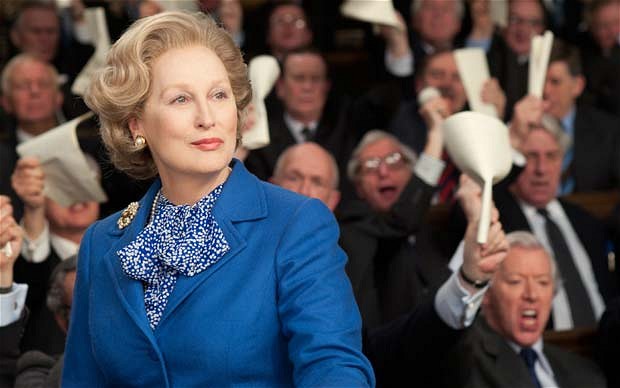
Actress Meryl Streep, who won the Academy Award for her performance as Margaret Thatcher in the motion picture The Iron Lady (above), has issued a very moving and fair statement on the death of the former Prime Minister.

Margaret Thatcher was a pioneer, willingly or unwillingly, for the role of women in politics. 
 
It is hard to imagine a part of our current history that has not been affected by measures she put forward in the UK at the end of the 20th century. Her hard-nosed fiscal measures took a toll on the poor, and her hands-off approach to financial regulation led to great wealth for others.  
There is an argument that her steadfast, almost emotional loyalty to the pound sterling has helped the UK weather the storms of European monetary uncertainty. 
But to me she was a figure of awe for her personal strength and grit. To have come up, legitimately, through the ranks of the British political system, class-bound and gender-phobic as it was, in the time that she did and the way that she did, was a formidable achievement. To have won it, not because she inherited position as the daughter of a great man, or the widow of an important man, but by dint of her own striving. To have withstood the special hatred and ridicule, unprecedented in my opinion, levelled in our time at a public figure who was not a mass murderer; and to have managed to keep her convictions attached to fervent ideals and ideas – wrongheaded or misguided as we might see them now – without corruption – I see that as evidence of some kind of greatness, worthy for the argument of history to settle. To have given women and girls around the world reason to supplant fantasies of being princesses with a different dream: the real-life option of leading their nation; this was groundbreaking and admirable. 
I was honoured to try to imagine her late life journey, after power; but I have only a glancing understanding of what her many struggles were, and how she managed to sail through to the other side. I wish to convey my respectful condolences to her family and many friends.

Wednesday, 16 January 2013

Queens of the Silver Screen


Over on Popular's new website, I put up a tongue-in-cheek, light list of some of the most beautiful on-screen queens. You can see the list, with pictures and commentary here. It's obviously not intended to be exhaustive.

1. Merle Oberon as Anne Boleyn in The Private Life of Henry VIII (1933)

2. Greta Garbo as Christina of Sweden in Queen Christina (1933)

3. Anita Louise as Marie-Antoinette in Madame Du Barry (1934)

4. Katharine Hepburn as Mary, Queen of Scots in Mary, Queen of Scots (1936)

5. Norma Shearer as Marie-Antoinette in Marie Antoinette (1938)

6. Bette Davis as Empress Carlota of Mexico in Juarez (1939)

7. Vivien Leigh as Cleopatra VII in Caesar and Cleopatra (1945)

8. Angela Lansbury as Anne of Austria in The Three Musketeers (1948)

9. Deborah Kerr as Katherine Parr in Young Bess (1953)

10. Romy Schneider as the Empress Elisabeth of Austria in Sissi (1955) and Ludwig II (1972)

11. Helen Hayes as the Dowager Empress Marie in Anastasia (1956)

12. Grace Kelly as Princess Alexandra in The Swan (1956)

13. Elizabeth Taylor as Cleopatra VII in Cleopatra (1963)

14. Genevieve Bujold as Anne Boleyn in Anne of the Thousand Days (1969)

15. Dame Dorothy Tutin as Queen Henrietta-Maria in Cromwell (1970)

16. Vanessa Redgrave as Mary, Queen of Scots in Mary, Queen of Scots (1971)

17. Joan Chen as the Empress Wanrong of China in The Last Emperor (1987)

18. Isabelle Adjani as Marguerite de Valois in La Reine Margot (1994)

19. Catherine Zeta-Jones as Catherine the Great in Catherine the Great (1996)

20. Cate Blanchett as Elizabeth I in Elizabeth (1998) and The Golden Age (2008)

21. Pilar Lopez as Queen Juana of Castile in Mad Love (2001)

23. Angelina Jolie as Olympias in Alexander (2004)

24. Emily Blunt as Queen Victoria in The Young Victoria (2009)

25. Lena Headey as Cersei Lannister in Game of Thrones (2010 - present)

26. Joely Richardson as Elizabeth I in Anonymous (2011)

27. Natalie Dormer as Elizabeth Bowes-Lyon in W.E. (2012)

28. Diane Kruger as Marie-Antoinette in Farewell, My Queen (2012)

Thursday, 29 November 2012

Hyde Park on Hudson


I haven't had a chance to see Hyde Park on Hudson yet, but I'm very excited to. It's based on the true story of the royal state visit to the United States by King George VI and Queen Elizabeth (our late Queen Mother) on the eve of the Second World War. Bill Murray plays President Roosevelt, with Laura Linney as his distant cousin, Margaret Suckley, Olivia Williams as the First Lady, Eleanor Roosevelt, and Samuel West and Olivia Colman as King George and Queen Elizabeth.

Monday, 12 November 2012

Director Benoît Jacquet discusses the lesbian undercurrents in "Les adieux à la reine"


The stunning movie Les adieux Ă  la reine, or Farewell, My Queen, in English, has caused quite the stir because it allegedly depicts Marie-Antoinette (Diane Kruger) as being a lesbian or bisexual, who was in love with her gorgeous best friend, the Duchesse de Polignac (above right, played by Virginie Ledoyen.) Told from the point of view of a palace servant in the days immediately after the fall of the Bastille prison, the movie is based on the novel by acclaimed French historian, Professor Chantal Thomas.

In this interview, the movie's director, BenoĂ®t Jacquet, discusses the lesbian undercurrent in the movie and how the intense nature of aristocratic friendships in the eighteenth century may have led to confusion over the relationship between Gabrielle and the Queen. Personally, I think the movie's ambiguity is kept quite nicely - although I don't for a moment think there anything even remotely sexual in Marie-Antoinette's relationship with Gabrielle de Polignac. From what I can tell, Jacquet himself does actually believe that it's possible that Marie-Antoinette was a (repressed) lesbian or, at the very least, in love with Gabrielle; whereas the actress who played the Queen, Diane Kruger, does not and believes the story was one of intense, but platonic, love. Either way, Les adieux Ă  la reine is a beautiful movie and Diane Kruger's performance is exceptional, as is her physical resemblance to Marie-Antoinette.


Friday, 28 September 2012

Missing Royals and Murder Mysteries: Anastasia and the allure of romance


The story of Anastasia Romanov is one of the great melodramas of royal history. In life, the real Grand Duchess Anastasia was the teenage daughter of Russia’s deposed emperor, Nicholas II. Her father had lost his throne during the revolution of 1917 and the entire family had subsequently been deported to Siberia. In July 1918, they were herded into a cellar and shot by local Communists. Their bodies were then stripped, doused in acid, hurled down a mineshaft and buried in a forest. In 1991, geologists announced they had discovered the bodies and surviving releatives of the Romanovs - including Britain's Prince Philip - were asked to provide DNA samples to help with the identification.

But between 1918 and 1991, no one knew, for sure, what had really happened to the Romanovs. The dishonesty and habitual secretiveness of the Soviet Union, the absence of the family’s corpses and rampant media speculation led to rumours that one, or more, of the Imperial Family had survived the massacre. By the 1920s, attention had narrowed to a single candidate – the youngest of the Tsar’s daughters, Anastasia, who had been seventeen at the time of her alleged murder. 

Why Anastasia became the centre of the greatest conspiracy theory of the twentieth century is hard to say. Maybe it was because the name ‘Anastasia’ has links to the theme of resurrection in the Russian language or maybe because it was the unconscious allure of the youngest princess (a favourite phrase in fairy stories.) For whatever reason, it was Anastasia who became fixed in the public’s mind as the 'one who got away,' whilst her three sisters faded into the history books as victims of the October Revolution. 

In time, the most famous of all the pretenders was a woman who travelled under the false name of ‘Anna Anderson,’ and who had first made the claim that she was Anastasia when she was recovering in a German mental asylum after a failed suicide bid in 1920. Anderson’s claim attracted global attention and she prosecuted the longest court case in European history trying to have her claim legally recognised. Some of her supporters included the Duke of Leuchtenberg, the Kaiser’s aging daughter-in-law Crown Princess Cecilia, the children of the doctor who had died alongside the royals in 1918, Anastasia’s childhood playmate who was now a wealthy American socialite called Xenia Leeds, the famous composer Sergei Rachmaninoff, the real Anastasia’s cousin Grand Duke Andrei, and, later, several prominent historians. However, there were notable dissenters – not least amongst them Prince Felix Yusupov, who called Anderson ‘an adventuress’ and ‘a horrible creature,’ the real Anastasia’s godmother the Grand Duchess Olga Alexandrovna, the real Anastasia’s cousin Princess Irina, several of the Tsarina’s surviving ladies-in-waiting, the real Anastasia’s French tutor Pierre Gilliard, the real Anastasia’s nursemaid Shura Tegleva, and the real Anastasia’s uncle Ernest, the deposed Grand Duke of Hesse. Ernest in particular became so incensed by Anderson that he spent years obsessively tracking down who she might really be instead. Eventually, he put forward the theory that Anna wasn’t a Russian princess at all, but a missing Polish factory worker called Franziska Schanskowska.


Anderson’s claim, and her court case, helped ensure Anastasia’s place in popular legend. The myth spawned several plays and movies – including the magnificent Oscar-winning Anastasia in 1956 (above), in which Anderson was played by Ingrid Bergman and her Danish grandmother was played by the ‘queen of Broadway,’ Helen Hayes; there was also a 2-part television movie in 1986, Anastasia: The Mystery of Anna, which had an impressive all-star cast that included first-time-actor Christian Bale (as Anastasia’s younger brother, Alexei), Amy Irving as Anna Anderson, Rex Harrison (in his last movie) as Grand Duke Cyril Romanov, Gone with the Wind’s Olivia de Havilland as Anastasia’s royal grandmother, Brideshead Revisited’s Claire Bloom as the Tsarina Alexandra and Oscar-winner Omar Shariff as Tsar Nicholas II. And, of course, there was the romantic 1997 musical cartoon Anastasia (below), with the voices of Meg Ryan, Kelsey Grammer, Angela Lansbury, Christopher Lloyd, John Cusack, Hank Azaria, Bernadette Peters and Kirsten Dunst. 


However, it is now absolutely impossible for any rational human being to persist in the belief that Anastasia Romanov lived beyond the massacre of 17th July, 1918. If she did survive the initial gunfire, she did so only by a matter of hours. When the bodies of the Romanovs were first unveiled to the world in 1991, it did admittedly seem as if Anna Anderson (below) might have been telling the truth, because two were missing. Scientists eventually confirmed that the absent corpses belonged to one of the Tsar’s daughters and to his only son, Alexei. Even by the time the bodies were ceremonially reburied in the Romanovs’ splendid Saint Petersburg crypt in 1998, the two missing skeletons had still not been found. Admittedly, many scientists insisted that the real Anastasia’s body was actually one of those being buried and that the missing princess was her elder sister, 19 year-old Maria. Supporters of Anderson responded by claiming that Maria and Anastasia had been so close in age and physical appearance that the scientists had mistaken Maria’s body for that of her younger sister – who, they believed, had survived the massacre, lived under the name Anna Anderson and died in Virginia at the age of eighty-three in 1984. 


But ten years later, in 2008, the last two royal bodies were discovered near the original burial pit. One of the Romanovs’ executioners had left records indicating that they had desperately tried to burn two of the bodies and, eventually, scientists were able to confirm his testimony. The bodies of Maria and Alexei Romanov were discovered near the site of the fire and at some point they will presumably rejoin their family in their Saint Petersburg tomb. In a final twist, DNA tests on a surviving scrap of intestine left from an operation undergone by Anna Anderson in the 1970s confirmed that Anastasia’s seemingly-paranoiac uncle Ernest had been right all along. Anderson wasn’t related to the Romanovs, but she was related to the Schanskowska family. Anna Anderson may have ended her life claiming to be the daughter of a tsar, but she had started it as the daughter of a penniless Polish factory worker.

Anderson’s claims have therefore been conclusively debunked and the body of the real Grand Duchess Anastasia rests inside the Peter and Paul Fortress of Saint Petersburg. But, incredibly, there are still those who refuse to accept that Anastasia died alongside the rest of her family in 1918 or that Anderson was nothing more than an extraordinarily gifted fraudster. What they're arguing is logically impossible, so why continue to cling to a belief that science and history have both debunked?

Part of the reason, I suspect, is that Anastasia was the last of a trinity of royal mysteries that have exercised and excited our curiosity for centuries. The other two are the missing Princes in the Tower and the ‘lost king of France,’ little Louis XVII, who disappeared at the height of the French Revolution. They died centuries apart, but there are similarities in their cases and in why they should still be studied today.


I don't believe that the princes in the Tower (above) survived or that they ever left its walls after 1483. If Richard III had shown unexpected clemency by allowing one, or both, to leave in the months after he became king, then it’s hard to see why he wouldn’t have paraded them through the streets when his regime was slowly being eroded by claims that he had murdered them. Furthermore, why would their mother agree to a scheme that would place Henry Tudor on the throne if she knew that her sons were still alive? There is, above all, absolutely no evidence – none whatsoever – that points to them having lived beyond 1483. There is plenty of passionate speculation, but nothing else. Bodies that are almost certainly theirs were discovered within the Tower’s walls in exactly the place that Saint Thomas More had said they were in, in his excoriating biography of their uncle. It’s too big a coincidence to dismiss. And, finally, if they did leave the Tower then where did they go after 1483? Narnia?


Louis XVII (above) died in horrible conditions, after months of physical and psychological abuse. He was ten years-old at the time and both his parents, Louis XVI and Marie-Antoinette, had already gone to the guillotine. He was autopsied in the prison but then he was almost certainly hurled into a mass grave. We have no idea where and probably never will. It is only because his heart was removed during the autopsy that tests were able to be performed in the twenty-first century that confirmed that Louis had indeed died in prison in 1795. 

And as for Anastasia: if eyewitness accounts of the Imperial Family’s murder are to be believed, she died towards the end of the massacre, after being repeatedly beaten and stabbed by Bolshevik soldiers. 

These are the awful, hideous, heartbreaking facts behind the three greatest mysteries in royal history and a million miles removed from the fairy tales they have spawned.

All four of these young royals – Edward V, his brother Richard of Shrewsbury, Louis XVII and Grand Duchess Anastasia of Russia – disappeared in times of turmoil and secrecy. Richard III could not reveal what he had done with the boys, or allowed to be done to them, without fears of toppling his own regime. The French Republic felt that drawing attention to the appalling treatment the little boy had suffered in jail would only inflame royalist sympathies and the fledgling Bolshevik movement were concerned that Kaiser Wilhelm II would back-out of his recent truce with them if he discovered what had happened to his cousins. The myths about their survival are therefore perfectly explicable by a process of historical logic: initially, no one knew exactly what had happened to them which led to them speculating about possible explanations. I suspect, of course, that it’s more than that and that the reason why so many people believed, or believe, in these fantastic tales of  imperial survival is because the allure of fairy stories never quite leaves us – however hard we try. We want to believe in royal glamour, excitement, danger and happily-ever-afters. We want to believe, I suppose, in some form of magic. 

What do we do with these stories, though, once we know they’ve been disproved? (In Anastasia’s case, and Louis XVII’s, definitively; in the case of Edward V and Richard of Shrewsbury, by all laws of probability.) Well, as a writer, I see nothing wrong in continuing to dramatize them. As long as you don’t get so caught up in your own fiction that you try to mislead people, I still think there’s a place for stories of lost princes and princesses. And why not? When I think of Edward, Richard, Louis and Anastasia, I often hear the words of poor Briony Tallis in Ian McEwan’s Atonement: ‘What sense of hope or satisfaction could a reader derive from an ending like that? So in the book I wanted to give Robbie and Cecilia what they lost out on in life. I’d like to think this isn’t weakness or evasion, but a final act of kindness.’ Robbed of a real life by their families' enemies, I suppose that there is a kind of kindness in giving these children a fictional afterlife. 

But the historian in me wants people to see that the real stories of these children are important in their own right. They are celebrity poster-children against what we are capable of, but shouldn’t be. They’re what happens when politics runs amok. Edward V and his little brother perished at the end of a brutalising century, in which political corruption and ruthless communal ambition had warped the moral fabric of an entire generation. Louis XVII and Anastasia Romanov died because their very existence was inconvenient to a new form totalitarian form of politics. The children did not ‘fit’ into the revolutions’ grand new vision of the world. As a result, in a world without compromise, they were expendable. Leon Trotsky himself dismissed Anastasia’s murder with a shrug, boasting that the horror it had caused would help unite the Red Army in fear behind the Communist cause. What we should be doing now is not focusing too much on what might have happened, but on what did happen. These dead children matter because their fates illuminate the fates of so many others who we now know only by statistics; they give us warnings, not just about politics but about the nature of humanity. Reflecting on the death of Louis XVII, one French royalist lamented that the child had been cut down ‘on the threshold of life.’ These four children died horribly, they died unfairly and they died illegally. Their stories should remind us that we should never go too far in the name of politics, to never cheapen our respect for the sanctity of human life and to remind us that we should never turn our backs on protecting the weak and the vulnerable.


Wednesday, 8 August 2012

"Brideshead Revisited" (2008)


In 1981, Evelyn Waugh's novel Brideshead Revisited was turned into a lavish eleven-part television drama, with a combined playing-time of nearly thirteen hours. It is still generally agreed to be one of the greatest television series of all time. It not only captured the fantastic characters of Waugh's book, but also the atmosphere of the 1920s and 1930s, when most of the novel is set. In 2008, a new movie version of the  same novel came out starring Emma Thompson, Michael Gambon, Ben Whishaw, Matthew Goode and Hayley Atwell. Any movie of Brideshead Revisited was always going to struggle by being compared to the television show thirty years earlier. After all, the movie has to do in two hours what the television show got to do in thirteen. Inevitably, parts of the story suffer or are cut short. 

For those unfamiliar with the story of Brideshead Revisited, it centres on a young upper middle-class student called Charles Ryder, who goes to study History at Oxford in the early 1920s. Initially, he befriends his cousin's circle of serious-minded friends and tries to devote himself to his studies like they do. However, he's already beginning to bore of this worthy but dull existence when he meets a strikingly handsome young aristocrat, Lord Sebastian Flyte. The pair (one is tempted to say "the couple") meet late one night when Sebastian, who has been out drinking heavily with his wealthy friends, vomits through Charles's open bedroom window and then sends him dozens of bouquets of flowers the next day to apologise. Charles is dazzled by the flamboyant, clever and eccentric Sebastian, who spends almost none of his time studying and most of it drinking, partying and organising picnics. (Needless to say, I'm a Sebastian fan.) Sebastian, who is repeatedly described as the most charming man anyone has ever met, is equally smitten with Charles and seems to regard their friendship as the only form of genuine affection he's ever known. One fateful day over the holidays, Sebastian invites Charles to visit him at home - which turns out to be a sprawling and magnificent country palace called Brideshead. There, Charles meets Sebastian's family, including his devoutly Catholic mother, Lady Marchmain, and his stunningly beautiful sister, Julia. From there, the slow disintegration of Charles and Sebastian's relationship - and Sebastian's sanity - dominates the rest of the novel.


To begin with, what's right with the new version of Brideshead Revisited? Well, there are some very fine performances. Matthew Goode is very handsome, in the manner of a 1930s' pin-up, and he plays the lead role of Charles Ryder with a lot more angst and heart than the character was given in either the novel or the TV show. Hayley Atwell also manages to make her character, Julia, far more likable and she captures all of Julia's spoiled flirtatiousness perfectly. Michael Gambon and Emma Thompson as Sebastian's parents, the Marquess and Marchioness of Marchmain, are both very good and Ben Whishaw is, as ever, absolutely marvelous. On the one hand, his version of Sebastian is far more openly pathetic and a good deal less charming than the television drama's, but he also lights up the screen any time he's on it and helps give the movie a heartbreaking curve that it might otherwise have lacked. Greta Scacchi, Felicity Jones, Ed Stoppard and Joseph Beattie are also memorable in their performances as Cara, Cordelia, Bridey and Anthony Blanche (far less camp and much more astute in this adaptation.)

The movie is also undeniably beautiful, in nearly every shot. Oxford looks, as ever, nothing short of breathtaking. Brideshead was filmed at Castle Howard (below), the home of the Earl of Carlisle, just like it was in 1981 and the house has lost none of its power to dazzle the audience, in the same way it dazzles the character of Charles. Venice, Italian beaches, 1930s London and luxury transatlantic liners all combine to make this a costume drama lover's dream. Like Sofia Coppola's Marie Antoinette, Brideshead Revisited is simply stunning to look at from start to finish.


But, like Marie Antoinette, there's an absence at the core of Brideshead Revisited. You're not quite sure what you're supposed to feel or who you're supposed to sympathise with - with the obvious exception of Sebastian. Part of the problem comes from the time issue, which naturally means certain storylines have to get simplified. In the novel, it is strongly implied that very early on in their friendship, the relationship between Sebastian and Charles was sexual. It was certainly romantic, with Charles describing himself repeatedly as being "obsessed" with Sebastian and later saying that Sebastian was the "forerunner" for all the subsequent (female) loves of Charles's life. However, the novel was published in 1945 when censorship was still rampant and Waugh himself was a devout Catholic, who was unlikely to go into too much detail about it. It's therefore left up to the reader to decide just how far Sebastian and Charles went with each other during their summer term at Oxford - and there are no clear answers in the novel about whether one is straight or gay. Indeed, at one point, the sexuality of both Charles and Sebastian seems to be equally confusing or confused. The issue is left unresolved, because Sebastian's alcoholism and nervous breakdown severs the boys' relationship and Charles, of course, eventually ends up in a messy love triangle with two women. In a nutshell, we don't quite know what happened between Sebastian and Charles, physically, but they're clearly supposed to be in love with one another in the book. With thirteen hours of screen time, the 1981 television show was able to play with this idea brilliantly and the television show is as ambiguous and teasing as the novel was. Shots of them sunbathing naked together on the roof of Brideshead, snuggling together in a gondola, being congratulated on their love by Sebastian's father's mistress, chatting while Sebastian bathes and strolling arm in arm through the Botanical Gardens in Oxford litter the television series, but not once are they shown actually kissing. Like the novel, the jury is still out in the television show. It's the original (and benign) form of "don't ask, don't tell."

The 2008 movie, however, doesn't have the time to do this and it was apparently felt that modern viewers wouldn't appreciate the subtleties. The ambiguity of both characters' sexuality is therefore stripped down to an easy-to-digest label - in the movie, Charles is straight and Sebastian is gay. And indeed, it's his inability to reconcile his homosexuality with his mother's fervent Catholic faith that eventually pushes Sebastian into the downward spiral that practically kills him in the end. Charles is obsessed with Sebastian, yes, but apart from one rather chaste kiss between the two of them after a night of heavy drinking, there's no indication that Charles genuinely believed himself to be in love with Sebastian, too. 


Portraying the two leads as being on opposite sides of the sexuality fence could actually work if it was done right, but all it did here was to make Charles's actions even more selfish and socially-ambitious than they are in the novel. (Which is saying something.) Charles Ryder's one redemptive feature, in my eyes, was that he had the capacity to love. In the movie, it now seems as if he goes along with Sebastian's infatuation with him, simply because he likes Sebastian's company and his big, big house. 

The reduction of the novel's portrayal of sexuality is also mirrored in how the movie chooses to portray its other great theme - spirituality. Whilst the novel and the television show both stuck to Waugh's pro-Catholic view of things, even though he could acknowledge its flaws, the film plumps for making Christianity the villain of the piece. And, in particular, Sebastian's mother - Lady Teresa Marchmain, played by Emma Thompson. Whilst Thompson's sweet voice sings the Salve Regina during evening prayers with her children, her all-consuming obsession with her Catholic faith crushes down on her family's life and, eventually, destroys at least three of them. With Sebastian's sexuality much more of an open issue in the movie, it's strongly implied that Lady Marchmain knows all about it and that she's doing everything in her power to force her psychologically-fragile son to "choose" an alternative lifestyle. Over dinner, she only seems to warm to Charles once she realises that he isn't friends with Anthony Blanche - the story's only "out and proud" gay man, whom Lady Marchmain evidently blames for having "manipulated" Sebastian into thinking he's gay. As she pushes and prods Sebastian to change his ways and places spies around him at Oxford, she ironically drives him further and further into the arms of the alcoholism she's trying to save him from. Thompson's performance is, I think, magnificent. And she clearly loves playing this ill-informed matriarch, who wreaks misfortune whilst firmly believing that she's doing good. The problem is that by turning Lady Marchmain and, by extension, Catholicism (or her version of it) into the baddie of Brideshead, the film strips away all of the story's ambiguities and complexities. With Lady Marchmain standing centre-stage as the fount of all that's wrong with her children's lives, and later Charles's too, we as an audience lose a lot of the other brilliant bits of Brideshead Revisited: Charles's social climbing, Julia's staggering self-obsession, Sebastian's weakness, Bridey's prudishness and Lord Marchmain's pleasure-loving selfishness. All of the other characters seem to become less interesting and less important, because of the story's insistence that it's Lady Marchmain who's to blame.

There are a few other tiny problems with Brideshead, namely that it doesn't quite seem to capture the accents and mannerisms of the era in the way the 1981 television show did. Trying to pull it out of the shadow of the TV show is also next to impossible and comparisons are inevitably made throughout, if you've seen it. Whilst the TV show will probably still enjoy cult status long after the film, there's still quite a bit to praise in the more modern adaptation. Brideshead Revisited is enjoyable, lovely to look at and it has some very fine performances. (Trailer below.)


Monday, 19 September 2011

Sneak peak at the new Marie-Antoinette movie


Here are some stills from the new movie about the fall of the French monarchy, Les Adieux a la Reine, with Diane Kruger as Marie-Antoinette (above) and Virginie Ledoyen, as I expected, as Gabrielle, Duchesse de Polignac (below). The movie is based on the wonderful novel by Professor Chantal Thomas, the author of a non-fiction book on Marie-Antoinette's demonisation by the libellistes of the 1780s, and it tells the story of the final three days of life at Versailles from the viewpoint of Agathe, a fictional maid in the Queen's household, whose job it is to read to the Queen in the mornings. Agathe is played by Lea Seydoux, who also appeared as Queen Isabelle in Ridley Scott's recent adaptation of the Robin Hood legend, starring Russell Crowe and Cate Blanchett. 

I'm very excited about this movie.


Friday, 3 June 2011

New still from Meryl Streep's Margaret Thatcher biopic


Ironically, after posting Courtney Pannell's fantastic article on the stagnation of conservative womanhood (below), I came across this still on-line, showing Oscar-winner Meryl Streep as the longest-serving Conservative Prime Minister of Britain, Margaret Thatcher. Seen here with Jim Broadbent as her on-screen husband, Dennis, the pair are recreating the famous 1980 Conservative Party conference at Brighton, at which Prime Minister Thatcher told the delegates of her government's plans to deal harshly with the Trade Unions and to end the long-term recession which had crippled Britain for the previous decade. It was also the conference where she made her famous declaration, "The Lady's not for turning," which you can watch below. Really can't wait for this movie, which The Daily Mail talks about here.


Related Posts with Thumbnails