Many congratulations to Libby, who won the competition to receive a copy of Sara Cockerill's new book, Eleanor of Castile: The Shadow Queen. The San Fernando Valley, named after Eleanor's father (above), is indeed in the US State of California. To all those who entered, thank you!
Showing posts with label United States. Show all posts
Tuesday, 21 October 2014
Sunday, 31 August 2014
Information on "The Emperors" in the US!
Good evening! I've had a few comments and enquiries about The Emperors on Amazon US, so I contacted the Marketing team at Amberley for clarification. The Emperors is available to order for US customers, but since it comes via a UK distributor because it is published by a British firm, it may be 4-6 weeks before it is available in the USA for delivery. Apologies to anyone who is waiting for a copy and thank you so much for your interest in it. I'll keep everyone posted with news of its availability in the States.
Saturday, 15 December 2012
Good night, children, and God bless.
On the outskirts of the town of Yekaterinburg in mid-Russia, there lies a field, filled with lilies. The lilies bloom in summer, near the anniversary of a terrible act that happened near this peaceful spot, nearly a century ago. In the summer, when the lilies are in bloom and swaying gently in the breeze, the field is filled with the muted sounds of respectful pilgrims. Nearby, several small churches allude to the site's religious significance for many Russians; bouquets of flowers and hand-made memorials litter the field, giving the impression that what happened here was a recent tragedy.
It was here, in this field, in the panicked darkness of a July night in 1918, that the bodies of Tsar Nicholas II, his wife, their five children and four remaining servants, were stripped, burned, disfigured with acid and buried. Later, the bodies were moved further into the forest, to avoid detection, but it is here that the gunmen who murdered the imperial family first tried to cover up the dreadful nature of their crime. The murder of the Romanovs became one of the most famous massacres of the twentieth century; at the distance of nearly one hundred years, it still has the power to shock and to horrify. Its lawlessness, its depravity, its disregard for human life and, perhaps above all, its contempt for the innocent blood of children, has helped fix it in the public's mind as a symbol "of the century we had." When the historian and writer, Jonathan Dimbleby, visited the field in 2008, his camera men picked up on one of the memorials in the field. It had been placed there by an English admirer of the Romanovs - a simple wooden cross, upon which was written the words, "Good night, children and God bless."
Yesterday in the Connecticut town of Newtown, a man who is presumed to have been 20-year-old Adam Lanza murdered his mother and drove to a nearby elementary school, with an approximate population of seven hundred. He entered the school with three weapons and gunned down twenty children and seven members of staff in the space of six or seven minutes. An employee risked their life by running through the school shouting warnings; another had the good sense to turn on the intercom to make the announcement. Teachers barricaded themselves in their classroom and did their best to save the students. Local law enforcement was on call swiftly and both the Governor of Connecticut and the President of the United States, clearly deeply moved himself, addressed a nation that was stunned by the horror of what occurred. Later, the people of Newtown gathered for a candlelight vigil outside the town's Saint Rose of Lima parish Church. They lit candles and sang Silent Night.
Inevitably, the debate will soon turn to America's gun laws and the second amendment of 1791. Some conservatives with more polemic than sense will insist that liberals are exploiting the tragedy of Newtown to criticize laws that they don't like and have never liked. They'll be accused of opportunism. What the proper political response is, though, I don't know. Only a fool, or an ostrich, would insist that after events like this that something doesn't need to happen. They are an all-too frequent occurrence in America and some tightening of the gun laws, I suppose, does seem inevitable - even desirable. That, however, is a debate for the elected representatives of the American people and one for the weeks ahead. On both sides of the aisle, we can dare to dream that there will be reasoned and thoughtful arguments; a proportional and fitting response to the reality of the circumstances.
In the meantime, moving away from the politics of change, the most fitting testament to the fallen of Newtown are the same words on the little wooden cross in the field of swaying lilies in Yekaterinburg - "Good night, children, and God bless." It is heartbreaking.
Labels:
Childhood,
Civil Rights,
Death,
Grief,
News,
United States
Sunday, 2 December 2012
"Popular" coming to the States!
I'm very excited that my first novel, Popular, will soon be available to order in the US! It'll be up on Amazon with a brand new cover, tagline and a special fun vocabulary section at the back. The brand new cover, designed by my publishers at MadeGlobal, will also be replacing Popular's old cover in the UK, Ireland and overseas. This is to mark Popular moving to MadeGlobal and in preparation for the release of its first sequel, The Immaculate Deception, which follows the same characters in the summer and winter after Popular.
I'll be posting more news about the books and where they can be ordered, soon, but thanks so much to all this blog's American readers and I hope you can order, and enjoy, Popular and The Immaculate Deception. Working on them, and with my new publishers, has been a great joy.
"Packed with wicked humour, glamorous characters and razor sharp dialogue." - ULSTER TATLER
On the first day of September, 16 year-old Meredith Harper rules over the teen it-crowd of Belfast, Northern Ireland. But beneath the surface, Meredith's complicated web of manipulative lies and self-serving intrigues are slowly beginning to threaten her social position and she finds herself being challenged by the handsome Mark Kingston, the only guy in the school who's always hated her.
In a world where nothing stays secret for very long, Meredith and her friends will need all their skills to guess who's in, out, coming out, going up, going down, dating, cheating, lying and trying to cope...
Let the games begin!
"Move over Blair Waldorf, Meredith Harper rules the school now." - Danielle Binks, the ALPHA review
Thursday, 29 November 2012
Hyde Park on Hudson
I haven't had a chance to see Hyde Park on Hudson yet, but I'm very excited to. It's based on the true story of the royal state visit to the United States by King George VI and Queen Elizabeth (our late Queen Mother) on the eve of the Second World War. Bill Murray plays President Roosevelt, with Laura Linney as his distant cousin, Margaret Suckley, Olivia Williams as the First Lady, Eleanor Roosevelt, and Samuel West and Olivia Colman as King George and Queen Elizabeth.
Labels:
Great Britain,
Monarchy,
Movies,
United States,
War
Monday, 20 August 2012
The White Star sisters
By 1907, Britain's White Star Line had an impressive fleet of liners that enabled the company to connect Britain with both its imperial colonies and with the rest of the world. Advertising maps alerted the public to the vast geographical remit of the White Star company and its corresponding ability to move passengers across the globe in comfort, speed and security. The most prestigious of all routes was the transatlantic passenger lane between England and America. Like their rivals at the Cunard Line, some White Star ships left from Liverpool and some connected to American ports like Boston, but the flagships of the line left from the southern port of Southampton, with stop-overs at Cherbourg in France and Queenstown in Ireland, before heading across the ocean to New York. White Star vessels were known for the comfort of their accommodation and the company's impressive safety record - its only major sinking had been the loss of the Republic in 1909, which had taken over a day to sink, enabling a full evacuation. There were five prestigious ships that operated the transatlantic route in 1907 for White Star - the Oceanic and the four sisters known as "the Big Four," the Cedric, Celtic, Baltic and Adriatic. The Oceanic had been nicknamed the "Queen of the Ocean" when she was launched in Belfast in 1899, at a ceremony watched by the cream of the Irish Protestant Ascendancy - including the Duke of Abercorn, the Marquess of Londonderry and the Marquess of Dufferin.
But by 1907, the arrival of Cunard's awe-inspiring Lusitania and Mauretania had removed the sparkle from White Star's commercial crown. Not only were the new Cunarders the largest ships afloat, but they were also the fastest and the most luxurious, as well as using the famous four funnel design previously reserved for German ships. With the funding of their new de facto owner, the wealthy American financier J.P. Morgan, White Star Line's chairman, J. Bruce Ismay, met with the former Lord Mayor of Belfast, Lord Pirrie, one of the controlling partners of the world-famous Belfast shipyards, Harland and Wolff. They agreed to combat the Cunard threat by building two new ships in quick succession that would dwarf the Cunard sisters in terms of size and in the comfort offered to its passengers. In order to do that, both Ismay and Lord Pirrie realised that speed would have to be sacrificed. Deciding to make a virtue out of a necessity, they later marketed that the White Star's journey across the Atlantic - which usually took a full day longer than the Mauretania's - could be done so in much greater comfort and stability. A third sister was planned for a later date, which would have re-established White Star's monopoly of the British transatlantic trade - had the plan worked. As with the building of the Oceanic, Ismay's directive was summed up in the phrase, "Nothing but the best."
Thousands of workers toiled for three years to build the first of the Olympic-class liners. Most of the men came from the Protestant-dominated working-class districts of east Belfast, where the Harland and Wolff yards were (and are.) The Olympic was launched in 1910 and sailed on her maiden voyage, to great media ballyhoo, in May 1911 (above). Nearly half again as large as the Mauretania, she was also much more attractive in terms of her outward appearance and she was deliberately designed to have the sleek, elegant exterior favoured by European royalty when it came to designing their enormous private yachts. White Star's hopes that their new queen would corner the lucrative upper-class transatlantic market was shown by the fact that there was room for over one thousand first class passengers. They had access to the ship's grand staircase (now legendary because of the number of times it's featured in movies about the Titanic), lounges and restaurants based on the royal apartments at the Palace of Versailles, a smoking room that rivaled the best gentlemen's clubs in London with its fireplace, leather armchairs, mahogany walls and stained glass windows. There were verandas that were based on the winter gardens made popular on German ships, wide promenade decks, an enormous dining saloon that could sit five hundred people at one sitting, reception rooms based on Jacobean country houses, Turkish baths inspired by the decadence of the Ottoman sultans, a gymnasium, a squash court and the world's first ever swimming pool onboard a luxury liner. The first class staterooms were decorated in a variety of historical styles and there was a huge range of prices, moving from the fairly basic cabins on A-Deck to the lavish parlour suites on B-Deck. Second class accommodation was sombre, comfortable and very obviously Edwardian (below) and third class was spacious, clean and comfortable. The prices, of course, for all three classes were correspondingly quite a bit higher than they were for other ships. It added to the Olympic's intentional sense of distinctive superiority over her rivals.
All of this positive publicity - and, some would say, the White Star Line itself - was dealt a death blow eleven months later, when the slightly larger Titanic sailed on her maiden voyage. She was practically identical to the Olympic and only ocean liner buffs can recognise the difference between the two from photographs (the Titanic enclosed part of its promenade deck, expanded the Louis XVI restaurant, added in an extra cafe for first class passengers and added an extra layer of exclusive luxury suites on B-Deck, hence why she was just over a thousand tons heavier than her sister.) Four days into her first voyage, the Titanic sustained a side-on collision with an iceberg and sank just under three hours later, with the loss of over fifteen hundred lives. It was, at that point, the worst maritime disaster in history and it caused a media sensation, that has never quite gone away. The White Star sustained a huge financial loss, but what was arguably even more damaging was the image the Titanic created of a company that was either callous or incompetent. Perhaps both.
With the benefit of hindsight, it does seem as if White Star was doomed from the moment its flagship became the most famous disaster in history. The shadow of the Titanic was a long one that would cast a darkness over the company for the rest of its existence, but it seems slightly simplistic to assume that from the moment Titanic hit the iceberg, White Star's own demise was also inevitable.
The third of the White Star sisters, the patriotically-named Britannic, was launched in 1914. Larger than the Titanic and kitted-up with enough lifeboats and the latest safety provisions, Britannic might have helped restore the White Star's reputation, had she had the chance. But when the First World came, the Olympic was pulled out of service and turned into a troop transport for the Royal Navy and the incomplete Britannic became a hospital ship. The Olympic had a stellar war-time service record and she was nicknamed "Old Reliable." But the Britannic sank in 1916 after hitting a German mine in the Mediterranean. Until 1936, she was the largest ship built on British soil; she is still the largest British passenger liner to actually have sunk at sea in a shipwreck.
When the war ended in 1918, White Star had lost a great number of its ships to the Allied war effort, and with only the Olympic left out of its three super-ships, the company was facing a bleak feature until the British government decided to honour its promise to reward the firms that had served it so faithfully during the war. Ocean liners were being taken from Germany under the terms of the peace treaties as a form of reparations and public feeling in Germany, like everything to do with the Versailles peace settlement, was outraged by it. A medium-sized liner called Columbus, which had been built in 1913 for the Nordeutscher Lloyd company, was seized and given to the White Star Line, who re-named her Homeric. With two funnels and a gross tonnage of just over 35,000, Homeric (above) was a pleasing ship, with a conservative aesthetic and comfortable accommodation (below - one of the first class corridors). A renovation was ordered in Belfast shortly after, when it was decided that her 18 knots sailing speed was too slow for White Star to maintain its weekly schedule of Atlantic sailings, but apart from that the Homeric proved a very popular running mate to the Olympic when she entered service for White Star in 1922.
But the Homeric, although pretty and popular, was not enough to replace the mighty Britannic, which would have been White Star's pride and joy if she hadn't been lost in Britain's campaign against the Germans and Ottoman Empire. The chosen replacement was the largest ship built in German history, so far, which would ameliorate the sting of having lost the largest ship built in British history, so far - at least, for the British. She was the 56,000-ton Bismarck, named after the statesman who had helped unite Germany in the 1870s. Her smaller sisters, the Imperator and Vaterland, had already been seized. Imperator had become Cunard's Berengaria and Vaterland had gone to become the United States's first major transatlantic luxury liner, Leviathan. Bismarck had never been finished and now she was finished for the White Star Line, under her new name, Majestic (below). She entered service in 1922 as the largest ship in the world and immediately helped re-solidify White Star's former reputation for size, luxury and security.
With the Majestic, Olympic and Homeric now in service as running mates, White Star was able to start operating one of the most financially successful routes on the north Atlantic. Having three ships meant that one ship would always be at sea or being re-provisioned, whilst the others were leaving New York and Southampton on a weekly basis to complete in-tandem crossings of the Atlantic. The Olympic remained one of the most consistently popular ships of the decade, which rather dispels the myth that the Titanic continued to haunt the ocean-going public's mind. The Majestic, with her cavernous first class rooms (below), also helped attract a loyal clientele in the economically-prosperous 1920s. However, when the Great Depression hit in the early 1930s, the transatlantic market temporarily imploded and ships that had been designed for point-to-point travel across the often-rough Atlantic, like the Majestic or Olympic, struggled to adjust to the indignity of short hot-weather cruises, desperately designed to turn some kind of profit.
By 1934, it was clear that White Star's days were financially numbered. Its fleet was made up of ships that were either too old, too big or both. There were a number of collisions, power-cuts, a huge drop in booking numbers and a new spate of edgy-chic superships were emerging from Germany, France and Italy which made British ships seem antiquated and fusty. The Olympic, alone, managed to keep up respectable (if not exactly healthy) booking numbers - a testament to the affection she was still held in - but her days were numbered and White Star began to look on her enormous running costs, frequent technological difficulties and occasional collisions as a headache. In 1934, the company merged with their old enemies, Cunard, to form the Cunard-White Star Line - all their resources would now be pooled into creating a glamorous new liner to modernise Britain's transatlantic image and counter the humiliation posed by Germany's Bremen, Italy's Rex or France's forthcoming Normandie.
There were clear signs from the beginning that Cunard was the dominant force in the new "partnership." Of the six prestigious ships the new company now had at its disposal for the premier run across the Atlantic - the Majestic, Olympic, Homeric, Berengaria, Mauretania and Aquitania - three would have to go, immediately. Two more would be kept around to run alongside the Queen Mary, until her new sister-ship, Queen Elizabeth, was completed in 1939/1940. Both the Mauretania and Olympic, as the oldest of the set and the ones most in trouble, were quickly agreed upon as the first two that had to go. There was a public campaign to keep one, or both, as floating hotels or museums and it's difficult not to groan at the financial and historical mistake that was made in not preserving the Olympic. In the age of Titanic mania that began in the 1950s and has continued ever since, it would surely have been a goldmine to whoever owned it. As well as a fascinating one for subsequent generations.
Signs of the pro-Cunard bias of the new merger came when a decision had to be reached about which of the two companies' flagships - the 52,000-ton Berengaria or 56,000-ton Majestic - should be kept on to serve until the Queen Elizabeth was ready. Despite the fact that the Majestic was larger, younger and safer than the Berengaria, it was Majestic who was sold for scrap and the Berengaria which was kept on. The Homeric survived long enough to participate in the festivities to mark King George V's Silver Jubilee in 1935, but as the slowest and smallest of the six ships, it did make sense that she should be scrapped too.
With its three former ships having completely vanished into scrap metal and scattered pieces of furnishing, the White Star's last two surviving ships were the motor ships Georgic and a new Britannic. They continued to sail under the White Star colours until their careers ended in 1956 and 1960, respectively. Cunard, however, dropped the White Star name in 1949 and today the company's name survives in a commercial sense solely as a kind of white-gloved service exclusively reserved for those occupying the most expensive suites on the current Cunard ships, Queen Mary 2, Queen Victoria and Queen Elizabeth. Once a year, on the anniversary of the sinking of the Titanic, those three ships hoist the White Star flag for the day.
Signs of the pro-Cunard bias of the new merger came when a decision had to be reached about which of the two companies' flagships - the 52,000-ton Berengaria or 56,000-ton Majestic - should be kept on to serve until the Queen Elizabeth was ready. Despite the fact that the Majestic was larger, younger and safer than the Berengaria, it was Majestic who was sold for scrap and the Berengaria which was kept on. The Homeric survived long enough to participate in the festivities to mark King George V's Silver Jubilee in 1935, but as the slowest and smallest of the six ships, it did make sense that she should be scrapped too.
With its three former ships having completely vanished into scrap metal and scattered pieces of furnishing, the White Star's last two surviving ships were the motor ships Georgic and a new Britannic. They continued to sail under the White Star colours until their careers ended in 1956 and 1960, respectively. Cunard, however, dropped the White Star name in 1949 and today the company's name survives in a commercial sense solely as a kind of white-gloved service exclusively reserved for those occupying the most expensive suites on the current Cunard ships, Queen Mary 2, Queen Victoria and Queen Elizabeth. Once a year, on the anniversary of the sinking of the Titanic, those three ships hoist the White Star flag for the day.
Labels:
Belfast,
Belle Époque,
Germany,
The Ascendancy,
The Sea,
Travel,
United States
Friday, 24 February 2012
Famous Shipping Disasters: The attack on the "Lusitania" (1915)
Although she is less famous than her equally-unlucky rival the Titanic, it's arguable that the Lusitania's actual impact on history was far greater. When she first entered service for the Cunard Line in 1907, the 32,000-ton flagship was instantly hailed in the British press as recapturing that all-important national maritime pride in the commercial race for transatlantic dominance with Imperial Germany. Since 1897, German companies like Northern German Lloyd and Hamburg-Amerika had garnered most of the international prestige with their series of patriotically-named superships. With the Lusitania and her slightly larger, slightly faster and slightly younger sister-ship, Mauretania, Britannia was fighting back. The Cunard sisters were nearly twice again as large as any of their rivals and both easily out-paced their German competitors when it came to speed. At the end of 1907, the Mauretania won the Blue Riband, the coveted prize for the fastest crossing of the North Atlantic, which she quite incredibly managed to keep until 1929. With room for 2,200 passengers in three classes, the Lusitania was praised for the opulence and comfort of her interiors (below), as well as for her speed, safety and commercial success.
But the Lusitania's ultimate historical importance arrived eight years later when she once again became a symbol for the rivalry between the British Empire and Germany. This time, the rivalry had turned into a bloody conflict and as the First World War raged, more and more of Britain's commercial fleet was requisitioned by the Royal Navy. A drop in passenger numbers meant that Lusitania's two running mates, Mauretania and Cunard's new flagship, Aquitania, were voluntarily removed from service and laid-up in Liverpool. (Both were called up for service as troop carriers and hospital ships once the Gallipoli campaign against the Ottoman Empire began.) By the spring of 1915, the Lusitania was the only major luxury liner still operating the route from New York to England.
The Imperial German embassy in America suspected that she was being used to transport munitions from British sympathisers in the United States. Furthermore, the government in Berlin had recently declared that any ships, commercial or military, attempting to bypass the German blockade of Britain would be legitimate targets for German submariners. Heedless of these warnings, or perhaps ignorant of them, the Lusitania set sail from New York from Pier 54 on May 1st, 1915. Six days later, off the Old Head of Kinsale in Ireland, she was struck by a German torpedo at 2.10 p.m. Passengers, finishing dessert in the first-class dining saloon, felt an enormous jolt rock the ship and from the periscope of the U-20, the German captain, Captain Schweiger, heard a second explosion, which he initially assumed to be an exploding boiler or coal powder.
The sinking of the Lusitania was quick, chaotic and hideous. The 32,000-ton steamer sank in only eighteen minutes, tipping hundreds into the beautiful but freezing Irish waters. The ship pitched so violently to one side that half the lifeboats could not be launched; power-cuts and the speed of the sinking meant that dozens of passengers were trapped inside the ship's elevators and drowned like caged animals; lifeboats fell and crushed survivors fleeing in ones below; children were separated from their parents in the chaos and dozens were killed by miniature explosions, scalding water and deck equipment. Residents in the nearby Irish port of Queenstown later said that the dozens of children's bodies in their little coffins in the town's streets was a sight they would never forget.
Since the day of the Lusitania's sinking, controversy has raged about what caused the second explosion and the actions of the respective British and German governments. In the United States at the time, there was no doubt that Germany was to blame. American public opinion was inflamed by the deaths of so many American civilians and Captain Schweiger was painted as a war criminal for refusing to give the Lusitania time to disembark her civilian passengers before firing. Britain, unsurprisingly, concluded that the sinking had been "the illegal act of the Imperial German government" and insisted the second explosion had been caused by Schweiger vindictively firing a second torpedo into the ship's side. Germany, and later conspiracy theorists, insisted the second explosion was Britain and America's fault, because they had been trading munitions and it was those munitions which exploded on impact, causing the Lusitania to sink in such record time.
It seems that the Lusitania was carrying arms - shells and cartridges - but she had been carrying those in trade even before the war began. It is doubtful that American port authorities would ever have allowed a commercial vessel to load significant amounts of military hardware, particularly at such a delicate time. In hindsight, the second explosion, which helped pitch the Lusitania onto her side as she sank, was almost certainly caused by the first torpedo igniting either a boiler fire or a coal dust explosion. The British version of events, which claimed there had been a second German torpedo, and the German version of events, which claimed the Lusitania had been little more than a military cargo ship with a civilian shield, were both almost certainly incorrect and self-serving. At the time, Germany's reputation in the United States was irreparably damaged and Germany's two principal allies, Imperial Austria-Hungary and the Ottoman Empire, both distanced themselves from the sinking and refused to condone it.
The United States entered the war on the Allied side in 1917.
Tuesday, 24 January 2012
Famous Shipping Disasters: The Loss of the "Republic" (1909)
This month, there was the tragic news of the sinking of the Italian cruise ship Costa Concordia, after it ran aground off the Isola del Giglio. Costa Concordia was, to date, the largest ship built on Italian soil and, at the time of writing, the sinking has claimed sixteen confirmed lives, so far.
The Costa Concordia's sinking is one of the first maritime losses of a luxury liner in the twenty-first century. Over the next few days, I'll take a brief look at some of the previous century's most famous disasters at sea.
The sinking of the RMS Republic (1909)
Ironically, given its name, the White Star liner Republic was actually built in Ulster, the most vociferously monarchist of the four provinces of Ireland. At the time, Belfast's Harland and Wolff shipyards were the largest and the best in the world; the east Belfast workforce produced ships for companies all over the globe, but their closest working relationship was with the British firm, White Star Line, one of the main British commercial bodies operating the lucrative transatlantic trade. Built in Belfast in 1903, she was originally christened Columbus and sailed under the livery of the Dominion Line, a sister-company of White Star's, before being transferred to the White Star and re-named, after only two voyages. Although Republic was praised in shipbuilding industry journals at the time for the comfort offered onboard, she was originally built with an eye to incorporating all of the latest safety techniques. In 1909, six years into her commercial life, these features were put to the test when Republic departed New York for the British colony at Gibraltar, and other Mediterannean ports. In thick fog, she was hit by the Italian liner Florida. Two of the Republic's passengers were killed on impact, as they slept in their cabins, and three of the Florida's crew men also died. Part of the rescue was carried out by the Florida and the U.S. coastguard's Gresham; the passengers were then transferred back to New York by another White Star steamer, the Baltic. In many ways, the tragedy of the Republic ironically gave the shipping industry, and White Star in particular, a false sense of security. The Republic took a full thirty-nine hours to sink. At nearly 16,000 tons, Republic was the largest ship to be lost to the sea, at that point in history. The slow speed at which she sank, the effectiveness of Marconi in securing multiple rescue ships and the low loss of life all helped persuade many industry insiders, like Captain E.J. Smith, that terrible, swift maritime disasters were a thing of the past - a view which the tragedy of the Titanic would brutally dispel three years later. Today, the Republic is most well-known for the rumour that at the time of her sinking, she was carrying $3 million in coins for the Imperial government of Russia. If that were true, the coins, if still onboard, could be worth nearly $5 billion in 2012. However, if these stories are true, to my mind, it's improbable that they would not have been evacuated along with all of Republic's passengers and crews during the lengthy rescue operation.
Friday, 25 November 2011
Can republics be snobbier than the Monarchy?
The National Post has a very interesting article upon the Monarchy and attitudes to class in Britain. Perhaps one of the things which people who aren't too well-acquainted with monarchical history will find surprising is how often various members of the British aristocracy have scorned and criticised the monarchy for being too "common". The gorgeous but fascist socialite, Lady Diana Mosley (nee Mitford), was extremely critical of the late Queen Mother, whom she rather unfairly and improbably characterised as a social climber. A little like members of the ci-devant nobility in pre-revolutionary France who criticised Marie-Antoinette for her farm at Versailles, because it was considered lacking in majesty.
Perhaps one of the most interesting points the article raises is that, contrary to popular misconception, the monarchy in Britain does not necessarily encourage snobbery and it cites the rather revealing example of how entrenched snobbery can be in the United States and France, both of them the most celebrated republics in the world and both founded, at least in theory, on the principle of equality. Historically, it's often true that "self-made" aristocracies or oligarchies, like those in the United States or, most obviously, in ancient republican Rome, can be the most precious and conscious of their status. I don't entirely know what I think of that argument, although there seems to be a lot of truth in it. In any case, The National Post raises an interesting point when it says: -
"Many commentators continue to follow Malcolm Muggeridge's argument that the monarchy is the source of class consciousness, that "the impulses out of which snobbishness is born descend from the Queen at the apex of the social pyramid, right down to the base." This neglects the fact that several countries routinely held up as progressive, egalitarian democracies - Holland, Sweden, Norway - are also monarchies. It also neglects the Olympic-class snobbery to be found in every non-royal society, from Ivy League America to the Crillon Ball crowd in Paris."
The full article can be accessed here and it's definitely worth a read. Perhaps one of the saddest and most interesting anecdotes is the tale of Queen Mary, consort of George V, obsessively pouring over her family tree and the Almanach de Gotha to see if she qualified as Rank I or II of royalty for the opening waltz at the wedding of the Kaiser's daughter in 1913.
Labels:
France,
High Society,
Historical trivia,
Monarchy,
United States
Wednesday, 6 July 2011
Caylee Marie
GLOUCESTER: Say that I slew them not?
LADY ANNE: Why, then they are not dead,
But dead they are, and devilish slave, by thee.
"If you were to say of these men that they are not guilty, it would be as true to say there ... are no slain, there has been no crime." - Robert H. Jackson, 1946
Friday, 3 June 2011
The Stagnation of the Conservative Woman: Courtney Pannell reflects
Writing in The Yale Herald, my friend Courtney Pannell, a young conservative woman herself, reflects in an absolutely brilliant article on the problems that many women are experiencing with American conservatism and the Republican Party today: -
"The GOP doesn’t plan on winning the female vote in 2012 — or ever, at this rate. Democratic opponents are calling the recent House move to slash funding from Planned Parenthood another example of the GOP’s “War on Women.” This war is only strengthened by conservative female figureheads, such as Michelle Bachmann and Sarah Palin, and the ideals that they are lauding, which are out of step with the desires and struggles of the modern woman.
Last week, I attended CPAC, the Conservative Political Action Conference, which is basically a red carpet event for the Who’s Who of the right... As a conservative woman myself, I was looking forward to commiserating with fellow right-leaning ladies — but they were awfully hard to find. Walking into the convention center lobby, I tweeted, “Where are all the women?” in an attempt to send a rallying cry. I was hard-pressed to find anyone that wasn’t a wannabe-cowboy or Mitt Romney look-a-like, much less someone with a two X chromosomes.
I finally found a room of women at a panel discussion called “The Awakening of the Conservative Woman.” The golden girl of the panel was Phyllis Schlafly, an 86-year-old woman who was pivotal in killing the Equal Rights Amendment in the ‘70s. Alongside her was columnist S.E. Cupp, campaign-finance lawyer Cleta Mitchell, and Rep. Michelle Bachmann.
Although all the panelists were accomplished workingwomen and the event was about awakening the conservative woman, I was shocked by their repressive and outworn messaging points. Someone should probably look up “awakening” in Webster’s, because I might as well have been taking life lessons at the kitchen table of June Cleaver.
Now, I’m not here to debate the value of stay-at-home wives and mothers; my mother has been one for 25 years. In my view, the family is the cornerstone of a great society, so marriage and motherhood should be celebrated. But... behind their glory stories about finding their mates was the idea that a woman has to compromise her career goals in order to achieve the supposed greatest goals of womanhood: marriage and motherhood. “You can’t have it all at the same time,” Mitchell even said to the crowd. She followed up the statement with an anecdote. A young woman (a Harvard student, no less) told Mitchell that she would eventually hire a nanny to help run her household, because she hoped to have a job and children. “Can’t you just get a dog?” Mitchell snarkily replied to the young lady.
What’s ironic about this working mother dichotomy is that in any other room at CPAC you would have heard speakers pleading with young attendees to go into business, become entrepreneurs, help America innovate. But the GOP women seem to want to leave that dream up to the boys..."
Tuesday, 24 May 2011
The Duke and Duchess of Cambridge meet the President and First Lady
Thanks to Lord Belmont for posting photographs on his blog about the meeting between Their Royal Highnesses the Duke and Duchess of Cambridge, who recently returned from their honeymoon, and the President and First Lady of the United States, who are visiting the United Kingdom.
The meeting took place at Buckingham Palace, earlier today.
Tuesday, 3 May 2011
"I don't care about the Royal Wedding. So I'm going to complain about it constantly."
Elena Maria Vidal, author of Trianon, Madame Royale and The Night's Dark Shade, comments on the interesting (I'm playing fast and loose with the word) phenomenon of Royal Wedding killjoys.
"I found it rather amusing how so many people on Facebook, Twitter and around the internet kept proudly proclaiming: "I don't care, I don't care, I don't care about the royal wedding....I happened to be up at 5 am and turned it on for a few minutes but I REALLY don't care. I'm an American and I'm above such medieval nonsense and besides...who cares? Have I told you that I DON'T care?" And so on and so forth. Finally, someone on Twitter said: "I am really not interested in the fact that you are not interested in the royal wedding.""
For Elena Maria's full article, click HERE.
Labels:
Great Britain,
Humour,
Marriage,
Monarchy,
Musings,
United States
Monday, 4 April 2011
"Gone with the Wind" (1939)
On my other blog, I continue with a look at some of my favourite movies - and how could I leave out Gone with the Wind?
You can read the full reflection, here."Manipulative, brazen, deceitful and often spiteful, Scarlett O'Hara is also flirtatious, ruthless and monumentally self-absorbed. Yet, somehow, she is undoubtedly the heroine everyone is cheering for throughout Gone with the Wind's four hour extravaganza. As romance after romance fails and the lavish lifestyle of the Southern upper-classes is swept away when the South loses the Civil War in 1865, Scarlett proves that whilst she is a woman likely to hurl herself onto her bed weeping for days when she doesn't get her own way about what dress to wear to a party, when it comes to the major catastrophes of life, she is definitely the ultimate survivor. Surveying the ruin of her homeland in the aftermath of the Civil War, Scarlett vows that if she has "to lie, steal, cheat or kill" she will overcome the poverty and chaos which has swallowed up the life of wealth and privilege she once enjoyed."
Tuesday, 29 March 2011
Has Christopher Hitchens mellowed in his attitude towards Christianity?
An article in The Catholic Herald notes the unlikely friendship between Vanity Fair journalist and well-known critic of religion, Christopher Hitchens, and the devout Christian scientist, Dr. Francis Collins, director of the National Human Genome Research Institute, whose pioneering techniques on treating cancer are currently being used by Mr Hitchens in his battle against throat cancer. Dr. Collins (above), who is an evangelical Protestant, also won praise for his scientific research's influence upon his faith in Pope Benedict XVI's book Jesus of Nazareth, where he commended the doctor's work in "the magnificent mathematics of creation, which today we can read in the human genetic code, we recognise the language of God”. Collins actually converted to Christianity, which he was not born into, thanks to his scientific research.
It's a moving and well written article. However, I think the story (but not the article) might over-state two things. The first is that Christopher Hitchens has always been much more fair in debates with theists than his more militant colleagues and the second is that unlike Richard Dawkins, Hitchens has never claimed that a lively intellect and, more importantly, scientific brilliance are incompatible with a religious faith. He just happens to believe that a religious faith is a waste of time which, contrary to the hysteria which greets the mention of his name amongst some devout Catholics and fundamentalist Protestants, does not make him a bad person. The idea that all those who profess a religious or spiritual faith are either insane or woefully stupid is perhaps the one I have always found most bizarre. The claim that no atheist regime has ever persecuted believers because of their religious faith, however, remains the most offensive.
I hope Christopher's battle against throat cancer, which he has fought doggedly, is successful. Not simply because of how well he is thought of by so many people but, although I disagree with almost everything he thinks both politically and religiously (his critique of The King's Speech was particularly misleading), he is a brilliant writer with a real way with words and the intellectual world would be poorer for his loss.
Labels:
News,
Religion,
Science,
United States,
Vatican
Friday, 25 March 2011
Happy Lady Day
Today is the Feast of the Annunciation in the liturgical calendar and until 1752, it marked the beginning of the new year in Britain and her colonies overseas, including the future United States. To read my history of the feast, click here.
Within the church's calendar, the feast honours the visit of Saint Gabriel the Archangel to the Virgin Mary to inform her that she was to conceive the Christ Child.
"And in the sixth month, the angel Gabriel was sent from God into a city of Galilee, called Nazareth, to a virgin espoused to a man whose name was Joseph, of the house of David, the virgin's name was Mary. And the angel being come in, said unto her: 'Hail, full of grace, the Lord is with thee: blessed art thou among women.' Who having heard, was troubled at his saying, and thought with herself what manner of salutation this should be. And the angel said to her: 'Fear not, Mary, for thou hast found grace with God. Behold thou shalt conceive in thy womb, and shalt bring forth a son; and thou shalt call his name Jesus. He shall be great, and shall be called the Son of the most High; and the Lord God shall give unto him the throne of David his father; and he shall reign in the house of Jacob for ever. And of his kingdom there shall be no end.'"
- The Gospel according to Saint Luke, Chapter II
Friday, 4 March 2011
Liberty's Exiles
Linda Colley at The Guardian reviews Maya Jasanoff's acclaimed new book Liberty's Exiles: American Loyalists in the Revolutionary World, which chronicles the often untold story of those Americans, both white and black, who chose to remain loyal to the British Crown during the War of Independence. As well as chronicling the often tragic fates of loyalist individuals and families, it is also Jasanoff's contention that the loss of the American colonies may actually, in the end, have facilitated the growth and expansion of the British Empire to the heights reached in the 19th and 20th centuries.
"When war erupted between Britain and its 13 North American colonies in 1775, a fifth (possibly as many as a third) of American colonists, as well as large numbers of indigenous peoples and free and enslaved blacks, had aligned themselves in support of a continuing transatlantic imperial and regnal connection. Many of these loyalists subsequently died in battle, or skirmishes, or from wartime epidemics. Others experienced a catastrophic loss of status, or saw their property confiscated; and some lost much more. Thomas Brown, who had arrived in Georgia from Yorkshire in 1774, refused to join the "rebels" the following year and was promptly set upon by a gang who tortured and almost scalped him. Shadrack Furman, a free black Virginian who worked for the British as a provisioner and guide, was captured by patriot troops, given 500 lashes, and then blinded and rendered mentally deranged by an axe blow to the head. A war involving high political ideals, this was also – as civil wars generally are – bloody, arbitrary and extremely cruel... For a very long time, loyalists were often left out of patriotic American histories of the revolution. Or they were caricatured as upper-class Tory reactionaries, or – rather like the Jacobites – made the subject only of nostalgic antiquarianism. Maya Jasanoff's achievement in this vivid, superbly researched and highly intelligent book is skilfully to weave together and supplement a mass of recent revisionist research on these men and women, and to analyse their complex roles and significance in the imperial and global history of the late 18th and early 19th centuries."
It sounds like a really fascinating story and it's definitely on my list of books to buy!
March 3rd, 1861: The Emancipation Proclamation
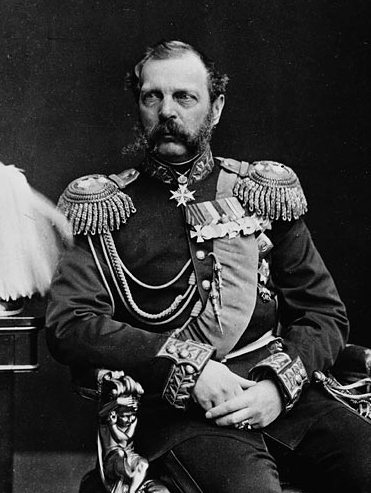
Serfdom had long plagued the Russian monarchy, both morally and pragmatically. Since the time of the Empress Catherine the Great, if not before, the House of Romanov had grappled with the unpleasant fact that the vast bulk of their subjects lived in a form of legal slavery that had long since died out in other European nations. The fact that the slave-owning enterprise only persisted in a country like the United States which in 1861 was considered positively frontier by the established Great Powers of Europe, only added yet further embarrassment to Russia's national prestige.
To his credit, Alexander II managed to do what several of his ancestors had conspicuously failed to do - he transformed his scruples into actions. His late father, the ultra-conservative Emperor Nicholas I, who ruled Russia for thirty years from 1825 until 1855, had possessed an abhorrence of social unrest, having come to the throne amidst the turmoil of the near-revolution called "the Decemberist Uprising," which had attempted to put his liberal brother, Grand Duke Constantine, on the throne instead of him. Like Thomas Jefferson, in private Emperor Nicholas had held the opinion that the only thing more dangerous than having serfdom was abolishing it. The imperial government had a wolf by the ears - a distinctly disagreeable set of circumstances - but if they let go, the wolf was likely to maul them to pieces.
After thirty years of comparative success, Nicholas I had died amidst the wreckage of his foreign policy and the once-revered tsar was held by many of his subjects to have been proof positive that conservatism had failed. Alexander ascended the Russian throne amidst a general outpouring of national euphoria and expectation, not too dissimilar to that which had greeted Louis XVI of France in 1770. And after clearing up the national humiliation of Russia's failure in the Crimean War - to date the only major conflict the House of Romanov had actually lost - Alexander then turned his attention to the fact that twenty-three million or more of his subjects lived in a form of slavery which had vanished from countries like England in the fourteenth century. (Although the British Empire had not actually abolished racially-based slavery until the reign of King William IV, thirty years earlier.)
Some aristocrats surrounding the Imperial Family - and some of the Emperor's own relatives - begged him not to sign the Emancipation Proclamation. Freedom from slavery would mean nothing more than the freedom to starve - or so Russian conservatives claimed. With some justification, they pointed to the luck of peasants in France in the aftermath of the supposedly liberating Revolution. Hadn't their lives become exponentially more difficult thanks to Liberty, Equality and Fraternity? Why inflict the same kind of anarchic liberalised cruelty on Russia's peasant population? But, French peasants had not been owned by Louis XVI or by the French aristocracy. Russian serfs in contrast were owned by their monarchy or by the 5% of the population which made up the empire's nobility. The Emperor believed adamantly that such a position was both morally untenable and practically unsustainable. If Russia's industrialisation was to continue, then it was the monarchy's duty to free her from the repugnant institution of serfdom and from its crippling effect on a modern economy.
On March 3rd, 1861, Alexander II formally proclaimed the emancipation of twenty-three million of his subjects and formally endowed them with the inalienable rights and legal privileges of being full and free subjects of His Imperial Majesty the Emperor-Tsar-Autocrat of All the Russias. The Emperor himself saw the sunrise on the Emancipation day wearing a cherry-coloured dressing gown, sitting in his study in the Winter Palace in Saint Petersburg.
Years later, there was to be some confusion over the reaction of Britain and America to this imperial decree. Considering that Russia was regularly described as an arcane despotism by most 19th-century Americans and Britons, the fact that the world's most powerful absolute monarch had moved in the cause of freedom much faster and more definitively than the world's most celebrated republic was something that caused genuine bafflement or embarrassment. Abraham Lincoln, who ironically became president twenty-four hours after Alexander II's emancipation of the serfs, said, "Our progress in degeneracy appears to me to be pretty rapid. As a nation, we began by declaring that ‘all men are created equal.’ We now practically read it ‘all men are created equal, except negroes.’ When the Know-Nothings get control, it will read ‘all men are created equal, except negroes, and foreigners, and catholics.’ When it comes to this I should prefer emigrating to some country where they make no pretence of loving liberty – to Russia, for instance, where despotism can be taken pure, and without the base alloy of hypocracy."
Later, many in America were to claim that the Tsar had been influenced in the cause of freedom by the American ambassador to Russia, Cassius M. Clay, a fifty-one year old Yale graduate and abolitionist who had served in the Kentucky House of Representatives. Clay was indeed to become American ambassador to Saint Petersburg, but he did not set sail from America until May 1st - nearly two months after the Emancipation Proclamation - and he did not formally have an audience with the Emperor until July 14th, a day which most 19th-century monarchists chose to spend with a cold compress pressed against their foreheads. Clay's actual impact in his first spell as a diplomat in Russia was confined to spending most of his time trying to impress Saint Petersburg's aristocratic party-goers. On his second spell to Saint Petersburg, he was more effective - helping to negotiate the selling of Alaska to the United States, but, in 1861, his impact on the momentous events in the Tsar's empire was non-existent. Indeed, it's far more likely to have influenced him than vice-versa.
The Emancipation of the serfs was something which many in America and Britain would like to have seen as a sign of the triumph of Whig historical progress, but whilst modern economics certainly played a part in Alexander II's heroic decision, it's also true that the seed for the emancipation had been sewn in Russia itself years before. If Catherine II or Nicholas I had enjoyed Alexander's level of courage and idealism, they would have done what he did. Both Catherine and Nicholas had come to the throne in uncertain circumstances and, as such, were extremely fearful at the prospect of rocking the boat of state. Alexander, who succeeded in uncontested legitimacy, had no such fears and for years after 1861 he was nicknamed "the Tsar-Liberator."
He was still known by that name when, twenty years and ten days after freeing tens of millions of people, he was blown to pieces by a revolutionary bomb on the streets of Saint Petersburg.
Sunday, 6 February 2011
An Interview with Christopher Gortner
Early this week, I reviewed Christopher Gortner's novel The Tudor Secret, which you can read here, and I'm delighted to post this interview between Christopher and I discussing his new book and its inspirations. My thanks to the author.
Labels:
Books,
Elizabeth I,
Great Britain,
Tudors,
United States,
Writing
Saturday, 1 January 2011
Hello, 2011!
Well, A.D. 2010 has been and gone and today is January 1st, 2011 - New Year's Day in the United Kingdom since the reign of King George III. (Prior to that, the English preferred to celebrate new year on March 25th.) 2010 has been like any year, namely a mixture of some good and some bad. As a family, we sadly lost my uncle, Richard Mahaffy, on the day before Saint Patrick's Day in March, an event which has obviously been personally very hard for my mother (his sister), his wife, daughter and stepdaughter, as well as (of course) for his parents, my wonderful, wonderful grandparents. Uncle Richard's funeral did however bear testament to how well-respected he had been, and also very much liked as well. It has not been easy, by any means, and Christmas this year was slightly more downbeat than others have been.
However, it's also had a lot of good things - my friends Emerald, Aisleagh, Laura and Elena Maria have had great success and been very inspiring in their career paths. Emerald's first major television appearance was aired at the end of the year. She played Lady Lottie Edgefield in Channel Four's adaptation of William Boyd's novel Any Human Heart - a fantastic show from a great novel. I think it's still on 4OD, if you're looking for it! Aisleagh has catapulted into the world of high-flying lawyer types (seems only yesterday we got stuck trying to climb out a bathroom window when we decided a high school house party we were attending was too boring, but we were too afraid to go out the front door in case it caused a scene... squealing like two stuck piglets in what was demonstrably a tiny, tiny window was how karma got us back.) Laura has just published her first book, Eat, Drink & Succeed: How to Climb to the Top using the Networking Power of Social Events and Elena Maria published her third novel, The Night's Dark Shade, set in 13th-century France during the turmoil of the Albigensian Crusade. Onwards and upwards, ladies - and congratulations!
I also had a wonderful summer vacation in America this year, with just a little bit of work thrown in, and I got to spend lots of time working with the team at Penguin, who are amazing and very entertaining. Puffin's 70th birthday party in London was riotous fun, although people seemed to be traumatised by the post-modern technological bathrooms. Not entirely sure that it showed either of us in a particularly good light when almost the first thing my editor and I discussed when she announced she was pregnant was the possibility of being able to shop in Baby Dior or the Ralph Lauren Children department... Still, it's best to be realistic about these things.
2011 is a year I have great reason to look forward to - my first novel, Popular, is being published in the United Kingdom and the Republic of Ireland on July 7th by Penguin and I'm very excited about that, as well as handing in the manuscript for its first sequel on January 14th; I'm back to work in the United States for a week in February, I hope to complete my masters in medieval history, my friend Aisleagh is getting married and I have made some truly wonderful friends in the past year, who I'm very excited to be starting 2011 with in my life. Don't get too conceited though; I am very capricious! Literally, at any second I can change my mind. Bam! ... I jest ... I do not jest.
This also marks the start of the first full calendar year in which I will be keeping this blog, having started back in spring 2010. Bearing that in mind, I thought I would have a look back over some of this blog's statistics to see what we've achieved since starting.
Well, since March this blog has had 96,857 hits. Of those, nearly 40% came from the United States and trailing along in a distant second were my own compatriots in the United Kingdom. Canadian, German, Australian, French, Dutch, Brazilian, Spanish and Finnish readers made up the rest of the international Top 10. And perhaps most interestingly of all, here are the top ten most popular articles: -
(A link to The Daily Telegraph's interview with the Dowager Duchess of Devonshire)
(A post where I discuss the perennial fascination with Henry VIII's second wife)
Labels:
Australia,
Family,
France,
Germany,
Great Britain,
Musings,
New beginnings,
Popular,
Scandinavia,
Spain,
United States,
Writing
Subscribe to:
Posts (Atom)


.jpg)


.jpg)