Showing posts with label Politics. Show all posts

Thursday, 18 April 2013

Meryl Streep's statement on the death of Lady Thatcher


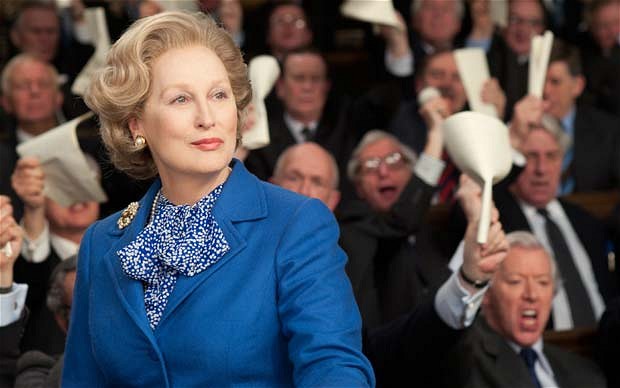
Actress Meryl Streep, who won the Academy Award for her performance as Margaret Thatcher in the motion picture The Iron Lady (above), has issued a very moving and fair statement on the death of the former Prime Minister.

Margaret Thatcher was a pioneer, willingly or unwillingly, for the role of women in politics. 
 
It is hard to imagine a part of our current history that has not been affected by measures she put forward in the UK at the end of the 20th century. Her hard-nosed fiscal measures took a toll on the poor, and her hands-off approach to financial regulation led to great wealth for others.  
There is an argument that her steadfast, almost emotional loyalty to the pound sterling has helped the UK weather the storms of European monetary uncertainty. 
But to me she was a figure of awe for her personal strength and grit. To have come up, legitimately, through the ranks of the British political system, class-bound and gender-phobic as it was, in the time that she did and the way that she did, was a formidable achievement. To have won it, not because she inherited position as the daughter of a great man, or the widow of an important man, but by dint of her own striving. To have withstood the special hatred and ridicule, unprecedented in my opinion, levelled in our time at a public figure who was not a mass murderer; and to have managed to keep her convictions attached to fervent ideals and ideas – wrongheaded or misguided as we might see them now – without corruption – I see that as evidence of some kind of greatness, worthy for the argument of history to settle. To have given women and girls around the world reason to supplant fantasies of being princesses with a different dream: the real-life option of leading their nation; this was groundbreaking and admirable. 
I was honoured to try to imagine her late life journey, after power; but I have only a glancing understanding of what her many struggles were, and how she managed to sail through to the other side. I wish to convey my respectful condolences to her family and many friends.

Tuesday, 11 September 2012

Golf, Rory and the ghost of the Anglo-Irish


23 year-old Rory McIlroy is, almost without question, the most globally-successful sportsperson to come out of Northern Ireland. Right now, he is the highest ranking golfer in the world. But in the last week far more attention has being paid to his nationality than to his achievements. Today's edition of the Belfast Telegraph ran the provocative headline: "Rory: I feel more British than Irish." The reason being that in a recent interview, McIlroy had expressed ambivalence about who he would compete for if golf was included as a sport in the 2016 Olympics in Rio: Team GB or Team Ireland? McIlroy stressed that he had not made his mind up yet. In fact, he hadn't even made up his mind if he would compete, but he acknowledged that whoever he competed for, he'd probably end up annoying somebody. 

To re-cap, Rory McIlroy is a Catholic, which on the basis of statistics means that he's expected to consider himself Irish rather than British. On the other hand, he's from Holywood and attended Sullivan Upper School, both of which are right slap-bang in the heartland of Northern Ireland's yacht, country and golf club scene. It's a place where the only tricolour you're likely to see is a French one at a wine and brie party. When it comes to his golfing career, he's so far competed under the umbrella of Ireland, because in golfing, the tournaments are still organised on all-island basis, rather than around political borders. But, if golf goes ahead to the Rio Olympics in 2016, that won't be the case. For the first time in his life, Rory McIlroy will have to choose to compete under the Union flag or the Irish tricolour and whether he'll be standing for God Save the Queen or Amhrán na bhFiann at the ceremonies

McIlroy himself is, understandably, a little piqued that his recent success has been drowned out in the media speculation about his preferred nationality. In an open letter, posted via his Twitter account, he eloquently expressed his frustrations and tried to put an end to the debate: -

Having just won three out of my last four tournaments, including a second Major Championship, I was hoping that my success on the golf course would be the more popular topic of golfing conversation today! However, the issue of my cultural identity has re-emerged, and with it, the matter of my national allegiance ahead of the Rio Olympics in 2016. 
I am in an extremely sensitive and difficult position and I conveyed as much in a recent newspaper interview. 
I am a proud product of Irish golf and the Golfing Union of Ireland and am hugely honoured to have come from very rich Irish sporting roots, winning Irish Boys, Youths and Amateur titles and playing for Ireland at all levels. I am also a proud Ulsterman who grew up in Northern Ireland, which is part of the United Kingdom. That is my background and always will be. 
I receive huge support from both Irish and British sports fans alike and it is greatly appreciated. Likewise, I feel like I have a great affinity with American sports fans. I play most of my golf in the US nowadays and I am incredibly proud to have won both the US Open and the US PGA Championship in the last two years. 
As an international sportsman, I am very lucky to be supported by people all over the world, many of who treat me as one of their own, no matter what their nationality, or indeed mine. This is the way sport should be. 
Since turning professional at 18, I have travelled the world playing the game that I love and consider myself a global player. As the World No 1 right now, I wish to be a positive role model and a sportsperson that people respect, and enjoy watching. 
I feel very fortunate to be in a position to play the sport that I love professionally and to have enjoyed the success that has come my way. 
I wish to clarify that I have absolutely not made a decision regarding my participation in the next Olympics. On a personal level, playing in the Olympics would be a huge honour. However, the Games in Rio are still four years away and I certainly won’t be making any decisions with regards to participating any time soon. 
The Olympics will be great for the growth of golf on a global scale, but my focus right now is on being the best player I can be, trying to win Major Championships and contributing to what will hopefully be a victorious European side at the forthcoming Ryder Cup Matches against the USA. 
Lastly, I would like to thank everyone for the amazing support that I receive around the world every time I play. It is hugely appreciated . . . Rory


If one was to look solely at Rory McIlroy's dilemma, then it undoubtedly seems silly and facetious to be kicking up a fuss over what team he might play for in four years time if he decides to go ahead and compete. It seems a bit like fighting over where to have your wedding, before receiving a marriage proposal. But the debate does shine light on an area of Irish modern culture that receives the old Irish problem of too much attention and too little understanding: Where do we stand on our national identity?

Northern Irish Protestants, particularly ones who have lived in Northern Ireland all their lives, are known to get quite angry if someone refers to them as "Irish." On the one hand, this seems stupid and pedantic. After all, before 1921, the phrase "Irish" was used to describe their ancestors. On the other, why shouldn't they have the right to embrace a new national identity, in the same way Czechoslovakians did after 1918 or Germans did after 1871? Simply because Northern Ireland hasn't been around forever doesn't mean that it has no right to exist or that people have no right to emotionally invest in it. 

Equally, Rory McIlroy's position as a cradle Catholic who self-identifies as British represents one of the great silent minorities of Northern Irish demographics. Since the days of Daniel O'Connell, Irish nationalism has not traditionally been very kind to Catholics who see themselves as British; the ugly sobriquet of "West Brit" was, and is, hurled at them because it's felt as if they've somehow let the side down. They're often seen as deficient and nobody, really, likes to talk about them. But they do exist and in fairly sizable numbers, particularly as you move "up" the socio-economic pyramid. Time after time, every census and every report that comes back about Northern Ireland indicates that there is a significant segment of the northern Catholic community who would not back a united Irish republic, either because of pragmatic, economic or sentimental reasons. Why are they not being acknowledged? And why, even more incredibly, are they not been targeted by the Unionist parties, particularly the moderate Ulster Unionist who, quite frankly, need every vote they can get? And why, when there is a Northern Irish British Catholic like Rory McIlroy, who is prepared to talk about it, do we all seem so incredulous?

But for me, the dilemma faced by Rory McIlroy and by thousands of people of our generation in the North summons up, Banquo-like, the ghost of the Anglo-Irish. The great losers of Irish historiography. Abandoned by their northern allies, who were only concerned with "saving Ulster" and in creating a new "Northern Irish" identity at the expense of the old Irish one, and completely written-out of the great myth of Irish nationalism, in which everything with the word "Irish" in it must ipso facto by anti-British, hardly anybody talks about the Anglo-Irish today. (If they've even heard of them, at all.) But their situation, and the hyphen in their nationality, is perhaps the one most relevant to Northern Ireland today; it merits being talked about.

The Anglo-Irish were a social group descended from the Norman invaders of the twelfth century, who subsequently intermarried with the native Gaelic aristocracy and also with the wider Irish population. They existed predominantly in the southern three provinces of Ireland - Leinster, Connaught and Munster - and they had little to do with the seventeenth-century plantations of Ulster, which saw the creation of the unique, if misunderstood, Ulster-Scots community. In the aftermath of the Boyne, the Anglo-Irish made up between about a tenth and a fifth of the overall Irish population; they are almost all members of the Church of Ireland and a significant number made up the aristocratic Ascendancy. Some of their more famous sons included the author Jonathan Swift, the "Iron" Duke of Wellington, the great politician Edmund Burke (below), the playwright Richard Brinsley Sheridan, the novelist C.S. Lewis, the famous Nationalist leader C.S. Parnell and the nineteenth century Foreign Secretary, Lord Castlereagh. And, of course, W.B. Yeats, who captured the Anglo-Irish view that some people should be poor and some should be rich because the world was prettier that way. A view, incidentally, which still survives on the Malone Road.  


Prior to the eighteenth century, the term "British" was hardly ever used - especially not in Ireland. One was simply an English/Irish/Cornish/Scottish/Welsh subject of the Crown. By the time the rising tide of nationalism was sweeping across Europe in the aftermath of the French Revolution, the Anglo-Irish community had already been settled in Ireland for six hundred years. It was far too late for them to suddenly get a new identity, just because everyone else on the European continent seemed to be rushing hell's-bells for a national label with which to define themselves and everything to do with their culture. (Edmund Burke, like his hero Marie-Antoinette, found the whole thing a bit unsettling, to say the least.) By the end of the nineteenth century, it was quite clear that the Anglo-Irish were on the wrong side of history, as Ireland pulled itself apart over the issue of independence from Britain. Unionism was strongest in the North and the orange-and-purple militancy of the Ulstermen had no time for the wishy-washy Anglo-Irish, with their fondness for old Irish culture. As far as the Nationalists were concerned, the vast majority of the Anglo-Irish were traitors. Loyalty to the King was loyalty to a foreign, hostile power. Since they didn't fit into either polarity, by the time Partition occurred in the 1920s, the Anglo-Irish simply vanished from the history books. For Northern Ireland to work, Unionists had to make it seem as if partition was predestined - a kind of six counties' manifest destiny, if you like. An historical view grew-up that the North had always been so inherently different from the South that separation was basically inevitable. In that version of events, there was no room for the 15% of the population who lived in the South, but who had self-identified as both royalist and Irish. For Nationalism, of course, it was easier to blame the English for everything, rather than to concede the awkward reality that there was a significant number of Irishmen and women who had not wanted independence.

It would be easy for me to stand on my historical pedant's drum and demand that we pay attention to the history of the Anglo-Irish because once upon a time they existed and, because of that, they deserve to be properly studied like any other part of history. It would equally be valid for someone to riposte that  I'm over-sentimentalising them, in order to make a point about modernity. Throughout the eighteenth and nineteenth centuries, the vast majority of the wealthiest member of the Anglo-Irish community had been far more concerned with preserving the privileges of the aristocracy against (what they saw) as the French Revolution-inspired hysteria of nationalism and from the jumped-up working-class demagogues of the Orange Order, who the Ascendancy loathed just as much as they did the IRA. Maybe there isn't much in the history of the Anglo-Irish that's actually worth emulating? Maybe they were predominantly selfish, reactionary and backward? Maybe the reason why they ultimately vanished from history was because they were an eighteenth century social class trying to live in a twentieth century world? (See below: enjoying their bling-tastic lives.)


But the point about the Anglo-Irish is that they chose and that the real reason that they were written out of Irish history wasn't because of what they did, but because of what they were. And that's the biggest problem in Ireland, then and now: we are far more concerned with what you are than with what you do. What Rory McIlroy captures is a generation that's sick and tired of having their identity forced upon them by history and other people's expectations. Why can't we acknowledge that the past happened and not keep trying to revive its divisions?

Basically, whether you like it or not, eight hundred years ago, in a period with radically different morals and attitudes to war, the English invaded Ireland. They came, they settled, they intermarried. They conquered Ireland, and then they ruled Ireland, with the help of the Irish themselves. Expecting every vestige of a British identity to vanish from the entire island of Ireland is a bit like expecting every immigrant group to vanish from the continental United States. Then again, another awkward fact: whether you like it or not, British rule quite clearly didn't quite work out for everyone and over the centuries, they didn't exactly set themselves to winning hearts and minds, did they? Seven hundred years after the invasion, the vast majority of Irish people chose to expel imperial rule and to become an independent nation. These two developments are historical fact, both the invasion of the 1100s and the independence of the 1900s brought good and bad things. Most things in History do. They have left a whole litany of national identities to chose from. The Anglo-Irish believed themselves to be a fusion of Ireland's cultures; the majority of them were strong monarchists, but many were also enthusiastic supporters of the Gaelic Revival, the Irish language, music, literature and the arts. They were, for better or worse, the original products of a mixed marriage. 

It's been nearly a century since Partition. It shouldn't surprise us that people are beginning to question their identities and that we're once again beginning to see a generation that's comfortable calling themselves Irish subjects of the British crown or Irish citizens of the United Kingdom. If you see yourself as solely British, solely Irish or as uniquely Northern Irish, then that's your prerogative. Go for it. 

And for all their many faults, perhaps that should be the legacy of the Anglo-Irish: take an interest in all the parts of Ireland's fascinating history, but be prepared to bend the rules a little. People fought and died for it a long time ago; you don't need to fight the same battles again. Don't be too rigid; don't be stuck in any one category. And while you're doing that, do what Rory McIlroy has done - have a strong sense of civic pride and make your homeland proud. After all, despite what we've done to it, it's still one of the best places on Earth. Maybe that's why we get so worked-up about it. 
Saturday, 28 July 2012

What's God got to do with it: Religion, Ireland and the Troubles


The Irish are always particularly hostile to outsiders' "interference." Woe betide the first foreign national who tries to pontificate upon an internal Irish matter. I was once at a party in America where someone informed me that Northern Ireland was nothing more than an imperialist occupation. Blood nearly streamed out of my eye-balls and I nearly couldn't finish my tequila. (That's how serious it was.) The northern Irish, in particular, are prone to getting especially antsy about it. Nothing irks them more than being told that their country is either a glorified warzone (entirely untrue) or that the troubles of the 1970s, 1980s and 1990s were the result of religion (debatable). As far as most northerners are concerned, it's got absolutely nothing to do with religion and only an ill-informed idiot could possibly assume that it had. 

I mean, when was the last time someone chucked a petrol bomb over the stigmata of Padre Pio or bricked a policeman because they didn't agree with justification by faith alone?

The Troubles in Ireland were political, not religious. They arose from a desire by one-third of the northern population to unite with the independent south and a conflicting desire by the other two-thirds to stay united with Britain. Over time, the demographics have shifted, but the issue remains the same. Shared sovereignty would be equally unpalatable to both sides of the debate. What it all comes down to is Ireland's relationship with Britain, not Jesus. Even some historians agree. In his recent book The Elizabethans, A.N. Wilson painted a brilliant and very witty portrait of everyday life under Elizabeth I (looking blingtastic, I might add. Me loves me some sceptres.) Wilson's book begins by looking at life in sixteenth-century Ireland; he argues that it was the Tudors who messed Ireland up for centuries to come, but that nationalism's cosy links with Catholicism only arose because of how much everyone hated the English, not how much they loved Catholicism. As Wilson points out, when the Reformation first occurred in the 1530s, the Irish went along with it far more easily than the English did: "It was not, initially at least, a specifically religious matter, though by the end of the sixteenth century the rebels Hugh O'Neill and Hugh O'Donnell, could see themselves as champions of 'Christ's Catholic religion' against the English heretics. The fundamental point of contention, though, was English interference in Irish affairs: English attempts to make Ireland less Irish. As a matter of fact, in the early stages of the Reformation, the Irish went along with Henry VIII's religious revolution more peaceably than the English did. There was no Pilgrimage of Grace, there were no Irish martyrs for the faith, no Irish Thomas More or Bishop Fisher. More than 400 Irish monasteries and abbeys were sold to Irish laymen during the reigns of Henry VIII and Elizabeth I. The Irish did not protest when Henry VIII made George Browne the Archbishop of Dublin - that was, the former Augustinian friar who performed the marriage ceremony between the King and Anne Boleyn. Perhaps, if a Gaelic Bible and Gaelic Prayer Book had been available in Ireland, as a Welsh Bible and Prayer Book were in Wales by 1567, Ireland might have remained Protestant." It didn't, of course.

What is frustrating from an historian's point of view is how little people in Northern Ireland actually know about history, but how much they use history to shape their views. (The phrase 'A little knowledge is a dangerous thing' springs to mind and has never been more applicable.) In 1641, when thousands of Irish Protestants were massacred by their Catholic neighbours, hundreds of Catholics joined a Catholic confederacy that pledged to stop further massacres and to support the rule of King Charles I in Ireland. Cromwell's infamous attack on Drogheda and Dundalk in 1649 was as much an attack on Irish royalists, who continued supporting Cromwell's fallen enemy, the King, as it was an attack on Irish Catholics. William of Orange won the Battle of the Boyne in 1690 with the help of the Pope. When the first serious rebellions against British rule broke out in 1798, most of its leaders were Presbyterian-Protestants. It was not until the early 19th century that a clear link between one religion and a corresponding political side could be seen in Irish politics. (Some people still blame Daniel O'Connell for this, but the lad needed to get himself some votes and we shouldn't be too nasty to the man who won Catholic Emancipation.) 

Anyway, the defenders of the idea that religion has nothing to do with Ireland's bullet-and-the-ballot-box history point out that at no moment has a theological debate formed the nexus for an outburst of violence. On the surface, it therefore seems very clear that what caused the Troubles (and lingering sectarian resentment today) was not faith, but instead questions of identity, culture, nationality and politics. 

But is it as clear cut as that? Anyone from Northern Ireland will know that the words "Protestant" or "Catholic" are used far more often in conversation than more accurate terms like "unionist" or "nationalist." It's a short-hand and instantly-recognisable way to convey what someone's political opinions are. And what their view of history is. Anything that can prove the other side wrong is met with metaphorical dances of joy. (Literal ones would be totes undignified.) For instance, recently, when I was tutoring a friend about Ireland's medieval past, his face lit up with a euphoric glow at the revelation that the English invasion of Ireland had actually been blessed by Pope Adrian IV. "So, let me get this straight: the Pope that they all adore actually ordered the English to invade?" (I didn't know that there were many "Pope Adrian IV fan clubs" around, but whatever. That's nice for him. Frankly, more 12th century personalities should have fan clubs. Eleanor of Aquitaine, for instance. Maybe he just meant popes, in general? I don't know. Oh, those crazy Catholics. Still, though - the Eleanor of Aquitaine thing should be considered.) 

You see, it's my contention that religion actually does matter in Ireland's troubles. And that it matters, a lot. Just because no-one ever started a fight over the perpetual virginity of Mary or the existence of Purgatory does not mean that faith doesn't influence us. Religion, in a strange way, is still everything in the north of Ireland. For most people, whether they like to admit it (and usually they don't), it establishes all the essential elements of someone's personality. It may reveal what school you went to, who you're likely to vote for, what sports you play, what national anthem you'll stand for, what you're likely to get offended by and what your world-view will be. Religion flows, subtly, beneath the surface, shaping everything above it.

How, though? Well, to put it in a nutshell - and I'm being reductive here, so I apologise - Catholics tend to think they're better at being Irish and Protestants think they're better Christians. And in both cases, it's annoying.

Northern Irish Protestants are brought up to believe that Catholicism is nonsense. Even if that phrase is never specifically said, there are numerous tiny influences in an Ulster Protestant's childhood that lead them to the inescapable conclusion that Catholicism is not "real" Christianity. That it's all superstition, Mary, saints, statues, priestcraft, paedophile priests and spiritual idiocy. Even if you get older and you claim to respect Catholicism because "we're all Christians," most Protestants are still utterly convinced, in their heart of hearts, that Protestantism is "real" Christianity. Okay, maybe Catholics aren't bad, but they're certainly wrong. Because of Protestantism's assertion of sola scriptura (Scripture alone) and its belief that the Bible is literally true (i.e. what you see is what you get), it's impossible for many of them to appreciate that Catholicism is, in fact, an enormously complex system of beliefs that happens to be based on the Bible just as much as Protestantism is, but through a different set of textual interpretations. 

This belief gives most Protestants a sense of rather irritating spiritual superiority. Even "bad" Protestants who go to church twice a year, who leave the service early, who shag all around them, swear, drink and generally have a good time, can still feel better about themselves, because no matter how shaky their own faith is, they're still automatically better Christians than every single Catholic they know. ("Bad" Protestants who are smug, nasty and self-righteous feel this all the time, but I digress.) For most Protestants, Catholicism is the "fan fiction" of Christianity; it's the unofficial spin-off. It's not quite real. At a recent table quiz, half the Protestants in the room did not know the name of the last book in the Bible. Had you pushed them though, they would still have sworn blind that they were more authentic Christians than the most devout of Catholics. (Btw, seriously? Revelation, guys. Isn't that general common knowledge?)

Northern Irish Catholicism breeds its cultural superiority in a different way to Protestantism. What happens in Sunday Schools, youth groups and Scripture Unions for Protestants, often happens in the school system for many Catholics. Whilst there are some schools that are nearly 100% Protestant, it is illegal for any school to have a purely Protestant ethos. There are, however, numerous Catholic-only schools - many of whom have excellent exams results. Mercifully (or hopefully) few of these schools teach a sectarian message; although many do teach a rather one-sided version of Irish history ("Protestant" schools often fail to teach it, at all.) The major point, however, is that in a school (or any social organisation) where there is no risk of offending anyone, it is permissible for ribald sectarian banter to run un-checked. What Northern Irish Protestants and Catholics say when they're in mixed company is a world-apart from what they say when they know that only their own "kind" is in the room. What they say to foreigners (including the English) is often outright, politically-correct, rose-tinted lies. For seven years, thousands of Catholics spend most of their time in an environment in which there is zero need for them to moderate what they say about politics or religion and they have zero daily interaction with Protestants. I am in favour of faith schools, but in Northern Ireland specifically, I do sometimes worry about them. That kind of environment can breed both a casual sectarianism and an innate, unconscious attitude that Protestants are "foreigners"; that they're somehow not really Irish and, as a result, that they don't belong here. Far too many Catholics think that Protestants all behave like mini-Ian Paisleys; too many Protestants think that all Catholics had a childhood that was basically a cross between The Magdalene Sisters, Titanic Town and Angela's Ashes.

In a recent survey conducted of Ireland's Catholic population, 80% stated that they did not believe in Transubstantiation - one of the core tenets of the Catholic faith. Few Protestants can name all the books of the Bible; even fewer know the relevant history, context and textual debate about what they emphatically believe to be the revealed Word of God. Ireland's relationship with faith is therefore a troubled one - to put it mildly. No wonder outsiders get it wrong so often. Sometimes, I don't even particularly understand it myself. We get angry about how religion is misused in our communities, but then we feel guilty about criticising people from our own "side" when they behave in a sectarian manner. We feel as if we're letting the side down; as if condemning an individual's actions is somehow condemning the whole community. It's stupid and it's spineless. And I've been guilty of doing it myself.

There are many other causes that keep sectarianism alive in Northern Ireland; just as there are also many factors which are, mercifully, slowly beginning to strangle it and starve it of oxygen. Religion is not the cause of the Troubles, but I can't help but think that it is still one of the reasons. If it doesn't cause the tensions, it certainly re-enforces them. And if that is the case, then the verse that springs to mind is the shortest in the Bible and one worth remembering for all believers: "Et lacrimatus est Iesus." (John 11:35 - "And Jesus wept.")

Wednesday, 25 April 2012

Belfast's Lord Mayor to resign early in order to avoid meeting the Queen

Only a few weeks after officially unveiling the city's beautiful new memorial gardens to mark the centenary of the Titanic disaster, the Lord Mayor of Belfast, Niall O Donnghaile (26), the youngest incumbent of the office in history, is to resign early from his post in order to avoid meeting Her Majesty the Queen during the 2012 Diamond Jubilee celebrations. An official visit by the Sovereign to Northern Ireland will be an accepted part of the Jubilee festivities, although Buckingham Palace has not yet confirmed a date.

Mr O Donnghaile is a member of Sinn Fein, the left-wing republican party strongly in favour of Irish unification. It is currently the second largest political party in Northern Ireland, with 29 seats in the Northern Ireland Assembly. (The largest party is the right-wing, pro-British Democratic Unionist Party, with 38 seats; in third place is another conservative, pro-British party, the Ulster Unionists, with 18.) Mr O Donnghaile's successor is tipped to be a member of the DUP, Mr Gavin Robinson, but Mr O Donnghaile's refusal to associate himself with the monarchist Jubilee means that the election for his replacement has been moved forward to Friday June 1st, the day before the official nationwide Jubilee celebrations begin.

Sources from within Belfast City Hall have confirmed that for the first time in Belfast's history standing orders have been changed to allow the new Lord Mayor to be elected at a meeting on that Friday.  Normally, only special meetings are held on Fridays.

Speaking on behalf of Sinn Fein, Mr J. McVeigh, the group's party leader on Belfast City Council, said: “We knew that the Jubilee celebrations were coming up and had a discussion with the DUP about that. We were happy to come out of that role and they were happy to come in a little bit early because of the issue of the anniversary. We as republicans obviously are not keen to celebrate the Jubilee in any shape or form. But, we have supported the recent round of funding when it came before council and we are happy for unionists to celebrate if they so wish. But, it is not something that we would be involved in as republicans. This is as much about accommodating the unionists as about us not wanting to be part of the Jubilee celebrations. We are republicans and have no great love for the royalty in any shape or form. We do not want to be part of the celebrations. A unionist Mayor would love to be on that seat when a member of the Royalty or maybe even the Queen herself comes to Belfast.”

Apparently, since Mr O Donnghaile's term was nearly up anyway, the decision was reached by general consensus between the unionists and republicans on the council. In February, many of the Sinn Fein councillors had voted to approve the spending of £56,000 (about USD 90,000) towards local community organisations across Belfast who wanted to organise their own celebrations for the Diamond Jubilee.

Some other unionists, however, are apparently angry at Mr O Donnghaile's decision and describe it as a snub to the apparently apolitical nature of the Lord Mayor's office and to the wider Protestant community in Belfast. Last year, one of the most prominent figures in Sinn Fein, Martin McGuinness, unsuccessfully ran for the presidency of the Irish republic; when asked in interviews if he would meet the Queen when she made a state visit to Ireland, McGuinness replied that, as prospective President, he would. In light of his colleague's promise to honour the office before personal political predilection, some unionist criticism of Mr O Donnghaile has been correspondingly severe. And not for the first time. 

Last year, the current Lord Mayor sparked another political storm in Northern Ireland after he refused to present a certificate to a 14-year-old Army cadet during a Duke of Edinburgh awards ceremony. The Army cadets prepare young people for a career in the Armed Forces and the Duke of Edinburgh awards scheme was one established by the Queen's husband, His Royal Highness Prince Philip, the Duke of Edinburgh. The Award programme offers chances to participate in physical, mental and skills-based improvement programmes across the United Kingdom to young people aged between fourteen and twenty-four, regardless of ability or background. The Duke's award offers a huge range of such programmes and Mr O Donnghaile had handed out certificates to many participants, but refused to for the 14 year-old Army cadet. The backlash against the decision was strong, even from many Irish nationalist politicians. He also caused outrage amongst unionists and liberals when he became Lord Mayor of Belfast last year and insisted upon removing royal portraits from his parlour.


Speaking of his decision to step-down a few weeks early, the former Lord Mayor of Belfast, Jim Rodgers, a member of the centre-right Ulster Unionist Party, said, "It is definitely a snub... When I was Lord Mayor I met a wide range of people from both sides. I was criticised both publicly and privately for it — but I believe you have to lead to the city and you have to be above politics. Unfortunately this current Lord Mayor has been one of the most political that I can remember in more than 20 years in council." 

Friday, 3 June 2011

New still from Meryl Streep's Margaret Thatcher biopic


Ironically, after posting Courtney Pannell's fantastic article on the stagnation of conservative womanhood (below), I came across this still on-line, showing Oscar-winner Meryl Streep as the longest-serving Conservative Prime Minister of Britain, Margaret Thatcher. Seen here with Jim Broadbent as her on-screen husband, Dennis, the pair are recreating the famous 1980 Conservative Party conference at Brighton, at which Prime Minister Thatcher told the delegates of her government's plans to deal harshly with the Trade Unions and to end the long-term recession which had crippled Britain for the previous decade. It was also the conference where she made her famous declaration, "The Lady's not for turning," which you can watch below. Really can't wait for this movie, which The Daily Mail talks about here.


The Stagnation of the Conservative Woman: Courtney Pannell reflects


Writing in The Yale Herald, my friend Courtney Pannell, a young conservative woman herself, reflects in an absolutely brilliant article on the problems that many women are experiencing with American conservatism and the Republican Party today: -

"The GOP doesn’t plan on win­ning the female vote in 2012 — or ever, at this rate. Demo­c­ra­tic oppo­nents are call­ing the recent House move to slash fund­ing from Planned Par­ent­hood another exam­ple of the GOP’s “War on Women.” This war is only strength­ened by con­ser­v­a­tive female fig­ure­heads, such as Michelle Bach­mann and Sarah Palin, and the ideals that they are laud­ing, which are out of step with the desires and strug­gles of the mod­ern woman.
Last week, I attended CPAC, the Con­ser­v­a­tive Polit­i­cal Action Con­fer­ence, which is basi­cally a red car­pet event for the Who’s Who of the right... As a con­ser­v­a­tive woman myself, I was looking for­ward to com­mis­er­at­ing with fel­low right-leaning ladies — but they were awfully hard to find. Walk­ing into the con­ven­tion cen­ter lobby, I tweeted, “Where are all the women?” in an attempt to send a ral­ly­ing cry. I was hard-pressed to find any­one that wasn’t a wannabe-cowboy or Mitt Rom­ney look-a-like, much less some­one with a two X chromosomes. 
I finally found a room of women at a panel dis­cus­sion called “The Awak­en­ing of the Con­ser­v­a­tive Woman.” The golden girl of the panel was Phyl­lis Schlafly, an 86-year-old woman who was piv­otal in killing the Equal Rights Amend­ment in the ‘70s. Along­side her was colum­nist S.E. Cupp, campaign-finance lawyer Cleta Mitchell, and Rep. Michelle Bachmann. 
Although all the pan­elists were accom­plished work­ing­women and the event was about awak­en­ing the con­ser­v­a­tive woman, I was shocked by their repres­sive and out­worn mes­sag­ing points. Some­one should prob­a­bly look up “awak­en­ing” in Webster’s, because I might as well have been tak­ing life lessons at the kitchen table of June Cleaver. 
Now, I’m not here to debate the value of stay-at-home wives and moth­ers; my mother has been one for 25 years. In my view, the fam­ily is the cor­ner­stone of a great soci­ety, so mar­riage and moth­er­hood should be cel­e­brated. But... behind their glory sto­ries about find­ing their mates was the idea that a woman has to com­pro­mise her career goals in order to achieve the sup­posed great­est goals of wom­an­hood: mar­riage and moth­er­hood. “You can’t have it all at the same time,” Mitchell even said to the crowd. She fol­lowed up the state­ment with an anec­dote. A young woman (a Har­vard stu­dent, no less) told Mitchell that she would even­tu­ally hire a nanny to help run her house­hold, because she hoped to have a job and chil­dren. “Can’t you just get a dog?” Mitchell snark­ily replied to the young lady. 
What’s ironic about this work­ing mother dichotomy is that in any other room at CPAC you would have heard speak­ers plead­ing with young atten­dees to go into busi­ness, become entrepreneurs, help Amer­ica inno­vate. But the GOP women seem to want to leave that dream up to the boys..."

For Coco's full article, click HERE.

Sunday, 24 April 2011

Eva PerĂłn: The Public Death of a Legend


The first sign that all was not well with Argentina's controversial First Lady came when she did not attend the Flag Day ceremonies in Buenos Aires on June 19th, 1952. When she failed to appear at any of the festivities for Argentina's Independence Day three weeks later, her millions of devoted followers began to get agitated. Initially, the government's doctors tried to downplay rumours that Evita was seriously ill and instead claimed that she was simply recovering from exhaustion. However, news that Evita had left Buenos Aires and was instead lying in a sickbed in the Quinta de Olivos, the presidential countryside palace, soon leaked to the press and by the end of the second week of July, Argentina was tottering on the edge of a communal nervous breakdown at the idea that the President's thirty three year-old wife might be about to die.

In Congress, fifty-nine politicians made impassioned speeches praising Evita's patriotism, her devotion to the cause of Peronism and her tireless care for the Argentine poor. Mafalda Piovano, a female politician recently elected to Congress thanks to Evita's campaign against male-only suffrage, collapsed during her speech and screamed out, "Oh God, we beseech you to return to Eva PerĂłn the health she sacrificed to save us!" Then, Congresswoman Piovano fainted and by the time she had regained consciousness, the President of the Chamber, Hector Campora, was proposing that Congress bestow upon Evita the new title of "Spiritual Leader of the Nation." The motion passed.


Out in the streets, the reactions of Evita's followers - her beloved "descamisados" - was even more frenzied. It would be wrong to characterise their devotion to her as simply the displaced religious loyalty of simple peasants, dazzled and manipulated by Evita's beauty and glamour. Undoubtedly, there was an element of that; the story of Eva PerĂłn is one of history's great rags-to-riches stories and to the Argentne working-classes there was something almost magical about the farmer's daughter from JunĂ­n who had become model, then movie star, then first lady. Always dressed in the height of fashion, for half a decade Evita was glamour personified for many of Argentina's disadvantaged. However, she was not just loved for her beauty and the Dior-stocked wardrobe she flaunted at every public appearance. She was also applauded for her role in supporting a woman's right to vote and, most importantly of all, for her work with the Eva PerĂłn Foundation. Having commandeered the entire Argentinean social welfare programme during her husband's first term in office, Evita had transformed it into a charitable foundation with her name on it and then authorised one of the most extensive expansions of social welfare in modern history, despite a global recession. Capitalising on her own celebrity, Eva encouraged Peronists to donate generously to the foundation and even insisted that all employed workers give one day's wage to the foundation per calendar year. The money kept rolling in and with access to both the treasury and donations from her supporters, Evita had been able to turn the foundation into one of the biggest charitable enterprises in human history. Allegations that she was siphoning off funds to a secret Swiss bank account are almost certainly untrue and if money was deducted for expenses, it must have been tiny in comparison to what was being handed out. A more valid criticism was that the foundation was contributing to the national deficit and that Evita had become so completely convinced of her identity as saviour of the nation's poor that she was basically, and sometimes literally, throwing money at anyone who asked for it, in a wasteful, recession-bolstering display of government over-spending. For Evita, of course, none of this mattered. She wasn't an accountant, nor did she have any interest in anything that even smacked of criticism. She was adored, she was loved and everywhere she went, she was mobbed by hysterical crowds. Of all the many people who believed in the legend of Eva PerĂłn, it's difficult to imagine a more zealous believer than Evita herself. 

The work and the criticisms of the Foundation and Peronism's social welfare programme are dramatised below in the song And the Money Kept Rolling In from the 1996 movie adaptation of the movie Evita, starring Antonio Banderas as the narrator and Madonna as Eva PerĂłn. Aside from Madonna's physical resemblance to the real Evita, I think this song brilliantly captures the tidal wave of enthusiasm surrounding Eva's charity and social welfare programmes. People before profit or gross fiscal irresponsibility?


It had been the eighteen or nineteen-hour days she had been putting in overseeing the foundation and making public appearances, coupled with the exhausting work of helping her husband campaign for a second term in office, which had made Evita ignore the aches and pains she had been experiencing for the best part of two years. By the time her aides finally convinced her to take some time off for a check-up, it was too late to do anything to treat the cancer which would kill her. She made her last public appearance on June 4th, 1952 to stand by her husband's side as he was sworn in as President of Argentina for another six years. Juan PerĂłn had won by a landslide, with sixty-six percent of the popular vote. But it was much more Eva's triumph than Juan's. PerĂłn's numbers had come from the fact that for the first time in Argentina's history, women were allowed to vote, thanks in part to the First Lady's constant lobbying. Many of these first time voters had been voting for the First Lady, not the President. And throughout the presidential swearing-in, the entire chamber could hear the sound of one hundred thousand spectators outside chanting "Viva Evita!" The re-elected president's name was hardly mentioned at all. 

Thursday, 10 February 2011

Meryl Streep as Margaret Thatcher


Words cannot describe how excited I am about this project, which will see Meryl Streep play British Prime Minister, Margaret Thatcher.

Miss Streep, seen above in the role, began filming in the UK in January 31st and attended Prime Minister's Question Time at the Palace of Westminster as part of her research. Of her new role, she said, "The prospect of exploring the swathe cut through history by this remarkable woman is a daunting and exciting challenge. I am trying to approach the role with as much zeal, fervour and attention to detail as the real Lady Thatcher possesses - I can only hope my stamina will begin to approach her own."

Jim Broadbent, Richard E. Grant and Anthony Head will be co-starring in The Iron Lady.

Sunday, 19 December 2010

Discovery of King Henri's skull


At the height of the French Revolution, the royal tombs of France were desecrated, violated and their contents scattered to the four winds in an excess of urban unrest. In the square outside the Basilica of Saint Denis in Paris, the skulls of the dead kings and queens were used as footballs or target practise by the revolutionary mob. Most were never recovered and to this day most of the magnificent restored tombs in Saint Denis are empty shells. 

Now, it seems that the skull belonging to the founding sovereign of the Bourbon dynasty, whose rule was overthrown in the Revolution of 1789 - 1792, has been discovered. King Henri IV, who ruled France from 1589 until 1610, unified the kingdoms of France and Navarre, as well as bringing about an end to the destructive Wars of Religion. He was (and to some extent still is) a popular monarch, whose assassination by a deranged religious fanatic in 1610 plunged the nation into mourning and political crisis. He was succeeded by his young son, Louis XIII, although practical power was held by his mother, Marie de Medici. 

The story of Henri IV's skull is a fascinating one. After being stolen during the ransacking of the cathedral, Henri's alleged skull somehow ended up in the possession of a Parisian tax collector, where it has remained since 1955. (Its exact whereabouts between 1789 and 1955 are still somewhat shady.) A team of nineteen scientists has, however, concluded beyond reasonable doubt that it is indeed the skull of King Henri IV and that the marks made by the dagger during the frenzied assassination can still be seen.

In a rather touching and appropriate gesture, the scientific team decided not to hand the monarch's head over to the current French government, but rather to entrust it to the King's closest living descendant - His Royal Highness Prince Louis de Bourbon, Duc d'Anjou (right). His Royal Highness described the moment as "very emotional" and stated that whilst he hoped to return the skull to its original resting place at the basilica of Saint Denis, where it can rest alongside the remains of Louis XVI and Marie-Antoinette, he is aware that as a claimant to the French throne he may not be able to persuade the current French republican government. The prince says that is profoundly aware of the "familial and moral" obligation he now has to find Henri IV a proper resting place. 

At the time of his assassination, King Henri IV was survived by both of his wives. His ex-wife, a glamorous and delightfully badly-behaved princess, known popularly as "La Reine Margot," and his current queen, an Italian aristocrat Marie de Medici. His legitimate children (all from his second marriage) included the new king, Louis XIII, who reigned from 1610 to 1643, his rebellious younger brother Gaston, and their three sisters - Elisabeth, Christine and Henrietta-Maria. The lovely Elisabeth became Queen of Spain through her marriage to King Philip IV, five years after her father's murder; the elegant but temperamental Christine married Vittore-Amadeo, Duke of Savoy and had five children and the youngest, Henrietta-Maria, married King Charles I of Britain and became the mother of two future British kings, Charles II and James II. 

For The Guardian's report on the hunt for Henri IV's skull, click here

Saturday, 16 October 2010

October 16th, 1793: The Execution of Marie-Antoinette


"I was a queen, and you took away my crown; a wife, and you killed my husband; a mother, and you deprived me of my children. My blood alone remains: take it, but do not make me suffer long."

Lancelot de Carles and the Portuguese author of the Alcobaca account said that when Death came for Anne Boleyn in 1536, she was still at the height of her beauty. The glossy brunette tresses were immaculately coiffed; the glistening dark eyes, the long, elegant fingers, the trim waist and the smooth skin were all still intact in the waif-like 28 year-old. Her jailers had treated her with respect – bowing as they entered her presence; the Constable of the Tower even stammered over his words in informing the Queen that the time had now come to die. It was left to Anne to offer soothing words of polite comfort to her gaoler, rather than the other way round. On the scaffold, thousands had knelt before a woman who was still young, still glamorous and still beautiful.

When they came for Catherine Howard in 1542, the teenage Queen still radiated that potent mixture of vulnerability and sexuality which had made her so lethally attractive to men. When they came for Jane Grey in 1554, she was dressed demurely in black – still the perfect, prim, Protestant porcelain doll, her eyes aglow with quiet ecstasy at the prospect of being martyred for her faith. When they came for the Romanov Grand Duchesses in 1918, they were all young, all pretty; their ages ranged from twenty-two to seventeen. Olga, Tatiana, Maria and Anastasia were still recognisably the iconic princesses who had stared out from hundreds of photographs celebrating the domestic bliss of Russia’s last Imperial Family.

But when they came for Marie-Antoinette in 1793, France’s most iconic queen was no longer beautiful or even pretty. Rather, she was in every way – apart from the curious beauty endowed by dignity – positively and undeniably ugly. The sufferings she had endured over the last four years and especially in the last thirteen months had destroyed what remained of her good-looks. As the poor woman sat writing her last letter between the two fat wax candles in the grim, cold and dank prison cell at the Conciergerie in the pre-dawn darkness of October 16th 1793, anyone hoping to see the one-time goddess of ancien rĂ©gime sophistication would have been cruelly disappointed. The trim waist which had once been encased in Rose Bertin’s legendary creations of haute couture had thickened and coarsened; the beautiful fair hair which the celebrity coiffeur, Monsieur LĂ©onard, had once styled into everything from towering poufs decorated with diamonds, jewels, powder and feathers, to simple chignons inspired by country-maids, was long gone. The Queen’s hair had turned entirely grey over the last year and it had even begun to fall out. That skin – the ivory-white smoothness of which had once caused her aristocratic contemporaries to fall into raptures of both praise and jealousy – was no longer alabaster, but rather emaciated, almost ghostly. The skin had begun to sag as well, around her chin, neck, cheeks and eyes, in particular. The sparkling blue eyes, shared by so many of the Queen’s Hapsburg relatives, had dimmed and clouded over, as the days and weeks spent in a darkened prison cell ruined her eyesight. She was thirty-seven years-old.

In the last forty-eight hours, the Queen had eaten almost nothing and her body was now rapidly beginning to fall apart, as if it too sensed that the end was near and that there was no point in holding itself together any longer. The Queen’s monthly period had started a few days earlier, but it had quickly degenerated into a frightening case of vaginal hemorrhaging. She had to constantly change her menstrual linens and trying to find the time to do so discreetly, when she was apt to be interrupted by the revolutionary guards at any given moment, was difficult. For a woman who was always so protective over her privacy and mortified by nudity, it was particularly humiliating set of circumstances.


Sunday, 10 October 2010

October 9th, 1514: The Marriage of Princess Mary Tudor to Louis XII, King of France


On her wonderful website The Anne Boleyn Files, Claire Ridgeway marks the anniversary of the marriage of Henry VIII's youngest sister, the teenage Princess Mary, to the middle-aged widower King Louis XII of France. Commenting on the young princess's arrival, His Grace the Bishop of Asti, then the Ambassador of the Republic of Venice to France, commented: -
"I promise you that she is very handsome, and of sufficiently tall stature (de statura honestamente granda). She appears to me rather pale, though this [I] believe proceeds from the tossing of the sea and from her fright. She does not seem a whit more than 16 years old, and looks very well in the French costume. She is extremely courteous and well mannered, and has come in very sumptuous array…"
Amongst the new Queen of France's retinue was one of the daughters of England's most accomplished diplomat, Sir Thomas Boleyn, the heir-apparent to the Earl of Ormonde. Claire, who is currently writing a series on Anne Boleyn's early life, reasonably hypothesises that the "Mademoiselle Boleyn" mentioned in the household accounts was Sir Thomas's youngest daughter, Anne, although other historians have suggested that it was in fact Anne's elder sister, Mary, and that Anne joined the French Royal Household slightly later. As with everything pertaining to Anne Boleyn's childhood, the sources are less complete than we would like.

The marriage of Louis XII and Mary Tudor lasted less than three months, with the King dying (allegedly of exhaustion) on New Year's Day, 1515. Mary seduced and then eloped her brother's best friend, Charles, Duke of Suffolk and the two returned to England, to try and face down the scandal. Mary was back in London for the birth and christening of her niece, the much more famous of the two Mary Tudors. Mary and Charles's daughter, Frances, was to become the mother of Lady Jane Grey, another iconic and tragic member of the English Royal Family.

To read more on the brief marriage of Louis and Mary, click here to see Claire's account.

Wednesday, 15 September 2010

"The Special Relationship" Trailer


Having already tackled his relationship with his successor, Gordon Brown, and the monarchy in The Deal (2003) and The Queen (2006), Stephen Frears has returned to the subject of Tony Blair's career as Prime Minister in HBO's amazing new movie, The Special Relationship, which tells the story of Blair's relationship with the then-President of the United States, Bill Clinton, at the time of the Northern Irish Peace Process.

President Clinton, played by Denis Quaid, is joined by Hope Davis as First Lady Hillary Clinton, with the amazing Michael Sheen reprising his role as Blair, with Helen McCrory returning as Cherie Blair and Mark Bazeley playing New Labour's spin doctor, Alistair Campbell, as he did in The Queen.

The trailer can be watched here.

Friday, 13 August 2010

"Northern Ireland's Union with the United Kingdom threatens Protestantism"


"[Irish]Republicans often ask how can they persuade Unionists to think more positively towards their 32 County Nirvana. With British Unionists, they’re genuinely wasting their time- our long term aim is not to ensure the survival of a religious faith but to help the Northern Irish enjoy the same kind of social and cultural freedom enjoyed by our fellow citizens in the rest of the UK."

The above quote is taken from a brilliant on-line article from the blog A Pint of Unionist Lite, which reflects upon the recent pronouncement by Rev. Foster, a former political ally and then an opponent of Rev. Ian Paisley, once he felt Dr. Paisley had become too liberal. Yes, you heard me.

The comments were made in the Newsletter's Unionism 2021 series, reflecting what a broad church Unionism has become now that the centenary of the Partition of Ireland, which was so frequently described as a short-term aberration in Ireland's history, is a mere eleven years away.

Basically, Rev. Foster declared that the United Kingdom is an unholy place and has thus sacrificed the loyalty that the people of Ulster placed in it 100 years ago. The good Reverend writes: "Now its secularism, its multi-faithism, its hatred of all things scriptural, its abandoning of the moral standards considered sacrosanct but a generation ago, and its embracing of the aspirations of those regarded deviants until recently, make it as uninviting as was Sodom to Abraham."

Ah... what would Unionism be without the token pint of crazy?

Thankfully, the writer of A Pint of Unionist Lite captures exactly what I think of this kind of statement and it's refreshing to read someone whose Unionism correlates so closely with my own.

***

Daughter of the Church: The Life of Matilda of Scotland, Queen of England


"From the time England first became subject to kings, out of all the queens none was found to be comparable to her, and none will be found in time to come, whose memory will be praised and name will be blessed throughout the ages."
- The Hyde Chronicle

For seventeen years after the death of Matilda of Flanders, England had no queen. William the Conqueror followed his wife to the grave four years later, to be succeeded in England by his son, William II, who for his own reasons decided not to marry. When William died and was succeeded by his brother, Henry I, in 1100, the new King married for reasons very similar to his father’s – his chosen queen was a princess of unassailable royal ancestry and famed for her piety. The two queens even shared the same Christian name and, in fact, the new Queen Matilda had been the god-daughter of the old. Unlike her predecessor however, the new Queen was not beautiful. One of her champions rather kindly said that the Queen’s appearance was ‘not entirely to be despised.’

Beauty or no beauty, Matilda of Scotland, Queen of England, had an august lineage and, as the career of her predecessor showed, such things mattered at that time. Matilda could claim in her family one parent who was to become a character in a Shakespearean play and another who was to become a Catholic saint. Her father, Malcolm III, King of Scots, was the hero whose victory heralds the end of Macbeth, whilst Matilda’s mother, Queen Margaret, was an English princess so famed for her religious zeal that she was to be canonised in the 13th century by Pope Innocent IV. Four of Matilda’s brothers and one of her half-brothers – Duncan II, Edmund, Edgar, Alexander I and David I – were to wear the Crown of Scotland and her sister, Mary, was to become the mother of the Queen of England in the next generation.

Sunday, 8 August 2010

Medical Team Slaughtered by the Taliban in Afghanistan


Above: Dr. Karen Woo, a British national, who was murdered today in Afghanistan

"Ten members of the Christian medical team — six Americans, two Afghans, one German and a Briton — were gunned down in a gruesome slaughter that the Taliban said they carried out, alleging the volunteers were spying and trying to convert Muslims to Christianity. The gunmen spared an Afghan driver, who recited verses from the Islamic holy book Quran as he begged for his life."
- A.P. News Report

"The expedition will require a lot of physical and mental resolve and will not be without risk but ultimately, I believe that the provision of medical treatment is of fundamental importance and that the effort is worth it in order to assist those that need it most."
- The late Dr. K. Woo


A medical team was lined up and shot by Taliban terrorists in the Badakhshan provice of Afghanistan, it has been confirmed.

It is a terrible and senseless tragedy, reminding us - as if any was needed - of the sheer, appalling barbarity of the Taliban and of the courage of those, from both Afghanistan and the rest of the world, who go out to try and assist many of those whose lives are still being ruined by the fanaticism and cruelty of the Taliban.

It is also deeply, deeply sad to think of ten families tonight who are grieving and my thoughts and prayers are with them, for whatever they are worth.

The story is being carried by the Associated Press here and The Daily Telegraph here.

Saturday, 17 July 2010

July 17th, 1918: The Execution of the Romanovs


"The decision was not only expedient but necessary. The severity of the summary justice showed the world that we would continue to fight on mercilessly, stopping at nothing. The execution of the Tsar's family was needed not only in order to frighten, horrify, and dishearten the enemy, but also in order to shake up our own ranks to show that there was no going back."
- Leon Trotsky (1879 - 1940)

"With the saints give rest, O Christ, to the soul of your servant where there is neither pain, nor sorrow, nor suffering but life everlasting."
- A Russian Orthodox prayer for the dead, contained within the last Church service the Romanovs ever attended on Sunday July 14th 1918. The officiating priest, Father Storozhev, reported that the Tsar's daughters had tears in their eyes as they said the prayer.

Today is the 92nd anniversary of the execution of the Imperial Family of Russia by their Communist captors, acting on the orders of Vladimir Lenin and the Moscow Soviet, in 1918.

Those slaughtered on that terrible night were Nicholas II, the former Emperor of All the Russias, his German-born but British-educated, the Empress Alexandra, their four daughters, 23 year-old Grand Duchess Olga, 21 year-old Grand Duchess Tatiana, 19 year-old Grand Duchess Maria, 17 year-old Grand Duchess Anastasia and the Emperor's 13 year-old son, Alexei, who, had things gone differently, might one day have reigned as Tsar Alexei II. Also killed on that night was the Imperial Family's faithful physician, Dr. Botkin, the Tsar's valet, Alexei Trupp, their cook, Ivan Kharitanov and Anna Demidova, the Grand Duchesses' maid.

I had wanted to blog about this terrible event in detail, but with several writing deadlines, I unfortunately do not have the time to do it justice. So, I shall return to the topic next year. However, one thing occurred to me recently and I would like to share it today, since it is particularly relevant.

The Emperor and Empress's second daughter, Grand Duchess Tatiana, was the tallest and most beautiful of the four Romanov sisters. A courtier, who knew her, said: "One never forgot she was the daughter of an Emperor." It is clear from the horrific physical wounds revealed by the examination of Tatiana's remains and the memoirs of those who helped kill her that she used herself as a sort of human shield, to protect her two younger sisters, during the first and second hail of bullets fired upon the family.

It is clear however that Tatiana died, eventually, from a single bullet wound to the head. Yakov Yurovsky, who was in charge of the execution that night, delivered the fatal gunshot and he recorded that as he marched towards her, Tatiana struggled to her feet from the corner where her eldest sister lay dead, her youngest lay unconscious and another lay in hysterical convulsions after sustaining a bullet wound to the leg. It is often assumed that Tatiana was attempting to run away from her executioner - a perfectly natural assumption, but one which Yurovsky himself did not suggest. There was, in fact, nowhere for her to run. She was backed into a corner - the bodies of her parents and eldest sister were in front of her, her two youngest sisters were cowering in a corner behind her and there were eleven men (so to speak) blocking the only exit from the cellar. Moreover, Yurovsky does not record her attempting to move, but rather pulling herself to her feet, using the blood-soaked wall for support.

The Grand Duchess chose to die standing. Death was coming and rather than weep on her knees in the corner, she hauled herself to her feet. She was relatively calm, under the circumstances, as Yurovsky fired a bullet through her head. And it is perhaps the perfect way to look at the disgusting, hideous massacre of Ekaterinburg. Those who were degraded were not the bleeding or the dying, the sobbing or the maimed, but those wielding the guns.

The firing squad revealed in that moment what Communism would mean to the people of Russia, what it would mean thirty million times over in the century to come. Thomas Jefferson once said that, every now and then, the “tree of Liberty” needed to be watered by a little blood. Perhaps he would not have been so quick to say something so stupid if he had seen what transpired in the name of progress in the early morning hours of July 17th, 1918. Then again, he might have been. The future President said those words as the streets of Paris were almost literally running with the blood of those who had not embraced the French Revolution. Why should Mr. Jefferson have felt any more charitably about those who perished a century later in Russia?

Needless to say, I am not one of those people who think Thomas Jefferson was a genius, nor am I one of those people who think that an ideology, however grand or however pleasing its platitudes of equality, merits being watered by the blood of innocent people. Instead, I prefer to take heart from the image of a 21 year-old princess, clawing herself to her feet, to face Death with a courage that shamed that of the "brave" Communist soldiers who were currently hacking her family to pieces.
Related Posts with Thumbnails