Wednesday, 29 December 2010

"I was a housewife"


In a short but very entertaining recorded interview, Her Grace the Dowager Duchess of Devonshire (90), Deborah Cavendish (born Deborah Mitford), discusses her childhood, her recently published memoirs Wait for Me!, her marriage to the late duke, Andrew, and her famous sisters - Nancy, Pamela, Diana Mosley, Decca and the controversial Unity. It's rather lovely I think and perhaps my favourite line is when the duchess discusses having met her future husband shortly after her coming out ball in 1938 - "it was the famous coming out. Which, of course, has slightly different meaning now." I laughed out loud. It's the perfectly wry, unsentimental and observant humour which the Mitford sisters were so famous for. Their observations, I think, are hilarious, as anyone who has read Nancy's novels (particularly The Pursuit of Love and Don't Tell Alfred), Diana's articles (published in an anthology called The Pursuit of Laughter) or Decca's works of journalism will know. 

For those wondering about the house the Duchess is speaking in (a large and very pretty cottage called Edensor), she no longer lives in the main house of the Chatsworth estate, but in a cottage on the grounds. Her son, the current duke, Peregrine, and his wife Amanda, live in the main house now. Having been hit with one of the most extraordinarily high penalties under the Death/Inheritance tax when her father-in-law died in 1950, Deborah was instrumental in turning Chatsworth, its surrounding estates and its farm into a thriving tourist and agricultural industry, including a luxury food firm, guided tours of the house, a visitors' farm and two hotels, all of which effectively saved the estates from going into ruin or becoming properties of the National Trust, as so many others did at that time. It is a real tribute to the capacity and potential of private industry. 

You can watch the interview (which lasts for about 2 - 3 minutes) here. I loved it and Wait for Me! is the first book I'm reading once the current work schedule lightens up a little. 

Tuesday, 28 December 2010

Entertainer of the Year

A wonderful friend of mine has been nominated for the Entertainer of the Year award, which I've written about on my other blog. 

Monday, 27 December 2010

"All girls are princesses. Didn't your father ever tell you that?"


Via Tea at Trianon comes quite an entertaining article by Virginia Postrel on the psychological appeal and utility of the "princess fantasies" of little girls.

Why, in a society without princesses, does this archetype remain so intensely glamorous to girls with all sorts of backgrounds and personalities? A princess is pretty, rich, beautifully dressed, loved, happy and, above all, special. She represents escape from the constraints of even the most bountiful childhood... Beyond that, a princess is what you make of her. She may be wise-cracking or demure, a blue-eyed blonde or a tawny brunette, goth or Gothic, a domestic goddess like Snow White or a warrior like Xena. The princess archetype is powerful because it is adaptable. It changes with time and circumstance, while retaining its emotional core. To play princess is to embrace two promises: "You are special" and "Life can be wonderful." 
Neither of these need entail narcissistic entitlement or female passivity. Even that old-fashioned children's classic, Frances Hodgson Burnett's 1904 novel "A Little Princess," portrays an imaginative, individualistic young heroine. Suddenly orphaned and destitute, Sara Crewe imagines herself a princess not only to escape her miserable circumstances but to maintain her good manners and self-control. "If you were a princess," she reminds herself, "you did not fly into rages." When unfairly abused, "you can't sneer back at people like that—if you are a princess."
For all its Victorian stoicism and sense of duty, this princess dream shares the mixture of openness and elitism that gives princesses their contemporary appeal. Like the superhero, the princess has a special identity and destiny. She is more than an ordinary girl. But her value is not determined by playground hierarchies. You don't have to be popular to be a princess. You can be an iconoclast, even an outcast, but you must be worthy. 

Saturday, 25 December 2010

Merry Christmas


"And he saddled the ass, and set her upon it; and his son led it, and Joseph followed. And when they had come within three miles, Joseph turned and saw that Mary was sorrowful; and he said to himself: 'Likely that which is in her distresses her.' And again Joseph turned and saw her laughing. And he said to her: 'Mary, how is it that I see in thy face at one time laughter, at another sorrow?' And Mary said to Joseph: 'Because I see two peoples with mine eyes; the one weeping and lamenting, and the other rejoicing and exulting.'"
- The Protoevangelium of James (approximately early 2nd century A.D.)

Christmas is a time for rejoicing, but for many people it is also a time for sadness - either as they mark the first time they have spent the holiday without a particular loved one or recalling painful memories. The above verse from a Jewish-Christian hagiography, intended to be a life of the Virgin Mary up to and until the point where she features in the biblical Gospel according to Saint Luke, is a very pretty and moving verse (I think), which captures the twin emotions Christmas can often invoke for people. In any case, I wish everyone the very best of Christmases and hope you and your family have been together and above all safe at this time of the year. 

Thursday, 23 December 2010

Anne Boleyn's Christmas presents

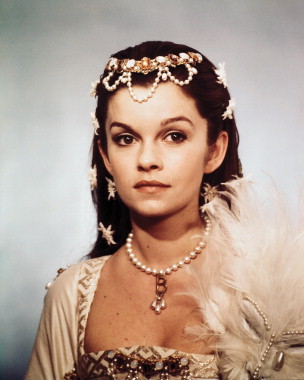
Claire Ridgway over at The Anne Boleyn Files posts a fascinating article on the presents Anne both gave to and received from King Henry VIII. Anne (above played by Quebecois actress Geneviève Bujold in the 1969 Oscar-winner Anne of the Thousand Days) was known to have a taste for the finer things in life. One of her favourite arguments in response to those who said such a love for materialism was incompatible with being a Christian was to quote a work of French theology, L'Ecclesiaste: "Should I say for all this that it is prohibited for to be merry and that Jesu Christ hath only chosen sturdy people: seeing that He Himself hath helped at feasts ... No surely!" 

As a young socialite, Anne had already acquired a reputation within the narrow world of the English upper-classes for the fine food and wines she served at her dinner parties, as well as the dances, gambling parties and hunting afternoons she organised. Dr. David Starkey writes that thanks to her childhood in France, she acquired "a gourmet's palette." She apparently did not eat very much, since she was very concerned to remain thin, but what she did eat seems to have been of an exceptionally high standard. Above all else, of course, Anne was famous for her sense of fashion - both as a debutante and in her early career as a lady-in-waiting to Katherine of Aragon, Anne was noted for being "the glass of fashion ... the most observed of all observers". When she became queen, she struck such a glamorous figure that even one of her bitterest enemies called her "the rose of state."

As Claire points out, giving presents at Christmas rather than during the Christmas festivities is a fairly recent phenomenon. England in the time of Henry VIII tended to function more like modern day Spain, in which the bulk of the presents were given in or on January 6th, the day which the Church usually celebrated as the anniversary of the visit of the Magi to the Infant Christ Child and the Holy Family in Bethlehem. When Anne became the King's wife-to-be, she suddenly found that she had a near-unlimited bank balance to finance her expensive tastes and Henry evidently took great pleasure in spoiling her. For example, when she was twenty-three, in the short period between Christmas and Saint Valentine's Day, Anne received a veritable treasure trove of jewels to mark the festive season, including: -

1. "Nineteen diamonds for her head" (Anne had a special fondness for weaving jewels through her long brown hair for balls or special occasions. As a virgin, she was still allowed to wear her hair down and uncovered in public. Only queens were allowed to do the same after they were married.)

2. Two bracelets each crafted from ten diamonds and eight pearls

3. Nineteen diamonds set in "trueloves of crown gold"

Sunday, 19 December 2010

Discovery of King Henri's skull


At the height of the French Revolution, the royal tombs of France were desecrated, violated and their contents scattered to the four winds in an excess of urban unrest. In the square outside the Basilica of Saint Denis in Paris, the skulls of the dead kings and queens were used as footballs or target practise by the revolutionary mob. Most were never recovered and to this day most of the magnificent restored tombs in Saint Denis are empty shells. 

Now, it seems that the skull belonging to the founding sovereign of the Bourbon dynasty, whose rule was overthrown in the Revolution of 1789 - 1792, has been discovered. King Henri IV, who ruled France from 1589 until 1610, unified the kingdoms of France and Navarre, as well as bringing about an end to the destructive Wars of Religion. He was (and to some extent still is) a popular monarch, whose assassination by a deranged religious fanatic in 1610 plunged the nation into mourning and political crisis. He was succeeded by his young son, Louis XIII, although practical power was held by his mother, Marie de Medici. 

The story of Henri IV's skull is a fascinating one. After being stolen during the ransacking of the cathedral, Henri's alleged skull somehow ended up in the possession of a Parisian tax collector, where it has remained since 1955. (Its exact whereabouts between 1789 and 1955 are still somewhat shady.) A team of nineteen scientists has, however, concluded beyond reasonable doubt that it is indeed the skull of King Henri IV and that the marks made by the dagger during the frenzied assassination can still be seen.

In a rather touching and appropriate gesture, the scientific team decided not to hand the monarch's head over to the current French government, but rather to entrust it to the King's closest living descendant - His Royal Highness Prince Louis de Bourbon, Duc d'Anjou (right). His Royal Highness described the moment as "very emotional" and stated that whilst he hoped to return the skull to its original resting place at the basilica of Saint Denis, where it can rest alongside the remains of Louis XVI and Marie-Antoinette, he is aware that as a claimant to the French throne he may not be able to persuade the current French republican government. The prince says that is profoundly aware of the "familial and moral" obligation he now has to find Henri IV a proper resting place. 

At the time of his assassination, King Henri IV was survived by both of his wives. His ex-wife, a glamorous and delightfully badly-behaved princess, known popularly as "La Reine Margot," and his current queen, an Italian aristocrat Marie de Medici. His legitimate children (all from his second marriage) included the new king, Louis XIII, who reigned from 1610 to 1643, his rebellious younger brother Gaston, and their three sisters - Elisabeth, Christine and Henrietta-Maria. The lovely Elisabeth became Queen of Spain through her marriage to King Philip IV, five years after her father's murder; the elegant but temperamental Christine married Vittore-Amadeo, Duke of Savoy and had five children and the youngest, Henrietta-Maria, married King Charles I of Britain and became the mother of two future British kings, Charles II and James II. 

For The Guardian's report on the hunt for Henri IV's skull, click here

Sunday, 12 December 2010

Faith, Reason and the Virgin Birth


".... There is much confusion as to the precise meaning of the Virgin Birth.  It is not to be confused with the Virginal Conception of Our Lord.   The Church, from the earliest times, has articulated the Perpetual Virginity of Our Lady as pertaining to three distinct moments:  before the birth of Jesus (ante partum), during the birth of Jesus (in partu), and after birth of Jesus (post partum).  Virtually every time the magisterium has spoken on the subject, this threefold distinction is made.  This teaching is derived from the early fathers of the Church, who maintained, defended and made the teaching a universally held truth..."

Via Tea at Trianon comes a defence of the perpetual virginity of the Blessed Virgin Mary and, in particular, the full meaning and theological relevance of the Virgin Birth.  
Related Posts with Thumbnails