Showing posts with label Fabulous. Show all posts

Saturday, 1 October 2011

My interview in THE IRISH TIMES


My interview with THE SUNDAY TIMES was published in July 2011. The interview is by Pavel Barter, the photograph by Kelvin Boyes.

"A BOY WHO'S DOWN WITH THE MEAN GIRLS"

Friends trashed his idea for a bitchy teen-fiction novel set in Belfast, but Gareth Russell's savagely witty debut wins out in the popularity stakes, says Pavel Barter.

When Gareth Russell said he wanted to write a novel about wealthy high-school kids in Belfast, everyone told him to wise up. Spoilt debutantes, popping into Victoria Square shopping centre for a spot of retail therapy, getting manicures, wearing Ralph Lauren, and sipping martinis at high-society functions? Not images you associate with Belfast.

The negativity bothered him. "Parents of friends told me that nobody would ever publish a book about being popular or a socialite set in Belfast," he says. "If it's not about the potato famine, the Titanic or the Troubles, no one cares. I thought, 'We'll see.' There is so much more to Belfast than  lot of literature and cinema has shown. It was great to set a comedy here. You can have craic in Belfast that you couldn't in New York, Miami, London or LA."

So Russell ignored the naysayers and the setting proved ideal. Popular, the 24-year-old's debut, is set in the fictional Mount Olivet Grammar School, on Belfast's Malone Park, a real-life private avenue. Sitting in the bar of the Europa hotel, the writer takes a gulp of Evian, and wonders if he should send the city's upwardly mobile princesses a thank-you note for providing his inspiration.

Cliques are commonplace in Northern Irish schools, Russell explains. An Oxford graduate, he is co-directing a stage adaptation for Belfast's Belvoir Players Studio, to be staged in early September. The cast includes Imogen ("the hot one"), Kerry ("she has Daddy's credit card") and queen bee, Meredith ("the one who'll kill you as you sleep"). With their token male pal Cameron, these filthy-rich beauty queens undergo rivalries, tantrums and faux emotional breakdowns. Popularity is considered the key to happiness; weakness is preyed upon. It's a ruthless social hierarchy, similar to prison, only with Marie Antoinette-themed parties and Gucci handbags.

In most high-school movies, prom queens are either villains or a plot device to teach the protagonist the error of her ways. This was the case in Mean Girls, which starred Lindsay Lohan, while in Clueless and The Breakfast Club the rich girls are vain yet good-natured at heart. In Popular, on the other hand, the characters are unrepentantly egotistical and superficial, owing more to reality fares such as The Hills, Perez Hilton blogs and Paris Hilton.


Russell has an affection for his characters, but understands if the reader loathes them. "There are times when I'm talking about the characters and people look at me with horror," he laughs. "Meredith and Imogen have their own fans, which, in a way, is a devastating reflection on [today's] morality."

His characters were created as a reaction to the political correctness that has crept into high-school fiction. "Glee went further down the line of feeling it had to tick every box," he says. "I wanted to write someone like Meredith who could say the things a lot of us secretly wish we could get away with. She's not particularly interested in what boys think of her. Meredith is much more interested in what girls think of her. She is a woman's woman."

Russell was inspired to create such an unapologetically savage character after reading a Julie Burchill article in which the journalist mourned the passing of the classic Hollywood bitch. "One of my favourite books is Gone with the Wind. You're not supposed to like Scarlett O'Hara at all because she's a husband-stealing, gold-digging, social-climbing hound," he says.

What Popular lacks in redeemable characters, it makes up for in humour. The writer excels at capturing the ability of teenagers to coin expressions and venomous put-downs. Case in point: "I hate her hair... It looks like someone stuck pubic hair on top of a potato." Popular's characters are routinely cruel, but the writer insists there is a difference between bitchiness and being a bully. It's also one of the few Irish teen novels to deal with gay themes, in the form of Cameron's awakening homosexuality.

Some of the incidences in Popular are gleaned from Russell's own experiences as a student in Downpatrick, but the story is not entirely autobiographical. It's as much influence by his history studies at Oxford University and his interest in Tudor history; Anne Boleyn, the second wife of Henry VIII, in particular. "There is a steel-butterfly element to her personality that I warm to," says Russell "In a strange way, she influenced Popular [by being] a good example of you can be bitchy without being evil. I liked the pageantry [of the Tudors] and their self-awareness. They knew everyone was watching them. They believed God was watching them. I found that an interesting idea: how would you live if you thought you were being watched all the time? It's Big Brother, with a change of purgatory at the end. It was a cauldron of big personalities and a society that valued outward appearance more than anything else."

At Oxford, Russell directed and wrote plays, including The Audacity of Ideas, set on the eve of the French Revolution. This experience spurred him to pen Popular after he graduated in 2008. The author received 17 rejection letters from agents before he hit gold. Penguin signed him for two books, and he hopes to write a third.

Russell plans to write a biography of Boleyn in a few years' time. "There is a popular version of her as the femme fatale, and a more recent academic trend to see her as incredibly political, like a 16th-century Margaret Thatcher. I don't think that's something she would have recognised. I'm trying to focus more on her position as a daughter of the aristocracy who had been trained to be pleasing, quick-witted, elegant, charming, but I don't think she was a social climber or a rabid politico."

There is a tactical decision to writing Popular now. The memories are fresh and a few years from now his insights may no longer be relevant. The unrepentant narcissism of these characters still feels like a stumbling block, however. Is there any merit in this lifestyle for teenagers? "It's totally vacuous," he admits. And is popularity really all that important? "No." He takes another sip of water. "In the grand scheme of things, the core clique in Popular are not going to damage your health. They're not promoting drugs or rampant sex [but] the scars they might leave on your confidence are another thing."

Bret Easton Ellis wrote his first book, Less Than Zero, about a similarly spoilt and cloistered gang. It became a grim tale of prostitution, drug addiction and snuff movies. Russell wants to keep a comedic tone - this is fiction for young adults - but plans on visiting darker places in the sequel. "Yes, there's the vacuousness, fabulousness and frivolity, but you have to acknowledge that schemes, rules and intrigues will eventually take their toll on the people doing them," he says.

"Nobody can control gossip. It's a liberated demon. There's no way that you can write a high-school book and not show that sometimes it can turn into the most awful experience imaginable."

Popular is out now from Penguin. 
British and European customers can purchase it here.
Australian readers can purchase here. Borders New Zealand also sells Popular.
Canadian and American readers can purchase here.
South African readers can purchase here.


Thursday, 9 June 2011

An article on "Popular"


Over on my other blog, actress Emerald Fennell (seen above in her role as 1930s aristocrat Lottie Mountstuart in the recent British television drama Any Human Heart), writes a very kind and very funny article about my novel Popular, which will be published in the UK and Ireland on July 7th this year, then in South Africa (August 1st), Canada (August 23rd) and Australia and New Zealand (August 29th.) 

Click here to read Emerald's full article and I hope you enjoy it!

"When Gareth gave me the first draft of Popular, I was in the middle of my university exams and supposed to be reading Chaucer’s Troilus and Criseyde, a grim task that I had already been putting off for months. I told myself that I would quickly read the first chapter of Gareth’s book and then get down to some serious study. That serious study never happened. I was completely gripped, and read the whole thing in one sitting, laughing like a lunatic and compulsively turning the pages. My degree almost certainly suffered, but unfortunately Chaucer didn’t stand a chance in the fight against Meredith and her friends: they kicked him in the crotch, called him a smelly peasant and sent him hobbling back to the fourteenth century."

Monday, 7 March 2011

Marie-Antoinette, Queen of Mardi Gras

"Although Carnival did amuse me a great deal, I agree that it was time it was ended. We are now back to our usual routine....It is true that I take some care of the way I dress; and, as for feathers, everyone wears them, and it would be extraordinary not to wear them. Their height has been much curtailed since the end of the balls...."
 - A letter from Marie-Antoinette (aged 19) to her mother, the Empress, in the aftermath of Mardi Gras, 1775


As a young woman, Marie-Antoinette was well-known for her love of parties and the exhausting social whirl of life in French high society. At the age of nineteen, the young queen was able to experience the joys of Mardi Gras in Paris for the first time, where she and her coterie of like-minded friends had already come to be regarded as a sort of "it" crowd for their generation. At least, for the time being. Marie-Antoinette's mother, the Empress Maria-Teresa, disapproved of her daughter's hectic social life and love of fashion and, indeed, Maria-Teresa seemed to disapprove on principal with anything that caused Marie-Antoinette joy outside of a chapel. Or the still-empty nursery, of course. Any time spent by Marie-Antoinette away from trying to have a baby as soon as possible was, as far as Maria-Teresa was concerned, practically insulting.

However, it would be wrong to paint Marie-Antoinette as a frivolous and graceless bimbo, eschewing responsibility to prance across the Parisian party stage like a stumbling, self-obsessed dilettante. My friend Coco's mother, Deonne, has a wonderful saying: "True class is making other people feel comfortable." And that is a gift that Marie-Antoinette had in abundance. She spent much of her time during Mardi Gras and the balls, festivals, banquets, firework displays and festivities thrown in Paris and at Versailles checking to see that her husband and guests were enjoying themselves.

After Mardi Gras, of course, came the beginning of Lent and it was a season of renunciation taken very seriously at Versailles, particularly by Louis XVI, who was very devout. Having been raised in a strongly Roman Catholic environment as a child, Marie-Antoinette was also scrupulous in observing the dietary and devotional laws mandated for Lent by her priests and confessors and although it was not until later in her life, when she was in her thirties and had become a mother, that she was to become truly devout, she was always a faithful Catholic, even in her younger days.

Novelist Elena Maria Vidal, the author of the novel Trianon based on Louis and Marie-Antoinette's marriage,  (you can read my review of Trianon here), profiles the young queen's love of the Carnival season. 

Above: American actress Norma Shearer in her Oscar-nominated role in Marie Antoinette (1938)

Tuesday, 28 December 2010

Entertainer of the Year

A wonderful friend of mine has been nominated for the Entertainer of the Year award, which I've written about on my other blog. 

Thursday, 23 December 2010

Anne Boleyn's Christmas presents

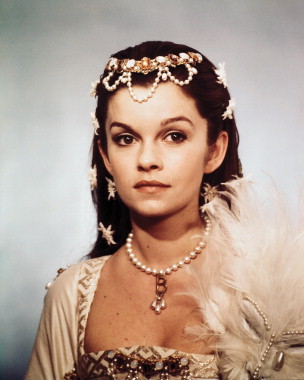
Claire Ridgway over at The Anne Boleyn Files posts a fascinating article on the presents Anne both gave to and received from King Henry VIII. Anne (above played by Quebecois actress Geneviève Bujold in the 1969 Oscar-winner Anne of the Thousand Days) was known to have a taste for the finer things in life. One of her favourite arguments in response to those who said such a love for materialism was incompatible with being a Christian was to quote a work of French theology, L'Ecclesiaste: "Should I say for all this that it is prohibited for to be merry and that Jesu Christ hath only chosen sturdy people: seeing that He Himself hath helped at feasts ... No surely!" 

As a young socialite, Anne had already acquired a reputation within the narrow world of the English upper-classes for the fine food and wines she served at her dinner parties, as well as the dances, gambling parties and hunting afternoons she organised. Dr. David Starkey writes that thanks to her childhood in France, she acquired "a gourmet's palette." She apparently did not eat very much, since she was very concerned to remain thin, but what she did eat seems to have been of an exceptionally high standard. Above all else, of course, Anne was famous for her sense of fashion - both as a debutante and in her early career as a lady-in-waiting to Katherine of Aragon, Anne was noted for being "the glass of fashion ... the most observed of all observers". When she became queen, she struck such a glamorous figure that even one of her bitterest enemies called her "the rose of state."

As Claire points out, giving presents at Christmas rather than during the Christmas festivities is a fairly recent phenomenon. England in the time of Henry VIII tended to function more like modern day Spain, in which the bulk of the presents were given in or on January 6th, the day which the Church usually celebrated as the anniversary of the visit of the Magi to the Infant Christ Child and the Holy Family in Bethlehem. When Anne became the King's wife-to-be, she suddenly found that she had a near-unlimited bank balance to finance her expensive tastes and Henry evidently took great pleasure in spoiling her. For example, when she was twenty-three, in the short period between Christmas and Saint Valentine's Day, Anne received a veritable treasure trove of jewels to mark the festive season, including: -

1. "Nineteen diamonds for her head" (Anne had a special fondness for weaving jewels through her long brown hair for balls or special occasions. As a virgin, she was still allowed to wear her hair down and uncovered in public. Only queens were allowed to do the same after they were married.)

2. Two bracelets each crafted from ten diamonds and eight pearls

3. Nineteen diamonds set in "trueloves of crown gold"

Friday, 10 December 2010

December 9th, 1793: The Death of Gabrielle de Polignac


'Who is this? And what is here?
And in the lighted palace near
Died the sound of royal cheer;
And they crossed themselves for fear,
All the Knights at Camelot;
But Lancelot mused a little space
He said, "She has a lovely face;
God in His mercy lend her grace,
The Lady of Shalott."'
- Alfred, Lord Tennyson

Illustration above: An anonymous royalist pamphlet from 1793, showing the Angel of Death inscribing a monument to the Duchesse de Polignac


On December 9th, 1793, one of the last and the most exquisite of the ancien régime's socialites, Gabrielle, Duchesse de Polignac, died in exile in Vienna, less than two months after the execution of her friend and patroness, Queen Marie-Antoinette. She had been ailing for some time, although what precisely caused her death is still something of a mystery. In his 1974 biography Louis and Antoinette, Vincent Cronin wrote "Gabrielle de Polignac contracted a sudden illness in December 1793 and was dead within twelve hours". It may be that the duchess's death was hastened by a sudden infection caught in the depths of the Austrian winter, but it seems clear to me from my own research that for quite a few years prior to her death, Madame de Polignac had not been in good health. Her young and pretty daughter wrote in a letter to one of her mother's many English friends that since the news of the Queen's execution in October it had been possible to see Death written all over Gabrielle's face. The former court painter, Madame Le Brun, living nearby, wrote that in the final months of her life Gabrielle's "still lovely" face had been drained of its colour by the combined effects of sorrow and illness. Lady Antonia Fraser, author of Marie Antoinette: The Journey surmises that the cause of La Belle Gabrielle's death may therefore have been terminal cancer, exacerbated by suffering. At the time, others suggested it may have been consumption (tuberculosis.)

Having written Gabrielle in as one of the major characters in my play The Audacity of Ideas, set at Versailles on the eve of the Revolution of 1789, I have grappled with what killed her. I would like to quote from my author's note for that play and also show the scene in which Gabrielle is informed by the court physician, Dr. Lassonne, about her condition - four years prior to her death. No disclaimer is needed for the educated, but it is always worth bearing in mind that the scene between the duchess and the doctor is, of course, fictional.

At the time of her death, Gabrielle was survived by her husband, Jules, her daughter and her three sons - Jules (the future Prime Minister of France), Armand and Camille. Today, Gabrielle's descendants sit on the throne of Monaco.

Saturday, 6 November 2010

"Any Human Heart" (2010)

I'm so excited to be able to post a link to Channel 4's new television series, Any Human Heart, an adaptation of the bestselling and award winning novel by William Boyd, which has one of my favourite people, Emerald Fennell, amongst its glitteringly delightful cast. Very exciting. 

Emerald and I first met at Oxford just before Christmas of 2006, when I was directing my second student play and she auditioned, as one of 83 girls competing for the three main roles in my favourite play, Cat on a Hot Tin Roof. We got to speak properly for the first time at the call-backs, when I accidentally scheduled the next auditionee an hour after Emerald's audition ended. So, we stayed and chatted for a while and I was heartily relieved that, at last, someone told me that my neurotic fear of flying was more than justified. It's not how often it happens, but how bad it will be when it happens. Even worse if the plane nose dives, then rights itself, and you're the person who wet yourself mid-plummet and have to live with that shame for the rest of the flight. True words. Perhaps some of my favourite memories of our time in Oxford include us, bedraggled and exhausted sitting, without shame, with various 18th century costumes and props slung over our arms as we waited for a post-rehearsal supper table to open up at the Chiang Mai restaurant. Good times. Less endearingly, on my part, there was an incident during a rehearsal for Dangerous Liaisons in a music room at Worcester College, when I - very tired and stressed with the dress rehearsal approaching - was interrupted by someone banging away on a defunct drum kit behind me. For some reason, I assumed it was my friend Johnny Rhodes, so I spun round in high fury and snapped, "Johnny, for f***'s sake! What are you doing?" Only to discover that it was Emerald on said drums; at which point, my demeanour changed entirely and I beamed, "Oh, it's you, Emmy. Well done." Johnny meanwhile, from the far corner of the room, glowered with seething fury from behind his 18th century valet's attire.

The novel Any Human Heart - published by Penguin - is written like a diary or a collection of papers and it follows the life of a fictitious author and art expert, Logan Montstuart, through his existence in the English upper-classes for most of the 20th century. Educated at Oxford in the years between the two world wars, Logan marries into the aristocracy - his wife Lottie (played by Emerald) is the daughter of an earl. However, life is not exactly plain sailing and the story of Any Human Heart chronicles Logan's misadventures across the British Empire as it enters its twilight, his interaction with the ex-King, Edward VIII and his social-climbing American wife, Wallis Simpson, Duchess of Windsor (played by X Files and Bleak House alum, Gillian Anderson), and his life in America and France in the later half of the 20th century. 

It's a fantastic book with a wonderful cast for the adaptation, which was written by William Boyd. It will be broadcast later this year by Channel 4, in four 2-hour segments. So do look out for it! Amongst the cast are Oscar winner Jim Broadbent as the elderly Logan, with Pirates of the Caribbean 4's Sam Claflin and Pride and Prejudice's Matthew Macfadyen playing the younger versions; joining them, apart from Emerald, are Brideshead Revisited's Hayley Atwell, Sex and the City's Kim Cattrall, Tom Hollander as Edward VIII, Gillian Anderson and The West Wing's Richard Schiff. 

I'm obviously hugely excited about this, especially since it seems absolutely no time at all since I was directing Emerald in a student production of Cat on a Hot Tin Roof and Dangerous Liaisons. And giving her the first three chapters of Popular which I had written, to see if she thought they were any good. I'm obviously incredibly grateful for the feedback I received right after she had finished reading them. Johnny, on the other hand, failed to read them at all and got away with saying, "Yeah, yeah, I loved the party in Chapter ...." And inserted any number he could think of. A clever strategy which worked until he accidentally hit upon the one chapter in the book sans party.

It's incredibly exciting that Any Human Heart is finished and I can't wait to see it.

The trailer for Any Human Heart can be watched here.

Sunday, 24 October 2010

"Popular" character profile: Catherine

Over at my book blog, I have started profiling in-depth the main characters of Popular, my first novel which will be released in the UK on July 7th, 2011.

The first character to be profiled is nice but dim popular girl, Catherine O'Rourke, the 16 year-old daughter of a local property developer, who is still desperate to cling onto her position in the school's elite.

Monday, 11 October 2010

Fit for a Queen

The blog Marie Antoinette's Gossip Guide to the 18th Century is hosting a rather fun video, celebrating the legendary wardrobe of the last Queen of France and her contemporaries.

The dress above is one of the cumbersome but magnificent gowns required by Versailles etiquette to be worn by the great ladies of the Court on formal occasions of State. Marie-Antoinette was not a fan of this particular style of dress, but she made the best of it by employing the talents of her famed dress-maker, stylist and so-called "Minister of Fashion," Madame Rose Bertin, who American Vogue credited with inventing the entire concept of haute couture in their September 2006 issue.

The personal style of Marie-Antoinette and her confidantes is something often misrepresented. Like earlier queens, such as Anne Boleyn and Henrietta-Maria, Marie-Antoinette was genuinely interested in fashion for fashion's sake - she enjoyed the touch and sight of gorgeous fabrics and daring, fashion-forward gowns. Unlike other sovereigns, such as Elizabeth I or Louis XIV, the Queen did not enjoy dressing for the sake of grandeur or political display. Her decision, in the 1780s, to patronise the movement for simpler, elegant lawn dresses was one of her more controversial, but is also indicates that the Queen preferred style to splendour and innovation to tradition when it came to fashion.

Perhaps unsurprisingly, given her own obsession with fashion and her appreciation of the power of aesthetics, Marie-Antoinette's set was known for being a fairly fashionable one. Her brother-in-law, the Comte d'Artois, was generally considered to be the best-dressed man in France, while several of the Queen's ladies-in-waiting were praised for their sense of style - the imperious but entertaining Princesse d'Hénin, a friend of the Comte d'Artois', had a preference for sophisticated and generally fairly conservative cuts in clothing; the pretty Thérèse-Lucy de Dillon, married to the Governor of Tobago and chatelaine of a beautiful townhouse on the rue du Bac, generally followed where the Queen led, but her love of the latest fashion and complimentary, highly-feminine styles were commented upon with approval by many of the courtiers at Versailles.

Amongst the Queen's extended circle, perhaps the most adventurous dresser was Victoire, the Princesse de Guéménée, wife of one of the highest-ranking aristocrats in the kingdom and related by blood to another of the nation's "first families." Victoire was noted for the general fabulousness of her lifestyle, her extravagant parties, her sophisticated manners, her luxurious homes, her gambling addiction, her financial recklessness, her love for her pet dogs and her dazzlingly decadent dress-sense. Madame de Guéménée dressed in the most lavish and ostentatious style, which so many of us associate in our heads with the last days of the ancien régime in France. Perhaps unsurprisingly, Madame and her husband were the only French aristocrats in the entire century who actually faced bankruptcy - a financial scandal which rocked the nobility and titillated the gossips of Paris and Versailles for months to come. The Queen, who was not particularly close to Madame but enjoyed her parties, arranged for a loan to be given to the couple to spare them the humiliation of debtors' prison, but the Guéménées were still forced to quit the capital for awhile, in order to live-down the disgrace of their bankruptcy.


Perhaps the keenest of the Versailles fashionistas, after the Queen herself, was her friend and Superintendent of her Household, the Princesse de Lamballe. A pretty society widow, the Princesse was not only one of the highest-ranking women in France as a Princess of the Blood, but also one of its wealthiest, thanks to the enormous fortune she had inherited when her young but immoral husband died at the age of twenty from advanced syphilis, leaving her everything but an infection. Mercifully, Madame de Lamballe had avoided contracting venereal disease, since her husband had quit his wife's bed for that of a dancer, Mademoiselle Chassaign, shortly after the wedding. That the Lamballe marriage had been abusive had long been whispered in the corridors of Versailles and with the inheritance received from her husband, it was cruelly (but accurately) reported that the prince had given his wife far greater pleasure in death than he ever had in life. Deeply religious, morally upstanding, highly sentimental, emotional and lady-like, Madame de Lamballe showed no wish to re-marry and instead used her vast fortune to give generously to her favourite charities and to maintain an extravagant yet elegant life as one of the French aristocracy's premier socialites. She kept two large homes - her town-house of the Hôtel de Toulouse (where the recent film Marie-Antoinette starring Kirsten Dunst was partially filmed; Madame's home was used to film the scenes of Marie-Antoinette's youth in Vienna) and her beautiful country house of the Château de Rambouillet (above left.)


Sunday, 26 September 2010

"In a true democracy, everyone can be upper class and live in Connecticut": Has the Preppy Era gone too far?


Thirty years after the publication of Lisa Birnbach's The Official Preppy Handbook, Eric Felten wonders if the culture of preppiness has actually been harmful to America's middle- and upper-classes? I think he may be overstating the case slightly, but it's well-written and it does point out that what was perhaps intended as satire suddenly became a bible for those who wish their lives were like something out of a Cecily von Ziegesar novel.

Via Tea at Trianon, to quote: -


The clothes may have been the most visible part of the preppy phenomenon, but they represented only a small part of the upper-class way of life Ms. Birnbach was championing (however cheerfully sly and subversive her advocacy may have been). Much of the book was devoted to a world-view that was casually aristocratic. Ms. Birnbach promised to make that outlook available to one and all. "In a true democracy," she wrote, "everyone can be upper class and live in Connecticut."

How could the suburban teenager from Peoria or Pomona all of sudden be "upper class"? It was less a matter of pink oxford cloth and Kelly-green poplin than of adopting an aristocratic lassitude, an attitude that exuded privilege by treating effort with contempt. One simply mustn't try too hard. A key principle of what Ms. Birnbach called the Preppy Value System was Effortlessness: "If life is a country club, then all functions should be free from strain."

There's no denying the seductive appeal of the old aristocratic disdain for those who strive. How much nicer (and, of course, easier) it is to adopt a blasé and boozy contempt for the grinds and geeks who put in effort than it is to compete with them. The original Handbook warned acolytes not to waste their college days studying "Professional majors" such as engineering, chemistry or mathematics, because they "all reek of practicality." Nor, we were told, did the preppy go for intellectually demanding subjects such as philosophy or linguistics because, "they smack of an equally undesirable effort."

And there's the rub. Unless you actually have a fat trust fund to underwrite your nonchalance, an aversion to effort is hardly a strategy for success. Which may explain some of our national woes.

Monday, 13 September 2010

"Elvis, Chatsworth, JFK and Me:" An Interview with Deborah Mitford


In light of the release of her memoirs, Wait for Me!, The Daily Telegraph writes a wonderful and very entertaining profile of Deborah Mitford, Dowager Duchess of Devonshire. There are certain quotes in the article, which remind me why I find the Mitfords' style so inimitably delicious and hilarious. There are also moments of great triumph in diversity, downplayed in a very old "stiff upper lip" kind of way - the quarter of a century it took her and her husband to pay of the Death Tax levied upon them, the deaths of three of her children and the Duke's battle with alcoholism.

***

Debo, as everyone calls her, was 90 this year. Having greeted me in her pretty garden, shaking my hand and looking me directly in the eye, she leads me into the apple-green-walled and flagstone-floored hall – 'Do put your bags down, no burglars here' – and shows me into her sitting-room, which has an extraordinarily nice atmosphere, and we take to the floral sofa, where she positively lounges, looking at me brightly, waiting to be amused.

There have been countless books about the Mitfords, both biographical and autobiographical, and now her own memoirs, Wait for Me!, are about to be published. (She has written several books, mostly about Chatsworth, her former home.)

Friday, 10 September 2010

"The Queen of Maryland"

Historical novelist, Elena Maria Vidal, profiles the life of Henrietta-Maria of France, Queen of England, Scotland and Ireland, wife of King Charles I and mother of Kings Charles II and James II. The daughter of King Henri IV of France and his second wife, Marie de Medici, Henrietta-Maria married the new King of England in 1625 and remained by his side until the traumas of the Civil War, which took her husband's life. It was in the Queen's honour that the future American state of Maryland, Elena Maria's home State, was named.

"In the lone tent, waiting for victory,  
She stands with eyes marred by the mists of pain,
Like some wan lily overdrenched with rain:
The clamorous clang of arms, the ensanguined sky,
War's ruin, and the wreck of chivalry
To her proud soul no common fear can bring:
Bravely she tarrieth for her Lord the King,
Her soul a-flame with passionate ecstasy."
From Henrietta Maria by Oscar Wilde

Thursday, 1 July 2010

Anne Boleyn: A Talent for Obsession


Claire at The Anne Boleyn Files runs a very interesting article, based on the recent opinion piece by British playwright, Howard Brenton, discussing Anne Boleyn's curious ability to inspire obsession in people, even five hundred years after her terrible death.

"Today there is a fast-growing Anne Boleyn cult. She appeals both to adolescents and to ageing romantics. Her story has a Wagnerian intensity of love, death and betrayal, shot through with a very un-Wagnerian sense of reckless fun, of daring sexiness. But there is a deeper reason for the growing obsession with her. The flowers acknowledge an unease; we love her story but feel guilty toward her. I think I've understood why and it's made me a paid-up cult member."

Sunday, 30 May 2010

The Mitfords and Marie-Antoinette


The Mitford girls have to rank alongside the Boleyn sisters, the Lennox girls and the Brontës as amongst the most famous sibling units produced by the English upper-classes. Born between 1904 and 1920, the six sisters were the children of Tory country squire, Lord Redesdale, and his wife, Sydney, and each was to lead an extraordinary life and to capture the attention of high society and the tabloid press. Their lives have been immortalised on screen, on stage and in musicals, with their childhood being memorably lampooned by the scathing wit of the eldest sister in her fabulous best-selling novel, "The Pursuit of Love." One sister is today the personal heroine of J.K. Rowling, the creator of Harry Potter, another (the only still living, sadly) is the curatrix of one of the most splendid private homes of the British aristocracy and another is a regular player in inaccurate and wild conspiracy theories that Hitler had a secret love child. There was also a brother, Tom, born between Pamela and Diana, who had a school-time fling at Eton with the future acclaimed architect, writer and socialite, James Lee-Milne, before becoming something of a ladies' man and who was tragically killed on active service in Burma in 1945.

Wednesday, 26 May 2010

An Interview with the fabulous Laura Schwartz, author of "Eat, Drink and Succeed"

Below is an interview on American television with my wonderful, fabulous friend, Laura Schwartz, author of the new book "Eat, Drink and Succeed," which is a phenomenal book based on Laura's incredibly popular series of lectures about the importance of social networking - the does and the don'ts - and it bears out Laura's brilliant personal maxim that whilst a job is 9-5, a career is 24/7.

Laura and I first met when she was speaking at the Oxford Union and visiting the area for the first time. I offered to give her family a tour of the city and I'm pleased to say we all hit it off and have been friends ever since. A fantastic weekend with some fantastic people!

Apart from being incredibly fun and a very dear friend, who has been incredibly supportive about my own book, "Popular," which is due for release in the UK in February 2011, Laura is also intelligent, gracious and unbelievably good at what she does. This blog's American readers may recognise her from her articles which have appeared in the likes of the New York Times and USA Today, or her appearances on Fox News, MSNBC, Larry King, the CBS Early Show and the Lehrer News Hour. International readers may have seen her on BBC World News, Newsnight, GM:TV and Al Jazeera's Frost over the World, with Sir David Frost. Today, Laura is an author, a media personality and the creator of the events, media, political and message consultancy firm, White House Strategies, which is based in Chicago. She is also the veteran of three presidential campaigns in the US and she was the Midwest Press Secretary, then White House Director of Television and finally White House Director of Events and Special Assistant to the President of the United States, during the Clinton Administration. Check this interview out and there's a link below for those of you who are interested in Laura's amazing book, which I'll be reviewing on this blog in more depth very soon - but consider it a firm recommendation!


You can order "Eat, Drink and Succeed" from Amazon.com, here.
Related Posts with Thumbnails