Saturday, 30 April 2011

That time of year again


"Age cannot wither her, nor custom stale
Her infinite variety..." 
- Anthony and Cleopatra, Act II, Scene II

Last year, when this blog was still in its early days, I began a series of day-by-day accounts of the downfall of Anne Boleyn, beginning with her final public appearance as a free woman on May 1st and ending with her tragic execution on May 19th. 

I was absolutely blown away by the response of readers and the level of interest, not just on this blog, but on others too This year I will be re-posting links to the original articles from May 1st to May 19th, and commenting on the comments readers left, as well as anywhere where I think my research or opinion might have changed since last year.

I hope you enjoy them. If that's the right word!

Friday, 29 April 2011

Congratulations!


"Be who God meant you to be and you will set the world on fire."
- Saint Catherine of Siena, quoted in today's wedding sermon

In his commentary for the BBC on today's happy events, the historian Simon Schama, author of A History of Britain and Citizens: A Chronicle of the French Revolution, himself a one-time socialist, remarked that in the midst of a zeitgeist which holds that this is a generation which does not value tradition or sentiment, the Royal Wedding was a grand refutation of that theory. As one million people surged down the Mall towards Buckingham Palace to cheer the couple's first appearance on the balcony, Schama stated the obvious when he said that the idea that this is a totally cynical generation obsessed with the individual must take something of a battering today. He also, thankfully, took a swipe at those who claim such outpourings of public sentiment are childish or naive, saying that it is a celebration of community, of nationhood and of sentiment. And that's a good thing.

As a family, we got up this morning at seven to watch the BBC's coverage of the event, beginning at eight. Shortly after the broadcast started, the news was broken that Her Majesty The Queen had bestowed on her grandson a title from each of the three peerages in the monarchy - England, Scotland and (northern) Ireland. His Royal Highness was to become Duke of Cambridge, Earl of Strathearn and Baron Carrickfergus and I will be blogging on the historical background of those three titles later. For us, it was a wonderful moment to see the Prince getting married in the uniform of the Irish Guard which, of course, his late great-grandmother Queen Elizabeth the Queen Mother had such a strong association with and which he himself is Colonel-in-Chief of. 

It was an absolutely wonderful day for all of us watching. It made me proud to be British and proud to be a monarchist. Without sounding too smug or triumphalist, I don't think there is another country in the world whose government could have commanded scenes like today. One million people surging calmly and happily down the Mall, having queued in some cases for days to be a part of today's historical events. It's just wonderful and I can't wait for next year's celebration of the Queen's Diamond Jubilee! I remember watching the Golden back in 2002 and promising that I would be there with my friends and the people I loved in 2012 to celebrate. Apart from anything else, it was so much fun and it's great to have days like this. The royal couple are so obviously in love and the smiles they shared, as well as the giggle from the new Duchess of Cambridge after her second kiss, was great to watch. I really enjoyed myself. The coverage was excellent and some of the interviews with the assembled crowd were by turns moving and hilarious. 

Wearing a tiara loaned to her by the Queen and carrying a bouquet of forget-me-nots which she will lay on the tomb of the Unknown Warrior later today, Princess Catherine looked timelessly elegant in her Sarah Burton-designed wedding gown. The music was magnificent and it was touching to see on the parade's return to the Palace that every time her husband, who is a member of the Armed Forces, saluted his comrades, the Princess bowed her head in respect. The couple repeated this action when they passed the Cenotaph memorial to the Glorious Dead and they saluted men and women who died in the defence of the nation. Seeing the Prince and Princess's actions, I was reminded of only a few months ago of the actions of others - when rioters swung from the memorial's flags. 


When the Queen returned from Westminster Abbey (where I thought the Bishop of London delivered a fantastic sermon), she turned to one of the footmen and said happily, "It's amazing." And, in more ways than one, it is. After all the smug criticism and the repeated carping in the press and from armchair intellectuals of "the tarnished crown," after years of being told that republicanism is a self-evident truth and anyone who is a royalist is either a snob or an idiot, it is amazing to find that people don't actually believe everything they're told. Billions tuned in from all over the globe to celebrate and millions thronged the capital city in a display of public happiness that you quite simply couldn't get from another political system. Proud, happy, fun - just a great, great day. Which I hope everyone reading this enjoyed too.

To Their Royal Highnesses, a very happy day and many congratulations. The love and affection between them was quiet but obvious. This was a wonderful moment and I am very happy.


Wednesday, 27 April 2011

The Sixth Catherine


On Friday, Catherine Middleton will be marrying into the British Royal Family and one day, God willing, becoming our country's queen consort and the sixth to be called Catherine. I have already blogged a little about this on my Popular blog, but I thought I would post some information here on the five other Queen Catherines in British history. And to wish everyone a great royal wedding day!


Catherine de Valois (1401 - 1437)
Queen of England 1420 - 1422

Wife of King Henry V and mother of King Henry VI

Married into the English Royal Family at the Cathedral of Saint Peter and Saint Paul in Troyes, France on June 3rd 1420


Parents: Charles VI, King of France and his queen, Isabeau of Bavaria-Ingolstadt

Born: Hôtel Saint-Pol, Paris, October 27th 1401

Died: In childbirth at Saint Saviour Abbey, London on January 3rd 1437

Buried: Westminster Abbey, London

Immortalised in Shakespeare's play Henry V, Catherine de Valois was a picture perfect medieval princess, with ivory white skin, long golden hair and delicate, beautiful features. Her marriage to King Henry V in 1420 symbolised the English military triumph over France, although it survived only marginally longer than Catherine's own marriage. She was left a widow at the age of twenty-one following her husband's death on military campaign and she was sidelined from affairs of state by the regency council set up to rule in the name of her infant son, Henry VI. Bored and lonely, the Queen Mother later eloped with a Welsh chamberlain, Owen Tudor, and by him had three more sons and became the grandmother of the first Tudor king, Henry VII. Tragically, the so-called "bride of peace" died at the age of thirty-six and, as the king's mother, she was buried in Westminster Abbey. In a macabre twist, her body was exhumed during the reign of King Charles II and found to be perfectly preserved, whereupon the famed diarist, Samuel Pepys, stole a kiss from the dead queen's lips.


Katherine of Aragon (1485 - 1536)

Queen of England 1509 - 1533

First wife of King Henry VIII and mother of Queen Mary I

Married into the English Royal Family twice. Her first husband was Arthur, Prince of Wales, who she married at Saint Paul's Cathedral, London, on November 14th, 1501.  She later married King Henry VIII at the Church of the Observant Franciscans in Greenwich on June 11th, 1509.

Parents: Ferdinand V, King of Aragon and his wife Isabella I, Queen of Castile

Born: The Episcopal Palace at Alcala de Henares, Spain, on December 16th, 1485.

Died: Kimbolton Castle on January 7th 1536 of cancer

Buried: Saint Peter's Cathedral in Peterborough, England.

Katherine of Aragon was a Spanish princess who won her subsequent fame for being the first of Henry VIII's six wives and for her heroic stance against his divorce of her in the 1530s. Originally married to his brother, who died during an outbreak of the plague in 1502, Katherine's marriage to Henry was initially opposed on these grounds by various conservative clergymen, despite the Vatican's dispensation of Old Testament Law. The marriage of Henry VIII and Katherine of Aragon was conventionally satisfactory by contemporary royal standards, with Katherine being well-equipped by both upbringing and personality to carry out the duties of a queen with dignity and confidence. A string of pregnancies ruined her figure and she was deeply humiliated when the King elevated his bastard son to the title of duke, which Katherine took as an insult to both her and her daughter, Princess Mary. She resisted Henry's attempts to divorce her in favour of Anne Boleyn - a stance which won her praise and condemnation in equal measure. She was praised for her tenacity and courage, but also later blamed for having allowed her attachment to her royal status blind her to the wider implications of her stance for the Catholic faith in England. A devout Roman Catholic, Katherine was horrified by her husband's break with Rome and the establishment of the independent Church of England. She was banished from court in 1531, stripped of her title in 1533 and she died with great dignity after an agonising battle with cancer in 1536.

For the death of Katherine's first husband, click HERE.
For Katherine's portrayal in movies and television, click HERE.
For an account of Katherine's own death in 1536, click HERE.


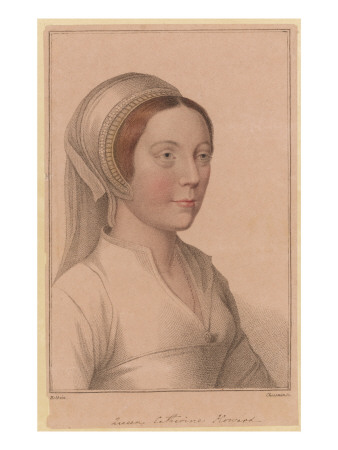
Catherine Howard (?1523 - 1542)
Queen of England 1540 - 1542

Fifth wife of King Henry VIII

Married into the English Royal Family at Oatlands Palace in Surrey on July 28th, 1540.


Parents: Lord Edmund Howard and his first wife, Lady Jocasta Howard (née Culpepper.)

Born: Sometime between 1522 and 1525 in southern England

Died: Executed in the Tower of London on February 13th, 1542

Buried: The Tower's chapel of Saint Peter-ad-Vincula

The eldest daughter of an impoverished aristocrat, Catherine was brought to court as a lady-in-waiting in 1539 through the patronage of her uncle, the Duke of Norfolk. Petite and flirtatious, she caught the attention of the middle-aged monarch almost immediately and he began making serious advances to her in the Easter of 1540. As soon as his divorce from his fourth queen was finalised that summer, he married Catherine in a private ceremony and immediately showered the young woman with gifts. Fun-loving and extravagant, Queen Catherine had no interest in politics, but her family had many enemies and when allegations concerning her private life surfaced in the autumn of 1541, those enemies capitalised on the scandal shamelessly. Allegations that Catherine had not been a virgin at the time of her marriage led to wider investigations and a letter discovered in the bedroom of the noted womaniser, Sir Thomas Culpepper, suggested that she had been unfaithful after the marriage too. Abandoned by friends and family, the poor girl was executed on a cold morning in February 1542.

For an account of Catherine's lavish fashion tastes, click HERE.
For the on screen portrayals of Catherine Howard, click HERE.
For an account of Catherine's execution in 1542, click HERE.


Katherine Parr (1512 - 1548)
Queen of England and Ireland 1543 - 1547

Sixth wife of King Henry VIII

Married into the English Royal Family at Hampton Court Palace on July 12th, 1543.

Parents: Sir Thomas Parr and his wife, Lady Maud Parr (née Green.)

Born: In 1512, probably in the south of England

Died: As a result of post-natal complications at Sudeley Castle on September 5th, 1548

Buried: Sudeley Castle Chapel

The daughter of two courtiers, Katherine was married twice before coming to court herself in 1543. Both marriages ended in widowhood but the Dowager Lady Latimer, as she was when Henry VIII began courting her, had a reputation for elegance, charm, intelligence and diplomacy. Despite this, her marriage to the King brought her many enemies, who despised her devotion to the Protestant faith. Her zeal in promoting evangelical theology almost lost her the King's favour and it was only by supplicating herself entirely to his will that she was able to survive the crisis. After Henry's death, she married again to the ambitious and seductive Lord High Admiral, Thomas Seymour, who broke her heart when he attempted to seduce (and possibly molest) her teenage stepdaughter, the future Queen Elizabeth. Pregnant with Seymour's child, Katherine died in childbirth at the age of thirty-six.

For Katherine's position as Queen of Ireland, click HERE.
For movie and television versions of Katherine, click HERE.
For an account of Katherine's death, click HERE.


Catherine of Braganza (1638 - 1705)
Queen of England, Scotland and Ireland 1662 - 1685

Wife of King Charles II

Married into the British Royal Family at the Church of Saint Thomas Becket in Portsmouth on May 22nd, 1662

Parents: João IV, King of Portugal and his queen, Maria-Luisa of Medina-Sidonia

BornVila Viçosa in Portugal on November 25th, 1638

DiedBelém Palace, Portugal on December 1st, 1705

BuriedThe Hieronymites Monastery, Belém, Portugal

Described by her mother-in-law, Queen Henrietta-Maria, as "a saint," Catherine was demure, gentle and devoutly Catholic. Her enormous dowry helped bolster the British Empire's expansion in India and she is credited with popularising the habit of drinking tea in England. However, her failure to produce a living child after four miscarriages led to calls from many courtiers and politicians for her to be set aside. This was something the King refused to do, despite his numerous public adulteries, which Catherine endured with great dignity. Despite her childlessness and his unfaithfulness, King Charles and Queen Catherine were relatively happy together and cared for one another deeply. She was faithful to him whilst he lived and to his memory after he died. Her quiet devotion to her Catholic faith led to her being targeted during the outburst of hysterical sectarianism known as the "Popish Plot," but as with the divorce crisis earlier in the reign, she weathered the drama gracefully. She may very well have been instrumental in helping with her husband's alleged deathbed conversion to Catholicism in 1685. The widowed Catherine returned to Portugal in 1692, after her religion again earned her public disapproval from the Protestant regime of William III and her niece, Mary II. Faced with the nervous breakdowns of her brother, King Pedro II, in 1701 and 1704, Catherine assumed the regency and lead the Portuguese government with great skill, despite having no formal political training. She was widely mourned when she died in 1705.

For an account of her husband's womanising, click HERE.

Sunday, 24 April 2011

Eva Perón: The Public Death of a Legend


The first sign that all was not well with Argentina's controversial First Lady came when she did not attend the Flag Day ceremonies in Buenos Aires on June 19th, 1952. When she failed to appear at any of the festivities for Argentina's Independence Day three weeks later, her millions of devoted followers began to get agitated. Initially, the government's doctors tried to downplay rumours that Evita was seriously ill and instead claimed that she was simply recovering from exhaustion. However, news that Evita had left Buenos Aires and was instead lying in a sickbed in the Quinta de Olivos, the presidential countryside palace, soon leaked to the press and by the end of the second week of July, Argentina was tottering on the edge of a communal nervous breakdown at the idea that the President's thirty three year-old wife might be about to die.

In Congress, fifty-nine politicians made impassioned speeches praising Evita's patriotism, her devotion to the cause of Peronism and her tireless care for the Argentine poor. Mafalda Piovano, a female politician recently elected to Congress thanks to Evita's campaign against male-only suffrage, collapsed during her speech and screamed out, "Oh God, we beseech you to return to Eva Perón the health she sacrificed to save us!" Then, Congresswoman Piovano fainted and by the time she had regained consciousness, the President of the Chamber, Hector Campora, was proposing that Congress bestow upon Evita the new title of "Spiritual Leader of the Nation." The motion passed.


Out in the streets, the reactions of Evita's followers - her beloved "descamisados" - was even more frenzied. It would be wrong to characterise their devotion to her as simply the displaced religious loyalty of simple peasants, dazzled and manipulated by Evita's beauty and glamour. Undoubtedly, there was an element of that; the story of Eva Perón is one of history's great rags-to-riches stories and to the Argentne working-classes there was something almost magical about the farmer's daughter from Junín who had become model, then movie star, then first lady. Always dressed in the height of fashion, for half a decade Evita was glamour personified for many of Argentina's disadvantaged. However, she was not just loved for her beauty and the Dior-stocked wardrobe she flaunted at every public appearance. She was also applauded for her role in supporting a woman's right to vote and, most importantly of all, for her work with the Eva Perón Foundation. Having commandeered the entire Argentinean social welfare programme during her husband's first term in office, Evita had transformed it into a charitable foundation with her name on it and then authorised one of the most extensive expansions of social welfare in modern history, despite a global recession. Capitalising on her own celebrity, Eva encouraged Peronists to donate generously to the foundation and even insisted that all employed workers give one day's wage to the foundation per calendar year. The money kept rolling in and with access to both the treasury and donations from her supporters, Evita had been able to turn the foundation into one of the biggest charitable enterprises in human history. Allegations that she was siphoning off funds to a secret Swiss bank account are almost certainly untrue and if money was deducted for expenses, it must have been tiny in comparison to what was being handed out. A more valid criticism was that the foundation was contributing to the national deficit and that Evita had become so completely convinced of her identity as saviour of the nation's poor that she was basically, and sometimes literally, throwing money at anyone who asked for it, in a wasteful, recession-bolstering display of government over-spending. For Evita, of course, none of this mattered. She wasn't an accountant, nor did she have any interest in anything that even smacked of criticism. She was adored, she was loved and everywhere she went, she was mobbed by hysterical crowds. Of all the many people who believed in the legend of Eva Perón, it's difficult to imagine a more zealous believer than Evita herself. 

The work and the criticisms of the Foundation and Peronism's social welfare programme are dramatised below in the song And the Money Kept Rolling In from the 1996 movie adaptation of the movie Evita, starring Antonio Banderas as the narrator and Madonna as Eva Perón. Aside from Madonna's physical resemblance to the real Evita, I think this song brilliantly captures the tidal wave of enthusiasm surrounding Eva's charity and social welfare programmes. People before profit or gross fiscal irresponsibility?


It had been the eighteen or nineteen-hour days she had been putting in overseeing the foundation and making public appearances, coupled with the exhausting work of helping her husband campaign for a second term in office, which had made Evita ignore the aches and pains she had been experiencing for the best part of two years. By the time her aides finally convinced her to take some time off for a check-up, it was too late to do anything to treat the cancer which would kill her. She made her last public appearance on June 4th, 1952 to stand by her husband's side as he was sworn in as President of Argentina for another six years. Juan Perón had won by a landslide, with sixty-six percent of the popular vote. But it was much more Eva's triumph than Juan's. Perón's numbers had come from the fact that for the first time in Argentina's history, women were allowed to vote, thanks in part to the First Lady's constant lobbying. Many of these first time voters had been voting for the First Lady, not the President. And throughout the presidential swearing-in, the entire chamber could hear the sound of one hundred thousand spectators outside chanting "Viva Evita!" The re-elected president's name was hardly mentioned at all. 

"Vision" (2010)


Novelist Elena Maria Vidal reviews the new German language film Vision, about the life of Saint Hildegard von Bingen, "one of the most extraordinary figures of the Middle Ages, Hildegard was not only a mystic but an author, a musician, a foundress and a director of souls, learned in the natural sciences as well as in theology and philosophy."

It sounds fantastic and it's wonderful that attention to medieval customs and details have been included in the movie. I'm definitely planning to watch it. 

The trailer can be watched below.


Saturday, 23 April 2011

April 21st, 1509: The Death of Henry VII


The death of Henry VII was, in many ways, the real death of the Middle Ages in England. No era ever truly dies, of course, unless it has been violently truncated, but having been born in a Welsh castle in 1457, Henry VII was the last leader of the nation to be born in what could indisputably be deemed the British Middle Ages. His path to the throne had been dangerous and his eventual triumph in 1485, when he won the crown in hand-to-hand combat at the Battle of Bosworth, had been improbable to say the least. In many ways, had it not been for the lethal incompetence of the House of York and the Machiavellian schemes of his mother, Henry Tudor might never have returned from exile in France, let alone seized the throne.

For the defeat and death of Richard III at Bosworth, Henry VII has never quite been forgiven by modern day adherents of the former, known as Ricardians. It's difficult, frankly, to see why, given that Richard himself had been more than capable of prosecuting similarly bloody conflicts against his own rivals in days gone by. Both Richard and Henry were products of the violent and duplicitous generation in English history known as "the Wars of the Roses," a name which endows the era with a poetic loveliness that it absolutely does not deserve. When the occasion called for it (and many times when it did not), Richard and Henry, as well as many of their contemporaries, were quite prepared to perpetrate deeds which violated the laws of church, justice and modern sensibilities.

Whatever one thinks of its beginnings, Henry VII's twenty-four year reign must be judged a political and fiscal success. Through shrewd and often dishonest manipulation of both the judiciary and the taxation system, the King had broken the power of the aristocracy, which had swollen to lethal proportions during the civil war. He had restored good government to his native Wales, he had ended definitively the possibility of the Rose conflict re-starting and he had left the monarchy secure, respected and, for the first time in a generation, solvent. By any impartial standards, Henry VII had been a successful monarch - intelligent, resourceful, determined and sober-minded. What he had not been was popular. And proof of this was given by the almost obscene euphoria with which the public greeted the accession of his son and replacement, the seventeen year-old Henry VIII.

Henry VII had been ailing since the spring of 1507, when he had apparently given up on the idea of marrying the Dowager Queen of the Naples, Giovanna. He had only been fifty at the time, but it was rumoured about the court within weeks that the King was suffering from consumption. The middle-aged monarch's health had become so frail that in Easter 1507, Candlemas 1508 and July of the same year, there had been very real fears that he was about to die. He rallied every time, but with each brush with death, the King became more and more devout. Perhaps tortured by the memory of the dishonest and amoral methods of financial extortion that he and his government had used to re-stabilise both the monarchy and the economy, Henry spent the winter of 1508 and the spring of 1509 performing penance. In his will, he insisted that any subject who had been unfairly squeezed by illegal taxation or fined unjustly by the government should be repaid and he left enough money for ten thousand Masses to be said for his soul in Purgatory. He pardoned all minor criminals and cancelled all existing fines owed to the Treasury lower than the sum of £15. On March 24th, the King collapsed and was taken to his bed. Within a week, the Venetian ambassador to London heard that there was no doubt that Henry was now "utterly without hope of recovery." 

Friday, 22 April 2011

Good Friday in the days before the Reformation

Stephanie Mann, author of Supremacy and Survival, chronicles the spiritual significance and the ceremonies associated with Good Friday in pre-Reformation England on her website.

"Good Friday was a solemn day of fasting and mourning in English Catholic churches before the English Reformation. The sacramental reality of Jesus's redemptive suffering and death were commemorated by the ritual of "Creeping to the Cross" which compares to our current form of Venerating the Cross as one of the four parts of the Good Friday service. There is no Mass celebrated on Good Friday. We read the Passion of Our Lord Jesus Christ from St. John's Gospel, offer sung Petitions, Venerate the Cross and receive the Pre-Sanctified Communion, reserved from Thursday's celebration of the Lord's Supper. We enter in silence and depart in silence, but during the Veneration, we hear the Improperia or the Reproaches as we venerate the Cross."

Click HERE for Stephanie's full post.
Related Posts with Thumbnails