Thursday, 2 August 2012

2nd August, 1589: The murder of a King


Henri III was thirty-seven years old on the day he was stabbed to death at the Palace of St.-Cloud. He had inherited the throne fifteen years earlier when his elder brother, Charles IX, died without children. Despite the fact that most historians seem to think of him as a mentally defective moron, the unhinged behaviour that Henri III is now so famous for was in fact only on show in the last few months of his life, when he was under near-unimaginable stress. In many ways, Henri III should actually have made an excellent king - he was elegant, charismatic, tall, dark, handsome, hard-working, clever, exceptionally religious and devoted to preserving the power and prestige of the monarchy in an age when it was under attack. He was also, unfortunately, gay (which made many people dislike him) and prone to bouts of hysterical unhappiness (which made him dislike them.)

The issue of Henri III's tortured sexuality is still something of a hot-topic in the historiography of Renaissance France. Historians seeking to "defend" Henri from the charge of homosexuality often point-out how much he enjoyed the company of beautiful women, but he never took a mistress from any of these bevy of beauties and he was never romantically linked with a woman. Even his choice of his wife, Louise, seemed curious. In contrast, Henri was quite clearly smitten (and at times obviously in love with) some of his handsome gentlemen-in-waiting. At the time, the King's sexuality was a gold mine to his enemies. They portrayed him as the very worst kind of homosexual stereotype and one which unfortunately endures to this day. For centuries, Henri has been presented as a cross-dressing, idiotic, promiscuous, unnatural, mincing, effeminate fop. However, those portrayals tell us far more about our attitude to stereotypes than they do about the real Henri III of France.
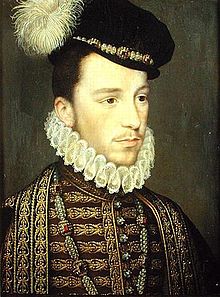
The fifteen years in which he had been God's anointed ruler over the French had not been happy ones for King Henri. He had inherited a truly horrific situation from his father and brothers. Protestantism had been on the rise in France for over a generation and it had been his father's policy to treat it harshly; ghettoising the emergent Protestant community and isolating them from full participation in the political life of the nation. Then, Henri II had been killed in a jousting accident, leaving the sectarian tensions to be handled by his sons and his widow, the brilliant but over-worked Catherine de Medici. No-one really knew what to do and any proposed solution seemed to offend one side, whilst simultaneously failing to satisfy the other. For over a decade, the monarchy's attitude towards the country's religious violence had been either well-meaning but incompetent, or idiotic and duplicitous. Much like the British government's future attitude to Ireland, conciliation was often followed by a crackdown which was, in turn, then followed by another round of conciliation. Sixteenth century French Protestants quite simply did not trust their monarchy and they would be satisfied with nothing less than full religious toleration and equal rights; meanwhile, many Catholics resented the monarchy for giving any concession to the Protestants. In Spain, Protestants were burnt; in France, they were tolerated. Both communities became more extreme and French Catholicism gave birth to the Holy League, a militant band of Catholic paramilitaries, led by the Duke of Guise - the mightiest aristocrat in France, who shamelessly used the prestige of the Holy League to suggest that it was his family who were the real leaders of Catholic France, rather than the ineffective royal family. In 1572, these sectarian tensions resulted in the infamous Saint Bartholomew's Day Massacre, when thousands of French Protestants were slaughtered by the Holy League and its supporters.

As a young prince, Henri had initially been captivated by the Holy League. Despite his fondness for fine clothes, jewels, parties, handsome men and wine, there was also a side of Henri's personality which was devoutly religious. He was also quite an effective soldier and swordsman, which meant that he could participate in the Holy League's fiery defence of Catholicism. However, after the massacre, Henri realised that the Holy League and its leader, the Duke of Guise, were deliberately exploiting the situation so that the power of the Guise family could rival that of the monarchy. Driven by his total belief that monarchy was ordained by God, Henri was prepared to resort to fair means and foul in order to crush the Guise threat and re-establish the supremacy of royal authority in France. For all his undoubted talents, however, he had not been successful. Nor had he been happy. 

The last few years of Henri III's reign had been miserable, exhausting and demoralising. His marriage to the pretty and devoted Queen Louise remained childless. The King became increasingly preoccupied with thoughts of his own sinfulness and had resorted to whipping himself, starving himself, humiliating himself and pushing himself to the brink of a breakdown through his increasingly-unhinged acts of religious mortification. His beloved mother and closest political adviser, Catherine, had died at the start of the year. She had died worrying about her son's sanity in the face of the odds now surrounding him. The Guise family had seized control of Paris, forcing the King and his court into humiliating exile in the countryside. The Protestants had rallied again behind the banner of Henri's brother-in-law, Henri de Navarre. The Holy League and the Guises had tarnished the King's name throughout France, portraying him as a Protestant-loving pervert. His relationship with his former brother-in-law, King Philip II of Spain, was tense because of Henri's (accurate) suspicion that Philip was secretly funding the Holy League. Relations with Queen Elizabeth I of England were also shaky, ever since she had been forced to execute Henri's former sister-in-law, Mary, Queen of Scots. (Henri had no time for Mary, but his refusal to declare war on England once she was beheaded was used by the Holy League as yet another example of his insufficient commitment to Catholicism.) One of his lovers, Philibert Le Vayer, had been found murdered in a narrow alleyway near the Louvre. His sister, Margot, once his favourite member of the family, seemed to have devoted herself to causing trouble for him wherever she went, with her string of lovers and reckless personal life. Crippled by internal fighting, France hadn't been able to defend herself when the Italian Duke of Savoy conquered the French territory of Saluzzo. Everywhere he looked, the power of the Holy League and the Guise family was growing. They were controlling his every action and thwarting his desires. They had even seized his late mother's favourite palace in Paris and given it to the duke's sister, the Duchesse de Montpensier.

During his mother's final few months alive, Henri III had dispatched a stream of angry letters to her, revealing his anguish at the situation he now found himself in. He complained that the Holy League was trying to "make my state semi-democratic," something which he, and his mother, found absolutely abhorrent. In another letter, he wrote, "I wish to be king and not a prisoner and a slave as I have been." He concluded by promising his mother, "I begin once more to be king and master." He did this by inviting the Duke of Guise to a dinner party in the palace and then having him stabbed to death. Apparently, as the duke who had once been called "the King of Paris" by his supporters lay bleeding to death, Henri III whispered, "There is only one king in France."

In killing the duke, Henri had hoped to divide the Holy League, so that the monarchy could re-assert itself. Instead, the mafia-style murder only spurred the Holy League on in its determination to destroy him. Only in time would the League begin to falter because of the duke's lack of leadership.

Ultimately though, it was not the Holy League which killed Henri III, but a delusional loner, disaffected with the world and convinced that he, and he alone, could really understand it. Jacques Clément was a twenty-two year-old friar with the Dominicans, a religious order that cheerleaded the Inquisition. Spurred on by the propaganda of the Holy League and reports of the King's unorthodox private life, the monk made his way to the palace of St.-Cloud, where the King was currently in residence. First, he gained an audience with the attorney-general by telling him that he had urgent news concerning the rebellion in Paris. He was brought immediately to the King's apartments, where Henri was still wearing his dressing gown, as he was dressed for the morning by his servants. Good Catholic boy that he was, the King remained so innately respectful of the clergy that he allowed the monk to approach him and whisper in his ear. Brother Jacques pulled a dagger from his robes and stabbed the King in the lower abdomen, twisting the knife in on impact.

Showing some of the great physical strength which he had been known for as a young man, Henri pulled the dagger from his own body with a scream. The royal bodyguard stabbed the monk to death and tossed his body out the window. As his blood and guts spilled into his hands, Henri III showed that he was far from the mincing stereotype of popular legend. He steadied himself and spoke calmly. He summoned his surgeons and then submitted to their operation, without anaesthetic. His 16 year-old nephew, Charles, the bastard son of Henri's late brother, came to see him and burst into tears to see his uncle in such a state. Henri comforted him and then tried to sleep.

He awoke later that evening and decided to carry on with the business of government. He had a letter sent to his wife and then to the provincial governors. After that, Mass was celebrated in the King's apartments, but his nephew noticed that the King seemed cold and he dutifully rubbed his uncle's feet to try to keep him warm. By nightfall, the King was wracked by a fever, infection and excruciating physical pain. 

Brother Jacques had stabbed Henri III because he believed the voice of God had told him to do it, in order to save the Catholic religion in France. Ironically, as Henri III lay dying, he began making preparations to leave the throne to a Protestant. He had no children of his own and all his brothers were dead; the only logical candidate was his Protestant cousin and brother-in-law, Henri de Navarre, a 34 year-old womaniser with a keen political brain. Summoning Navarre to his bedside, Henri III begged him to embrace the Catholic religion; even if it was only for politics' sake. He also warned him of all the many dangers which could face a king of France. Navarre was greatly moved and couldn't speak as Henri forced all his courtiers to swear an oath of allegiance to their future king. Navarre, who was not by nature a demonstrative man, wept and knelt to receive the King's blessing. A few hours later, Henri III made his last confession and passed away at four o'clock in the morning on 2nd August 1589. With his death, the direct line of Valois kings, who had ruled France since 1328, came to an end with one of their most glamorous, but unlucky, rulers. His life had been sucked-up and destroyed by prejudice, both sexual and religious; his own mistakes had been numerous and often unforgivable, but it is hard to see how the story of Henri III could have had a happy ending, given the time and situation he was born into. 

As Henri IV was proclaimed the new king of France, the rule of the equally glamorous and equally unlucky Bourbon family had begun. 

Wednesday, 1 August 2012

1st August, 1787: The Death of Alphonso de Liguori, writer and saint


Canonised in 1839 by the conservative Pope Gregory XVI, Saint Alphonsus (or Alphonso) de Liguori is today revered as a Doctor of the Roman Catholic Church, due to his skill in philosophy and his devotion to Mariology (the veneration of the Blessed Virgin Mary.) Saint Alphonso de Liguori is also the patron saint of the Naples, arthritis sufferers, confessors and moralists.

Born in a suburb of the Naples in 1696, when the entire southern Italian peninsula was still ruled by the Spanish, Alphonso was born into a well-to-do family of the local aristocracy. His father was an officer in the navy of the Spanish king, Carlos II. The eldest of his parents' seven children, he was christened at a nearby church devoted to the Virgin Mary, which was appropriate given his later devotion to her. Like many future saints, Alphonso's initial academic interests seem to have been with law. He qualified and was a very successful lawyer, but not a happy one. In a private letter to a friend, he reflected that a solicitor's life was a "too full of difficulties and dangers; we lead an unhappy life and run risk of dying an unhappy death. For myself, I will quit this career, which does not suit me; for I wish to secure the salvation of my soul." At twenty-seven, Alphonso re-trained as a priest with the Oratorian order and once he was ordained, he spent the first few years of his ministry working with the homeless, particularly the young, in Naples. 

This early experience gave Alphonso de Liguori a passionate belief in the role the young should play in the church. With their help, he set up evening chapels, where the worship and service was led by the young people themselves. Here, Alphonso would deliver his sermons, which were apparently particularly effective at bringing young people back to their faith when they had become disillusioned with it. In time, seventy-two of these youth chapels would have been set-up across the Italian peninsula. Often appalled at the level of poverty in the Naples, Father de Liguori sometimes undertook missions to alleviate rural poverty, as well.

As his reputation grew, Alphonso also threw himself into the great theological debates of the era. At that time, Catholicism was being divided over the issue of a philosophy known as Jansenism. Jansenism was a form of Catholicism that had originated in France in the previous century and it drew heavily on the philosophy of the more extreme Protestant sects. Whilst it emphasised Catholicism's belief in original sin and human weakness, it also adopted the radical Protestant belief in pre-destination and denied the impact of Free Will. This led many to regard Jansenism as heresy. It was seen by many to be too harsh because it combined the worst elements of both strands of Christianity - Catholicism's belief in the innate sinfulness of humanity, with radical Protestantism's belief that there was nothing you could do to save yourself from it. With the help of his friend, Sister Maria-Celeste, Alphonso set-up a new Catholic faith organisation called the Congregation of the Most Holy Redeemer, which combined two of Alphonso's great passions - to alleviate the suffering of the poor and to challenge Jansenism. 

For the next few decades, the work of the Congregation of the Most Holy Redeemer consumed Alphonso de Liguori's life and in 1762, when he was sixty-six, he was made Bishop of Sant'Agata dei Gioti by Pope Clement XIII. As bishop, he kept up the work he had started with the Congregation and worked hard to eradicate poverty in his diocese. He also pursued his interest in theology, by publishing many books including Moral Theology (which was his great attack on Jansenism), The Great Means of Prayer, The Practice of the Love of Jesus Christ, Visits to the Most Holy Sacrament and his series promoting devotion to the Virgin Mary - The Glories of Mary, Marian Devotion, Prayers to the Divine Mother, Visitations to the Blessed Sacrament and the Divine Mother and Spiritual Songs. In total, Alphonso wrote over one hundred works of theology, as well as numerous hymns, some of which are still sung today. His books were aimed at ordinary Catholics and he sought to encourage them to engage emotionally with their faith, rather than be seduced away from it by the scientific rationalism that was being promoted during the 18th century by the "Age of Enlightenment." Within Catholicism, Alphonso was sometimes criticised by his fellow theologians, who either saw his promotion of Marianism as over-zealous (particularly in his repeated references to the Immaculate Heart of Mary, which led to his books being briefly banned in some Catholic municipalities, like Venice) or for being too emotional and "crowd-pleasing." Some of his opponents were harsh in their criticism of him; others, like the Dominican pastor, Vincenzo Patuzzi, simply respectfully disagreed with his take on how central Mary should be to Catholicism.

In his old age, Bishop de Liguori resigned his post and went into retirement, living with a community of Redemptorist priests in Campani. He died there on 1st August 1787, at the age of ninety. By that point, his homeland of the Naples was an independent kingdom, ruled over by King Ferdinand IV and his wife (Marie-Antoinette's sister), Queen Maria-Caroline. Alphonso died only two years before the outbreak of the French Revolution, which was to seriously threaten and then, through the strength of its persecution, rejuvenate the pastoral, grass-roots Catholicism that Alphonso was so devoted to.

He was beatified by Pope Pius VII in 1816 and formally canonised as a Roman Catholic saint in 1839. Pope Gregory XVI, anxious to turn back the hands of time to the days before the Revolution and impressed, like many were and are, by the extent of Alphonso's holiness, was a keen champion of the canonisation of Alphonso de Liguori. Today, he is buried in the Basilica of Sant'Alfonso in Pagina, Italy.

Sunday, 29 July 2012

Famous Shipping Disasters: The torpedoing of the "Carpathia" (1918)


Famous for rescuing the survivors of the Titanic disaster in 1912, the 8,000-ton Carpathia was one of the smaller members of the vast Cunard fleet. Over the course of her career, which began in 1903, nine years before she became famous because of the Titanic, the Carpathia had operated the route between Liverpool and Boston, undertaken cruises to the Mediterranean and sailed between New York and the Austro-Hungarian city of Fiume. 

In 1914, she was requisitioned for the Imperial war effort and assigned to help the Canadian Expeditionary Force move Canadian troops across the Atlantic to the Western Front. As with most requisitioned passenger ships, her voyage routes and purposes were often changed and she served in a variety of functions between 1914 and 1918. One of the troops she brought over for active service was the American soldier, Frank Buckles, a native of Missouri who went on to become the last living American veteran of the First World War; dying at the age of 110 in 2011.

On 17th July 1918, a date that was to become famous in European history for another event entirely, the Carpathia was sailing through the Celtic Sea, near the southern coast of Ireland, en route for Boston. The recent influx of American service personnel, some of whom the Carpathia had helped bring over, had hastened the defeat of the Central Powers and the Great War was now in its final months. But, at 9:15 in the morning, the Imperial German Navy showed that it still had some teeth; its submarine, U-55, fired two torpedoes into the Carpathia's side. Five men died in the initial explosions. Captain William Prothero ordered everyone into the lifeboats, which were quickly lowered, as the ship began to sink. Keen to hasten the ship's end, the U-55 vindictively fired a third torpedo and was menacingly approaching the lifeboats when the Royal Navy ship, Snowdrop, arrived and opened fire.

It was a measure, perhaps, of just how appallingly vindictive the First World War had become that the U-55 seemed to be preparing to target the survivors. In 1915, when another Cunard ship, the Lusitania, had been torpedoed, the German navy had insisted that they would never have fired a second torpedo into a sinking ship. By 1918, such niceties had vanished and three had been fired, with the possibility of attacking the survivors in the lifeboats only being prevented by the arrival of a British warship. 

The Carpathia sank in one hour and forty-five minutes; its wreck was discovered by American author Clive Cussler in the year 2000. 

Saturday, 28 July 2012

What's God got to do with it: Religion, Ireland and the Troubles


The Irish are always particularly hostile to outsiders' "interference." Woe betide the first foreign national who tries to pontificate upon an internal Irish matter. I was once at a party in America where someone informed me that Northern Ireland was nothing more than an imperialist occupation. Blood nearly streamed out of my eye-balls and I nearly couldn't finish my tequila. (That's how serious it was.) The northern Irish, in particular, are prone to getting especially antsy about it. Nothing irks them more than being told that their country is either a glorified warzone (entirely untrue) or that the troubles of the 1970s, 1980s and 1990s were the result of religion (debatable). As far as most northerners are concerned, it's got absolutely nothing to do with religion and only an ill-informed idiot could possibly assume that it had. 

I mean, when was the last time someone chucked a petrol bomb over the stigmata of Padre Pio or bricked a policeman because they didn't agree with justification by faith alone?

The Troubles in Ireland were political, not religious. They arose from a desire by one-third of the northern population to unite with the independent south and a conflicting desire by the other two-thirds to stay united with Britain. Over time, the demographics have shifted, but the issue remains the same. Shared sovereignty would be equally unpalatable to both sides of the debate. What it all comes down to is Ireland's relationship with Britain, not Jesus. Even some historians agree. In his recent book The Elizabethans, A.N. Wilson painted a brilliant and very witty portrait of everyday life under Elizabeth I (looking blingtastic, I might add. Me loves me some sceptres.) Wilson's book begins by looking at life in sixteenth-century Ireland; he argues that it was the Tudors who messed Ireland up for centuries to come, but that nationalism's cosy links with Catholicism only arose because of how much everyone hated the English, not how much they loved Catholicism. As Wilson points out, when the Reformation first occurred in the 1530s, the Irish went along with it far more easily than the English did: "It was not, initially at least, a specifically religious matter, though by the end of the sixteenth century the rebels Hugh O'Neill and Hugh O'Donnell, could see themselves as champions of 'Christ's Catholic religion' against the English heretics. The fundamental point of contention, though, was English interference in Irish affairs: English attempts to make Ireland less Irish. As a matter of fact, in the early stages of the Reformation, the Irish went along with Henry VIII's religious revolution more peaceably than the English did. There was no Pilgrimage of Grace, there were no Irish martyrs for the faith, no Irish Thomas More or Bishop Fisher. More than 400 Irish monasteries and abbeys were sold to Irish laymen during the reigns of Henry VIII and Elizabeth I. The Irish did not protest when Henry VIII made George Browne the Archbishop of Dublin - that was, the former Augustinian friar who performed the marriage ceremony between the King and Anne Boleyn. Perhaps, if a Gaelic Bible and Gaelic Prayer Book had been available in Ireland, as a Welsh Bible and Prayer Book were in Wales by 1567, Ireland might have remained Protestant." It didn't, of course.

What is frustrating from an historian's point of view is how little people in Northern Ireland actually know about history, but how much they use history to shape their views. (The phrase 'A little knowledge is a dangerous thing' springs to mind and has never been more applicable.) In 1641, when thousands of Irish Protestants were massacred by their Catholic neighbours, hundreds of Catholics joined a Catholic confederacy that pledged to stop further massacres and to support the rule of King Charles I in Ireland. Cromwell's infamous attack on Drogheda and Dundalk in 1649 was as much an attack on Irish royalists, who continued supporting Cromwell's fallen enemy, the King, as it was an attack on Irish Catholics. William of Orange won the Battle of the Boyne in 1690 with the help of the Pope. When the first serious rebellions against British rule broke out in 1798, most of its leaders were Presbyterian-Protestants. It was not until the early 19th century that a clear link between one religion and a corresponding political side could be seen in Irish politics. (Some people still blame Daniel O'Connell for this, but the lad needed to get himself some votes and we shouldn't be too nasty to the man who won Catholic Emancipation.) 

Anyway, the defenders of the idea that religion has nothing to do with Ireland's bullet-and-the-ballot-box history point out that at no moment has a theological debate formed the nexus for an outburst of violence. On the surface, it therefore seems very clear that what caused the Troubles (and lingering sectarian resentment today) was not faith, but instead questions of identity, culture, nationality and politics. 

But is it as clear cut as that? Anyone from Northern Ireland will know that the words "Protestant" or "Catholic" are used far more often in conversation than more accurate terms like "unionist" or "nationalist." It's a short-hand and instantly-recognisable way to convey what someone's political opinions are. And what their view of history is. Anything that can prove the other side wrong is met with metaphorical dances of joy. (Literal ones would be totes undignified.) For instance, recently, when I was tutoring a friend about Ireland's medieval past, his face lit up with a euphoric glow at the revelation that the English invasion of Ireland had actually been blessed by Pope Adrian IV. "So, let me get this straight: the Pope that they all adore actually ordered the English to invade?" (I didn't know that there were many "Pope Adrian IV fan clubs" around, but whatever. That's nice for him. Frankly, more 12th century personalities should have fan clubs. Eleanor of Aquitaine, for instance. Maybe he just meant popes, in general? I don't know. Oh, those crazy Catholics. Still, though - the Eleanor of Aquitaine thing should be considered.) 

You see, it's my contention that religion actually does matter in Ireland's troubles. And that it matters, a lot. Just because no-one ever started a fight over the perpetual virginity of Mary or the existence of Purgatory does not mean that faith doesn't influence us. Religion, in a strange way, is still everything in the north of Ireland. For most people, whether they like to admit it (and usually they don't), it establishes all the essential elements of someone's personality. It may reveal what school you went to, who you're likely to vote for, what sports you play, what national anthem you'll stand for, what you're likely to get offended by and what your world-view will be. Religion flows, subtly, beneath the surface, shaping everything above it.

How, though? Well, to put it in a nutshell - and I'm being reductive here, so I apologise - Catholics tend to think they're better at being Irish and Protestants think they're better Christians. And in both cases, it's annoying.

Northern Irish Protestants are brought up to believe that Catholicism is nonsense. Even if that phrase is never specifically said, there are numerous tiny influences in an Ulster Protestant's childhood that lead them to the inescapable conclusion that Catholicism is not "real" Christianity. That it's all superstition, Mary, saints, statues, priestcraft, paedophile priests and spiritual idiocy. Even if you get older and you claim to respect Catholicism because "we're all Christians," most Protestants are still utterly convinced, in their heart of hearts, that Protestantism is "real" Christianity. Okay, maybe Catholics aren't bad, but they're certainly wrong. Because of Protestantism's assertion of sola scriptura (Scripture alone) and its belief that the Bible is literally true (i.e. what you see is what you get), it's impossible for many of them to appreciate that Catholicism is, in fact, an enormously complex system of beliefs that happens to be based on the Bible just as much as Protestantism is, but through a different set of textual interpretations. 

This belief gives most Protestants a sense of rather irritating spiritual superiority. Even "bad" Protestants who go to church twice a year, who leave the service early, who shag all around them, swear, drink and generally have a good time, can still feel better about themselves, because no matter how shaky their own faith is, they're still automatically better Christians than every single Catholic they know. ("Bad" Protestants who are smug, nasty and self-righteous feel this all the time, but I digress.) For most Protestants, Catholicism is the "fan fiction" of Christianity; it's the unofficial spin-off. It's not quite real. At a recent table quiz, half the Protestants in the room did not know the name of the last book in the Bible. Had you pushed them though, they would still have sworn blind that they were more authentic Christians than the most devout of Catholics. (Btw, seriously? Revelation, guys. Isn't that general common knowledge?)

Northern Irish Catholicism breeds its cultural superiority in a different way to Protestantism. What happens in Sunday Schools, youth groups and Scripture Unions for Protestants, often happens in the school system for many Catholics. Whilst there are some schools that are nearly 100% Protestant, it is illegal for any school to have a purely Protestant ethos. There are, however, numerous Catholic-only schools - many of whom have excellent exams results. Mercifully (or hopefully) few of these schools teach a sectarian message; although many do teach a rather one-sided version of Irish history ("Protestant" schools often fail to teach it, at all.) The major point, however, is that in a school (or any social organisation) where there is no risk of offending anyone, it is permissible for ribald sectarian banter to run un-checked. What Northern Irish Protestants and Catholics say when they're in mixed company is a world-apart from what they say when they know that only their own "kind" is in the room. What they say to foreigners (including the English) is often outright, politically-correct, rose-tinted lies. For seven years, thousands of Catholics spend most of their time in an environment in which there is zero need for them to moderate what they say about politics or religion and they have zero daily interaction with Protestants. I am in favour of faith schools, but in Northern Ireland specifically, I do sometimes worry about them. That kind of environment can breed both a casual sectarianism and an innate, unconscious attitude that Protestants are "foreigners"; that they're somehow not really Irish and, as a result, that they don't belong here. Far too many Catholics think that Protestants all behave like mini-Ian Paisleys; too many Protestants think that all Catholics had a childhood that was basically a cross between The Magdalene Sisters, Titanic Town and Angela's Ashes.

In a recent survey conducted of Ireland's Catholic population, 80% stated that they did not believe in Transubstantiation - one of the core tenets of the Catholic faith. Few Protestants can name all the books of the Bible; even fewer know the relevant history, context and textual debate about what they emphatically believe to be the revealed Word of God. Ireland's relationship with faith is therefore a troubled one - to put it mildly. No wonder outsiders get it wrong so often. Sometimes, I don't even particularly understand it myself. We get angry about how religion is misused in our communities, but then we feel guilty about criticising people from our own "side" when they behave in a sectarian manner. We feel as if we're letting the side down; as if condemning an individual's actions is somehow condemning the whole community. It's stupid and it's spineless. And I've been guilty of doing it myself.

There are many other causes that keep sectarianism alive in Northern Ireland; just as there are also many factors which are, mercifully, slowly beginning to strangle it and starve it of oxygen. Religion is not the cause of the Troubles, but I can't help but think that it is still one of the reasons. If it doesn't cause the tensions, it certainly re-enforces them. And if that is the case, then the verse that springs to mind is the shortest in the Bible and one worth remembering for all believers: "Et lacrimatus est Iesus." (John 11:35 - "And Jesus wept.")

Sunday, 22 July 2012

Famous Shipping Disasters: The sinking of the "Britannic" (1916)


When news reached Belfast in 1912 that the Titanic had sunk on her maiden voyage with such an enormous loss of life, the Harland & Wolff shipyards in the city were quick to learn lessons from the tragedy. When the findings of the American and then the British inquiries were published, numerous changes were made in the building of the Titanic's incomplete younger sister. Designed to be the third of three luxurious transatlantic liners for the White Star Line, most of east Belfast's workforce were still toiling away on building this ship when changes were made to prevent a repeat of what had happened with the Titanic. Both the Titanic and the first sister, Olympic, had been named after powerful figures in Greek mythology - the Olympic after the fictional gods of Mount Olympus and Titanic after the titans, a race of younger gods gifted with incredible strength. The third and largest of the three sisters was apparently originally intended to be named Gigantic, which had the same triumphalist air as the name Titanic. Desperate to put as much distance between their new ship and the disaster of 1912, White Star stealthily had the name changed to the more patriotic Britannic and then denied there had ever been any serious intention of christening her Gigantic.

Weighing in at 50,000 tons, the Britannic was the largest ship ever built in the British Isles at the time of her launch in 1914. She was four thousand tons heavier than her unlucky sister Titanic and five thousand heavier than her eldest sister, and future running mate, Olympic. Together, the two surviving sisters were intended to operate a weekly crossing of the north Atlantic - with one leaving from New York, at the same time another would leave from Southampton in England. Unlike her sisters, however, the Britannic was not the largest ship in the world at the time of her construction. That honour had already gone to a 52,000-ton German liner, the Imperator, and would soon go to her sister, the 54,000-ton Vaterland - which, like Britannic, was pandering to the ultra-patriotic environment of 1914. However, she was to remain the largest ship built on British soil until the Queen Mary in 1936 - quite the achievement for Harland & Wolff.

Britannic took to the water in Belfast for the first time on 26th February 1914. Some of the proposed changes included extending the watertight bulkhead divisions, making it easier for steerage class passengers to reach the lifeboats and nearly quadrupling the number of lifeboats. There were also more cosmetic alterations, including expanding the ship's famous grand staircase, its first class Louis XVI restaurant, adding a Parisian coffee house like the one the Titanic had and making various expansions to the top private suites in first class.

However, the Britannic was destined never to see commercial service and when the First World War came in August 1914, the new ship was hastily converted into a hospital ship on the government's orders. Now formally serving as His Majesty's Hospital Ship Britannic, HMHS Britannic's first tour of duty involved her evacuating the numerous British and Commonwealth casualties from the military campaign in the Dardanelles, against the Ottoman Empire. 

After safely depositing thousands of invalids in Greece, the Britannic was returning to collect more soldiers, under the command of Captain Bartlett and with a combined crew and medical staff of just over one thousand people on-board. There had been some trouble with the weather earlier in the week, but by the morning of 26th November 1916, the Britannic was steaming through a glorious Mediterranean winter's morning. At about twenty minutes past eight, a massive explosion shook the liner. The ship had struck a German mine and soon began listing rapidly on her side. None of her new safety features, designed to protect her from the kind of natural disaster which had destroyed her sister, could feasibly cope with the technological attack from a military mine. 

Captain Bartlett's response was rapid and within ten minutes, the first lifeboats were leaving the Britannic. In a truly horrifying moment however, the Captain's tactical decision to try and race the ship closer to the shallows and thus run her aground to save her, meant that one lifeboat was torn to pieces by the still-turning propellers. Fifty-five minutes after being struck, the Britannic suddenly turned over on her side and vanished into the crystal blue waters. One of the nurses, Violet Jessop, who had once served as a stewardess on the Titanic, later wrote, "She dipped her head a little, then a little lower and still lower. All the deck machinery fell into the sea like a child's toys. Then she took a fearful plunge, her stern rearing hundreds of feet into the air until with a final roar, she disappeared into the depths, the noise of her going resounding through the water with undreamt-of violence...."

Had the Britannic hit the mine on her way back from her mission, when she was filled with injured soldiers, it's likely that her sinking would have constituted one of the worst humanitarian disasters in maritime history. As it was, the disaster cost "only" thirty lives. The survivors were soon picked up by the British Royal Navy and conspiracy theories later circulated that the ship had been deliberately targeted by either a German spy or a German torpedo. However, given the scale of the damage inflicted on the wreck, it seems clear that it was a mine which sank the Britannic.

After the war, White Star Line were rewarded for their service to the British war effort and for the loss of the Britannic. Under the terms of the Treaty of Versailles, Germany was forced to reimburse Britain for her lost liners. The 56,000-ton Bismarck, then the largest liner in the world, was given to White Star and renamed Majestic (below.) She became the flagship of the White Star Line and the largest passenger ship in the world for over a decade, until the French Line's Normandie was designed by a former Tsarist naval architect in 1935.


Today, the Britannic lies on her side at the bottom of the Mediterranean. Her wreck was discovered by the famous oceanographer Jacques Cousteau in 1976. All that remains on dry land of her fabulous interiors, which were never completed or installed because of the war, is the lavish philharmonic organ that was intended to add a 'Baroque' feel to her grand staircase. It is on display at the Swiss National Museum in Seewen. 

Tuesday, 17 July 2012

17th July 1918: The Execution of the Imperial Family


"Remember that the evil which is now in the world will become yet more powerful, and that it is not evil which conquers evil, but only love." - Grand Duchess Olga of Russia, four months before her death in 1918.
In the early hours of 17th July 1918, eleven people were brutally murdered in the cellar of a house that stood near the centre of Yekaterinburg, a medium-sized city in the middle of Russia's Ural mountains that drew most of its employment from the local mining industry. The deaths of eleven people in the summer of 1918 is hardly remarkable. Millions of young men were still dying on the battlefields of the First World War; the Spanish influenza pandemic was about to claim the lives of nearly seventy million people worldwide and for the last fifteen months, Russia had lurched from one political crisis to another. It was now in a state of civil war, political terror and social unrest. The downfall of the Russian monarchy in February 1917 and the collapse of the democratic republic set-up to replace it after only ten months had resulted in the world's first Communist regime coming to power in Russia. Led by Vladimir Lenin and the Bolshevik party, Communism would continue to rule over Russia until 1991, but in 1918 it was faced by a formidable cabal of enemies.  It was by no means certain that it would survive. Hatred of Communism had led to monarchists, democratic republicans, moderate socialists and liberals allying with one another in the shared common goal of destroying Communism's hold over Russia. Communism had responded with an official policy known as "the Red Terror," which saw mass arrests, intimidation, widespread torture, spying, the suspension of civil liberties, numerous executions, assassinations and punishment beatings. By July 1918, thousands were perishing as a result of the Red Terror and many more were dying because of the civil war between the new Communist government (known as the "Reds") and its opponents (known as the "Whites".)

Amidst all this carnage, why were the deaths of those eleven people in Yekaterinburg considered so important? Well, it was because seven of the eleven were members of Russia's deposed imperial family - 50 year-old Tsar Nicholas II, his British-German wife Alexandra, their four daughters - Olga (22), Tatiana (21), Maria (19) and Anastasia (17) - and their 13 year-old brother, Alexei. As with most things associated with royalty, the symbolic significance attached to them went far beyond the issue of personality or an individual life. For three hundred years, the House of Romanov had been regarded by millions of Russians as the living embodiment of the Russian nation. The Tsar had been appointed by God to rule over one of the largest empires in history and as head of the government, army, church and court, the Romanov emperors were believed to stand far closer to God than to the rest of humanity. The savage execution of the last of the Romanov tsars was intended to cripple the Russian monarchist movement and to rob them of their most valuable figurehead - the same rationale justified the execution of Nicholas's teenage son, Alexei. It was also designed to shatter the mystique of three hundred years of monarchy. However, it was not the execution of the ex-emperor and his son which caused the most comment - then or now. It was the decision to murder his four daughters - without a trial, in secret and when none of them had any political power. Lenin's right-hand man, Leon Trotsky, later admitted that the girls were murdered because it would send a psychological message to the Russian people: it would show that there was no turning back and that anything that stood in the way of Communist victory in Russia would be ruthlessly eliminated. In a nutshell, it was terror for terror's sake.

Ever since the collapse of the monarchy, the Tsar and his family had been living under house arrest. As time had gone on, the conditions of their detention had deteriorated. Immediately after the first revolution, they had lived in their former home at the Alexander Palace near Saint Petersburg, where they still had access to many of their servants and where there had initially been plans to send them abroad to live in Britain, France, Switzerland or Spain. For their own safety, they were then moved to the town of Tobolsk in Siberia, where they lived in a former governor's mansion. In April 1918, they were moved to Yekaterinburg, where they were imprisoned in the Ipatiev House, a merchant's home which was heavily fortified and where the family were guarded by a local division of the Cheka - the feared Communist secret police. For the last few weeks, the Cheka had been making preparations to kill the entire family and their four remaining servants. The White armies were closing in on the area and Lenin had signed off on the idea, telegraphing the local branch of the Communist party from Moscow giving his firm and unequivocal approval that all the Romanovs now in captivity should die. The task of organising the logistics of the execution fell to a man called Yakov Yurovsky, a forty-year old member of the Cheka who was in charge of security at the Ipatiev House. The meetings had taken place in the town's local "American Hotel." It was decided to murder the family in the Ipatiev House's cellar, disfigure their bodies with sulphuric acid and then hide the remains in the nearby forest.

At half-past one in the morning of 17th July, Yurovsky went upstairs and woke Dr. Eugene Botkin, the imperial family's private doctor and a staunch monarchist who had chosen to share imprisonment with his employers. The doctor was asked to wake the family; Yurovsky fed him the lie that because of fighting in the area, the Soviet government had decided to move the family to another location. In the meantime, artillery fire had been heard in the forest and Yurovsky thought it best if the family took shelter in the cellar downstairs. Botkin knocked on the Imperial Family's doors, informing the Tsar first - as protocol demanded. Nicholas II dressed quickly and efficiently, before turning his attention to waking his son. The Tsarina Alexandra and her four daughters took a lot longer to get ready - Yurovsky later estimated it taken them over half an hour - perhaps because Alexandra's bad back required her to be dressed slowly and with great care. Eventually, they emerged from their rooms and Yurovsky noticed that Nicholas was carrying his thirteen year-old son in his arms. Alexei (above) suffered from haemophilia, a rare genetic blood disease that meant his blood had an inability to clot properly. He had recently suffered another spate of ill-health and without constant exercise, he was finding it difficult to walk. 

As they walked down the stairwell and through the house, the Imperial Family stuck rigidly to the etiquette which demanded they walk in order of precedence. Nicholas and Alexei went first, followed by Alexandra, who was in a great amount of pain and leaning on the arm of her eldest daughter, Olga. One of the other guards, Victor Netrebin, remembered later that he was struck with how thin and tired the Tsarina and her eldest daughter looked. Twenty-two year-old Olga's dramatic weight loss and intermittent bouts of depression had been remarked upon by other eyewitnesses, who had also noted that the stress of captivity had aged the young Grand Duchess prematurely. Coming up behind her were her three younger sisters, Tatiana, Maria and Anastasia, whom Netrebin would later contrast with Olga by saying how pretty they all looked - moments from death. The youngest of the princesses, Anastasia (17), was carrying her sister Tatiana's pet Pekinese dog, Jemmy. After that came the family's four servants - Doctor Botkin, the Tsar's valet Alexei Trupp, the family's private chef Ivan Kharitanov, and the Tsarina's maid, a tall blonde called Anya Demidova. Demidova was carrying pillows to alleviate the Tsarina's chronic backache.

Contrary to later Hollywood dramatisations of the execution, the family did not go straight into the cellar. The basement of the house was actually separated from the main body by a small courtyard and so the group momentarily stepped outside for one last time, into the warm July night air. Then they re-entered the house by a second door and descended a flight of twenty-three stairs. The room that they were told to wait in was a cross between a storage facility and a traditional cellar. There were double doors at the back, leading to more storage space, which Yurovsky had cleverly locked beforehand. There was also a barred window and a single harsh light-bulb, casting a cold, brutal light over the room. Alexandra (above), who suffered from terrible migraines, heart palpitations, intermittent dizziness and excruciating sciatica, immediately expressed her incredulity that there were no chairs for her to sit on. Later the Communist guards were to mock her for her imperious demand, but given the level of physical agony the Empress was in, it was surely an understandable request. Her health had not been good since the birth of her youngest daughter in 1901 and the stress of the revolution, coupled with what she saw as the humiliation of imprisonment, had nearly killed her. For the last year, she had been administered a substantial number of opiates and even cocaine-laced medication by Dr. Botkin. They were standard early twentieth century treatments for her many ailments, but with medical supplies dwindling, the Tsarina was likely suffering some kind of withdrawal symptoms now, as well. The guards, who hated her more than any other member of the family, reluctantly brought in two chairs. The Tsar lowered his son onto a chair and then stood protectively in front of him, whilst the four girls and their maid helped Alexandra sit on the other one. The three eldest daughters then stood behind their mother's chair, whilst the youngest, Anastasia, stood in the back corner, chatting to the servants. Yurovsky then left them all alone for about half an hour, whilst he went upstairs to go over the final preparations. In the meantime, the execution squad were getting nervous and many of them tried to calm their nerves with numerous shots of cheap vodka. A Fiat truck was brought round to the courtyard. Hearing the noise from the basement, the family must have assumed it had come to take them out of Yekaterinburg. In reality, it was to transport their bodies for dismemberment and burial.

After half an hour, the double doors into the cellar swung open, to reveal Yurovsky standing with ten other men. The official justification for the execution was to be the support that some of the Romanovs' foreign royal relatives were giving to the White armies (Britain was supporting them and Nicholas II was King George's cousin.) Yurovsky cleared his throat and read out a brief statement: -

In view of the fact that your relatives in Europe are continuing their assault on Soviet Russia, the presidium of the Ural Soviet had sentenced you to be shot. In view of the fact that the Czechoslovaks are threatening the red capital of the Urals - Yekaterinburg - and in view of the fact that the crowned executioner might escape the people's court, the presidium of the Regional Soviet, fulfilling the will of the Revolution, has decreed that the former Tsar Nicholas Romanov, guilty of countless bloody crimes against the people, should be shot.

There were some words of incoherent, stunned protest from the Tsar and Dr. Botkin. The Tsarina and Olga, the two most intensely religious members of the family, immediately crossed themselves and began to pray. Yurovsky then calmly pulled out his Colt pistol and shot Nicholas II directly in the heart. Eager to claim that they too had played a part in killing the last Tsar, three other men then turned their guns on Nicholas and fired into his corpse. 

A hail of bullets was then unleashed upon the screaming people in the cellar. The Tsarina died almost instantly, mid-prayer, when she was struck on the left side of the skull. The valet and the cook - Alexei Trupp and Ivan Kharitanov - received multiple gunshot wounds in the first few minutes and died either from a direct hit or from heavy bleeding shortly after. There is some confusion over what happened to the Grand Duchess Olga (left), whose corpse was later shown to have a bullet wound in the jaw. The trajectory of the impact would indicate that the bullet hit her when her head was thrown back and upwards, perhaps indicating that she, too, died very quickly and was quite possibly knocked backwards by the collapsing bodies of either her father or mother. As she stumbled backwards, one of the stray bullets shot upwards through her jaw and killed her instantly.

The room had by now filled with smoke and visibility was poor. It almost certainly stank, too, as the bodies expelled their fluids as they went into their death-throes. Yurovsky ordered a temporary halt and took the men back outside to re-load their weapons and fetch some rifles with bayonets, which could be used to stab any victims who survived the next attack by gunfire. Re-entering the cellar, Yurovsky saw that Dr. Botkin, who sustained several bullet wounds to the abdomen, was crawling along the ground to lie next to the body of his emperor. Yurovsky shot him twice in the head, before turning his attention to the rest of the room. The two youngest girls - Maria and Anastasia - were huddled in the corner of the room, shrieking hysterically and Maria was trying desperately to claw at the doors in the hope of escape. Tatiana, their twenty-one year-old sister, was generally considered the most beautiful and elegant of the Romanov sisters. Innately conscious of her royal rank, she had been the most right-wing member of the imperial family, after their mother. Now, she was shielding her two younger sisters with her own body and today, Tatiana's remains are the most badly damaged of all the Romanovs'. Seeing Yurovsky approach her, the Grand Duchess dragged herself to her feet to face him and was shot point-blank through the head. She died standing. A very brave young lady. 


Maria and Anastasia (above) were then dispatched by being beaten, shot and stabbed to death by the remaining guards. One of them, a local Communist called Peter Ermakov, admitted to lunging at them like a wild beast and some of the guards allegedly vomited or fled the room at the sound of the girls' screams. Their little brother, Alexei, was repeatedly beaten as he clawed pathetically at his father's coat. Yurovsky intervened to stop the beating; he shot the boy twice through the ear, ending his life. The family's screaming maid, Anya Demidova, was the last to die - apparently from repeated stab wounds from the company's rifle bayonets. It had taken nearly half an hour to massacre the entire family; as Yurovsky would later remark in a stunning under-statement - "It is not easy to kill people."

The bodies of the Imperial Family and their servants were then pumped with the remaining bullets, to ensure that they really were all dead. They were then stripped and taken out to the truck. Yurovsky had them driven into the forest, where they were all doused in sulphuric acid to disfigure them, dismembered and set on fire. Then, they were hurled down a mine-shaft.

It had been a horrible, violent, lawless death - carried out in secret, without a trial or without justice. It was a fate that was to befall millions of ordinary Russians in the years under Communist rule - a system of government which has still, inexplicably, managed to escape the historical condemnation it so richly deserves. The Soviet Union was a depraved and genocidal regime, which even on its best days bore all the qualities of a sociopath. It was devoid of morality or respect for human life. It was infinitely worse than any regime in Russian history. And although it had technically come to power in October 1917, it was the events in Yekaterinburg on 17th July 1918 that should arguably be seen as the Soviet Union's true birth-date. Everything that defined it and everything that it was prepared to resort to was contained in how it executed the Romanovs. As Trotsky so rightly pointed out, with his chilling disinterest in human suffering - it proved that there was no going back. It defined what was to come.

Tuesday, 26 June 2012

The Ultimate Social Climber?


From the portrait painted by Madame Lebrun, Gabrielle de Polignac gazes out at the world with bambi-eyed complacency. She looks so comfortable in her disarmingly simple white linen gown, there is a little poesy of flowers in her hand and on her head; she wears a wide-rimmed straw hat, like any country housewife. The portrait gives the impression that Lebrun managed to capture the beautiful duchess unexpectedly, on a lazy summer afternoon in the gardens. It has the feel of a photograph, snapped suddenly, capturing and preserving a fleeting moment like a fly caught forever in amber. It all looks so effortless - the governing maxim of Gabrielle de Polignac's social existence.

But, of course, it wasn't effortless. Portrait painting was a lengthy and time-consuming business. Artist and subject must have spent hours negotiating one another's schedule - finding the right outfit, the right style, the right look, the right time of day, the right light and, for Lebrun, the right price. Gabrielle must have known that she was taking a risk by appearing in such a revealing, faux-peasant ensemble. She knew that the more rigidly pious and conservative members of the French court, not to mention the woman-loathing, sexuality-fearing neo-puritans of the French revolutionary emergent "Left", were going to criticise her for appearing in what they saw as such a fundamentally indecent gown. Duchesses were not supposed to be painted looking like shepherdesses - but Gabrielle was indifferent to the criticism of those outside her charmed palace-dwelling clique. Her one nod to conventional portrait etiquette was that she appeared wearing a wig - had she appeared showing her own gorgeous brunette tresses au naturelle, it's likely that her (many) opponents would have had a collective aneurysm. 

So there she stands - two hundred years later - fresh-faced, pretty, elegant, simple. Lebrun, apparently, for what it's worth, didn't like the portrait very much and felt that she had failed to capture the one quality everyone could agree upon about Gabrielle - her beauty.

In his account of the French Revolution, the historian Simon Schama describes this portrait of Marie-Antoinette's favourite friend in her diaphanous shift as the painting of a woman who was "by any standards, strikingly comely ... looking like some freshly harvested and luscious fruit." Perhaps Gabrielle's most unusual feature were her lilac-coloured eyes, but her alabaster skin, youthfulness, pearly straight white teeth and brunette hair also combined to make her a devastatingly beautiful young woman. It was the first thing anyone commented on when describing her and the only thing they all seemed to agree upon. The Duc de Lévis, who didn't particularly like her, said she looked like a Raphaelite Madonna; Marie-Antoinette's chief perfume maker, Fargeon, choked out that Gabrielle's ravishing good looks masked her hateful personality; the first adjective used to describe Gabrielle by another of Marie-Antoinette's ladies-in-waiting was "beautiful", another said "lovely". When Gabrielle lay dying, her own daughter was at pains to stress that her mother's face had remained "beautiful" up to the very moment her life ended. Beauty and the strange affect it has on other people flowed through Gabrielle de Polignac's life, like a silent stream that slowly shaped the course of her destiny. De  Lévis rather nastily remarked that her beauty had ruined her; she had come to rely solely on it and she therefore had no other personality, no other interests, beyond simply being beautiful. Many would have agreed. The fact that her own child seemed preoccupied with stressing their mother's beauty, even in extremis, suggests how frighteningly inextricable it had become to how people, even her close loved ones, perceived her. How she would have coped without her looks, we shall never know. She died before they had begun to fade.

Gabrielle de Polignac was born Gabrielle de Polastron, the daughter of an impoverished family of the French aristocracy. She was married-off, whilst still a teenager, to Jules de Polignac, the son and heir of an equally well-bred and equally down-on-their-luck noble clan. It was a conventionally satisfactory aristocratic marriage - Jules and Gabrielle did not make each other miserable, but nor is there any sign of great love between them. They had four children together - their daughter, Aglaé, and three boys, Armand, Jules and Camille-Henri. Gabrielle's pushy sister-in-law, Diane, was a courtier at Versailles and it was through her that the couple were invited to a new year's party at the palace in the first year of Louis XVI's reign. It was there that Gabrielle was introduced to the new Queen of France, Louis's twenty year-old Austrian wife, Marie-Antoinette. The two women struck up an instant rapport and Marie-Antoinette was fascinated by Gabrielle's unshakable self-confidence, her poise, her charisma and, almost certainly, her other-worldly beauty. Years later, it would be suggested that Marie-Antoinette had a lesbian or bisexual crush on Gabrielle; a version of their relationship that was recently revived in the new French movie Farewell, My Queen where Diane Kruger plays Marie-Antoinette and Virginie Ledoyen plays Gabrielle (below.)


There is nothing to suggest that Gabrielle's relationship with the Queen was a sexual one, or even romantic in the way that we would now understand it. It is by no means impossible, of course, for otherwise-heterosexual people to develop intense 'crushes' on a particularly interesting or attractive individual of the same sex; or for otherwise-homosexual people to do so vice-versa with the opposite sex. Marie-Antoinette's most recent biographer, Lady Antonia Fraser, concludes that, in the early years of their friendship, this is the best way to describe Marie-Antoinette's devotion to Gabrielle. She writes, "None [of their behaviour] corresponded to an active lesbian relationship, if the test of that is physical consummation. But it is plausible to believe that Marie Antoinette was in some romantic sense in love with [Gabrielle] de Polignac (or, in girlish language, had a crush on her), at least in the early years of their relationship." For those familiar with the world of Brideshead Revisited, there was a relationship between the Queen and the Duchess which was not so very different to the one between Charles and Sebastian in Evelyn Waugh's novel. Intense, passionate, almost certainly platonic in the physical sense, but romantic in the emotional sense. To extend the metaphor even further, in Brideshead Revisited Sebastian was the desperately lonely son of an absent marquess and Charles was a middle-class social climber dazzled by Sebastian's wealth and ineffable charm; Marie-Antoinette was the desperately lonely wife of a foreign king, crushed and depressed by the stultifying conservative court etiquette at Versailles, homesick for her sisters and prone to hysterical bouts of crying, shortness of breath and general unhappiness. Gabrielle de Polignac was the impoverished wife of an impoverished aristocrat, who was smart enough to know that friendship with the young queen could  lead directly to the golden fountain of royal favour - i.e. money.

From the moment they met, Gabrielle and Marie-Antoinette were inseparable. Gabrielle was cool, chic and glamorous; unlike everyone else at Versailles, she seemed indifferent to things like money, position, etiquette and power. In reality, there's absolutely no doubt in my mind that Gabrielle de Polignac was anything but indifferent to any of those things. Gabrielle rose quickly in the Queen's favour and in the King's, who, like his wife, found her to be a breath of proverbial fresh air. (There is no truth in the rather ridiculous theory recently put forward that the devoutly Catholic King Louis was sexually interested in Gabrielle himself; Louis XVI had a famously low sex drive and an extremely conservative Christian faith.) Gabrielle became an integral part of the royal couple's lives and, with her, came her family. Gabrielle managed to get them all jobs, pensions, generous salaries, good marriages and positions at court. She became the metaphorical centre of a rather fast, hard-partying clique of young courtiers, socialites and aristocrats who helped alleviate Marie-Antoinette's crushing sense of boredom. As Antonia Fraser writes, Gabrielle helped banish the ennui - "People enjoyed themselves in her company; her manner was gently pleasing and she had a delightful laugh." But, "For one seemingly lacking in avidity, she would amass an amazing amount of positions and rewards for herself, her large family [and] her connections".

One historian, Vincent Cronin, who wrote a dual biography of Louis XVI and Marie-Antoinette, has admittedly sprung to Gabrielle's defence, arguing that it was only natural that the Queen should provide jobs and funds for a down-on-her-luck friend. Furthermore, given that Gabrielle was now expected to host various entertainments and parties because she was living at Versailles, Louis and Marie-Antoinette were "duty-bound" to help her afford it. 

There is some truth in Mr. Cronin's arguments, but the sheer amount of money that poured into Gabrielle's pretty little hands in the 1770s and 1780s went far, far beyond what was either prudent or necessary. Another one of Marie-Antoinette's biographers, Stefan Zweig, was infinitely more critical of "la belle Gabrielle," fulminating in his 1933 biography, "Not even Madame de Maintenon, not even the Pompadour, cost as much as this favourite, this angel with downcast eyes, this modest and gentle Polignac." That, too, is perhaps an exaggeration. Gabrielle de Polignac was no more responsible for damaging the French economy than Marie-Antoinette was. In the grand scheme of things, the amount of money being paid to the Polignacs and their dependents was a drop in the metaphorical ocean compared to the ludicrous sums being spent on frequent (and inevitably failing) recession-busting initiatives, in funding the American revolutionaries' fight against Great Britain or on trying to fix France's federalism-run-amok, creaking, out-of-date taxation system. But you can't get mad at federalism and you can't get mad at long-term socioeconomic trends, either. You can, however, look at the violet-eyed duchess and her Versailles crew and apportion all blame to them. She's visible and she's memorable. Gabrielle de Polignac, to put it mildly, was therefore loathed within a few years of joining Marie-Antoinette's circle.

Within the palace, the reasons for her unpopularity sprang mainly from jealousy. With Gabrielle monopolising Marie-Antoinette's time and affection, no-one else could climb the social ladder and become the Queen's new favourite. Many a failed socialite would utter the cry of the insidious and vile Madame de la Motte, who complained in her memoirs, "To be sure, one could hope for presentation to the Queen only through the Polignac clique, but the Duchess, jealous and fearful of losing the royal favour she monopolised, disdainfully repulsed any outsider who sought so much as a smile or a glance from the Queen... I was outraged by the attitude of this haughty and imperious woman. Well could I remember the Polignacs in Paris when they were impoverished nonentities". Gabrielle therefore became a useful scapegoat for any aristocrat who wanted to say they didn't enjoy the Queen's favour because the Duchess controlled all access to her; not because they themselves were too boring, annoying or unpleasant to actually win Marie-Antoinette's much-coveted friendship. 

Gabrielle also managed to tick people off with her (rare) displays of political sympathies - she was almost alone at Versailles in being pro-British and anti-American and she was rather too fond of drawing-up lists of people like the Duc de Brissac or Baron de Breteuil who had annoyed her. People on that list soon found their social lives at the palace being severely restricted and, in doing so, their opportunities for political advancement correspondingly dwindled. One palace servant likened Gabrielle to a steel dagger in a silken glove; another noted that the sweeter her tone got, the meaner her sentiment was likely to become.

Outside the palace, Gabrielle took the place of the royal mistress in public opinion. The French had a tradition of blaming all the mistakes of their government on the King's mistresses, rather than on the kings themselves. Even today, we have an ugly tendency to get angry when a woman, no matter how capable, seems too close to a powerful man - as poor Hillary Clinton found to her cost during her husband's presidency. However, both Louis XVI and Marie-Antoinette were too clean-living to provide the country with paramours to blame. In Marie-Antoinette's case, anti-monarchists responded by simply making up hundreds of accused lovers - including animals, children and transvestites. They also, increasingly, insisted that she was having affairs with Gabrielle de Polignac and another close friend, the Princesse de Lamballe. Marie-Antoinette, with rather touching innocence, wrote to her mother that she was mainly being criticised in the gutter press for having a taste for lovers and a taste for women. Which rather suggests to me that the sheltered young royal wasn't aware that she was actually being accused of combining the two categories.

As they grew-up, Gabrielle and her queen remained close, but the girlish, co-dependent infatuation of the early days was long gone. They did, occasionally, quarrel. Marie-Antoinette loathed the Comte de Vaudreuil, a pushy military man whom Gabrielle was terribly fond of and who many believed she was having an affair with. The possibility that Gabrielle did have an affair with Vaudreuil cannot be disproved, nor should it be too easily dismissed; although, for what it's worth, my money is that they probably were not lovers. Marie-Antoinette also began to resent Gabrielle's numerous, parasitical relatives and their constant demands for more money and more favour, particularly at a time when the Queen herself was making drastic economies within the royal household. Sensing that time apart might do them good, Gabrielle went on a visit to England, where she stayed at Chatsworth with another close friend, Georgiana, Duchess of Devonshire, whom she had first met at a Belgian spa a few years earlier. By the time she returned, French politics was teetering on the brink of its most epic crisis. Gabrielle hurled herself into supporting the agenda of what we would now recognise as the far-right. The diplomat, Marc de Bombelles, noted that he found her "working hard" with the King's younger brother, the Comte d'Artois, to have the liberal chief minister, Jacques Necker, dismissed from office.

Gabrielle de Polignac died in Austria on 9th December 1793, less than two months after the guillotine claimed the life of Marie-Antoinette. The cause of her death has variably been suggested as heartbreak, cancer or tuberculosis. In the two centuries since her death, historians have generally dealt harshly with her. At a time when many felt the French monarchy was in urgent need of reform, Gabrielle had actively supported the harshest possible measures against reformers and revolutionaries. In an age of great philosophers and the emergence of new political ideologies, the pretty duchess had laughed at intellectuals, mocked politicians and excluded anything too serious or too unpleasant from conversation at Versailles. She came to symbolise the corruption of the ancien regime - a government for blue-bloods, by blue-bloods. She was the last of the royal favourites. As more and more evidence was uncovered that Marie-Antoinette was nothing like the money-burning bimbo of popular legend, it was still possible to hurl all the blame onto Gabrielle de Polignac. Gorgeous, self-centred and wilfully isolated, Gabrielle became the historical poster girl for what had been wrong with a gorgeous, isolated, out-of-touch monarchy. She has, admittedly, had her defenders, too. Apart from Vincent Cronin, there have also been passionate rebuttals of her critics  - beginning, understandably, with her friends and family in the early nineteenth century. Recently, a "trad" Catholic royalist got rather carried away, I'm afraid, and compared her to Saint Nathaniel, which rather seems to be overegging the proverbial pudding.

Gabrielle de Polignac was not a "bad" woman - either by the standards of her own day or, really, by ours. She was a conventionally observant Roman Catholic, she was not promiscuous and she conformed to the general political beliefs of her religion and her class. She was not murderous, nor was she an ideologue. Whilst she was certainly selfish, vain and capable of petty nastiness, she was also gracious, elegant and had moments of great tenderness, as shown by her ability to soothe Marie-Antoinette's intermittent bouts of depression. But apart from the extraordinary times in which she lived and the extraordinary queen whose friendship she won, there is nothing too intrinsically fascinating about Gabrielle de Polignac - beyond two things. The first, as has been mentioned, is her great beauty. Beauty is, in itself, a fascinating topic. Good looks can both improve and bedevil the life of their holder. Beauty, which is good looks magnified, can also cut both ways like a double-handed sword. In Gabrielle's case, it propelled her into the spotlight, but it also led to people instinctively disliking her. Then and now, people don't like someone to "have it all". To be that beautiful, that confident and to have acquired the eighteenth century holy grail of royal patronage was quite simply too much for most of Gabrielle's contemporaries to stomach. 

The second point of interest is her astonishing success. It might seem strange to say that. After all, what did Gabrielle de Polignac really contribute to the world? She had no discernible talents and she produced nothing that impacted on French or European culture; even her letters are few and far between. By our standards, she did nothing except happen to be very rich and very pretty. Furthermore, she ended her life as a refugee from the bloody revolution that had destroyed the world she had grown-up in. But, by the standards of her own era, I do believe firmly that Gabrielle de Polignac not only succeeded but did so spectacularly. To an eighteenth century aristocrat, there were fewer obligations higher than family. Using nothing but her charm and self-belief, Gabrielle de Polignac dragged two families - her own and her husband's - from the genteel poverty that they had languished in for nearly a century. Regardless of the cost to her own personal reputation, she took the Polignac family and skyrocketed them into the upper echelons of the French nobility - a position that they hold to this day. Gabrielle's descendants included future prime ministers, Confederate generals, composers, mathematicians, socialites and royalty. Today, some of her surviving jewels nestle in the collection of the Grimaldi royal family of Monaco - who are also her descendants. She was, quite simply, the most spectacular social climber of her century and the trick behind her success was that she hid it so well. Gabrielle seemed so perfectly well-mannered, so at ease in herself and so completely indifferent to the usual mechanisms of "high society," that for decades after she was dead, she was still held up as the ultimate icon of the old aristocracy's wealth, supreme indifference to the outside world and entrenched privilege. She made it look effortless, just like the supremely affected unaffectedness in the Lebrun portrait of her. No-one ever saw Gabrielle's little feet paddling desperately beneath the water - all they saw was the gorgeously self-confident swan representing "all the glories of those set apart by privilege and wealth, flaunting themselves once more like the last beacon of an expiring world."
Related Posts with Thumbnails