Saturday, 31 July 2010

"The Friend of True Piety": The Life of Matilda of Flanders, Queen of England


This is the first in a new series chartering the lives of the Queens of England.

“She was even more distinguished for the purity of her mind and manners than for her illustrious lineage… She united beauty with gentle breeding and all the graces of Christian holiness.”
- The Anglo-Norman chronicler, Orderic Vitalis (1075 – 1142)

“The story of English queenship begins with a French princess. In the centuries after the collapse of Roman imperialism, Europe experienced a perpetually fluctuating regathering of territorial power. Put simply, such power was achieved through violence, but the role of kings was increasingly delineated and formalised by religious liturgy. While their status had yet to become institutional, much less constitutional, a similar process began to arise in the case of queens… Consecration, coronation. These are the processes which set a queen apart from other women in a mystery she shared only with her husband… An unruly twinge of reverence for such beliefs might now be dismissed as embarrassing sentimentality, but there existed no sense of the irrationality of such a contention for the period in question. Just as the Church was omnipresent for every individual, from peasant to magnate, so the idea of difference, of selection by God, coloured the concept of the medieval monarch. Though there is ample, touching, funny evidence of the humanity of medieval queens, it is essential to remember that they were isolated as well as elevated by consecration. They were unique, they were sacred, they were magical.”
- Lisa Hilton, Queens Consort: England’s Medieval Queens (2008)

Matilda of Flanders was born in a violent age and married to a violent man. She was the mother of violent sons and first lady of two nations which were controlled and subjugated by violence. Indeed, her marriage itself – much like her later elevation to the position of queen – may very well have begun in violence of the most intimate kind. Hearing that her father planned to marry her to Duke William of Normandy, who was the illegitimate son of an upstart duke and his working-class concubine, the impeccably royal Matilda snobbishly refused, telling anyone who would listen that she would rather die than marry someone as uncouth and ill-bred as William. The chronicler, Orderic Vitalis, reports that Matilda was not alone in feeling this way, since because of his birth out of wedlock William was considered “a bastard, despised by the native nobility.” In the more charming phrase of the modern historian, Lisa Hilton, the ancestry of the House of Normandy was certainly “good for a giggle.” William, however, evidently didn’t see the humour and he was determined to have the well-connected Matilda for his wife. The Chronicle of Tours decorously reports that he barged into her bedroom and beat her until she agreed to marry him. Overcome by this display of masculinity, Matilda fainted and agreed. A much more believable account, however, is that William raped her – either in her bedroom or one afternoon when she was out riding. With her all-important virginity now snatched from her, it was impossible for Matilda to marry anyone else in her social class and, as a result, she had to marry William.

As with most of her contemporaries, Matilda of Flanders’ exact date of birth is unknown. It was probably in 1032 or 1033, not long after the consummation of her parents’ marriage. She was the daughter of Baldwin V, Count of Flanders and his wife, Adèle, the King of France’s youngest daughter. As a result, the baby’s grandparents included King Robert the Pious of France and his queen, Constance of Arles. Like her father, Adèle was an exceptionally religious woman, who would later be nicknamed “Adèle the Holy” and she imparted this love of Christianity to her only daughter, Matilda, along with an excellent education, which she personally oversaw. As with most fathers of the age, it is likely that Count Baldwin was more interested in his sons than in his daughter – certainly, given the way he acted over her marriage, Matilda’s feelings did not seem to particularly factor into his equations in any meaningful way. In this case, Baldwin was lucky, for Adèle had fulfilled the primary function of a royal bride in providing her husband with four sons – Baldwin, Robert, Henri and Richard. Henri died as a baby, but the others flourished. Perhaps, however, it is unfair to be too harsh on Matilda’s father, who spent most of his life attempting to increase the wealth and security of his country, whilst having to face constant opposition from the local nobility, who were disapprovingly described as figures of “atrocious cruelty” and selfishness by religious scribes at the time. Still, by the time Matilda reached her teenage years, Baldwin’s efforts on Flanders’ behalf were clearly paying dividend. The foundations had been laid for a strong infrastructure and trading network, which would continue to grow throughout the Middle Ages until Flanders had become the economic power-house of Europe in the 15th century.

Thanks to her parents’ ancestry, Matilda was one of the more well-connected of the European princesses born in the early 11th century. In her veins, ran the blood of the famous Christian emperor, Charlemagne (d. 814), the most venerated Christian monarch apart from Constantine the Great, in an era which was obsessed with them. She was also descended from King Alfred the Great (849 – 899), the famed, brilliant and pious King of Wessex, whose reputation was already becoming legendary in his native England. Matilda was also a very good-looking young woman, described by her contemporary William of Jumièges as “a very beautiful and noble girl of royal stock”. There is a story, repeated in the Guinness Book of World Records, that Matilda was to become the shortest of English queens, but the idea that she only ever reached 4’ 2” in height is based on an inaccurate measurement of her bones, undertaken in 1819, when the restored French monarchy was attempting to undo some of the damage done on the royal tombs by the Revolution. A more scientific exhumation of Matilda’s body in 1959 established that, in fact, she grew to 5’ in height by the time she reached maturity.

Maturity for Matilda of Flanders came in a fairly brutal form, as has been discussed, at best through a coerced marriage, at worse (and most probably) through rape. As she approached her sixteenth or seventeenth birthday, her father began to seriously consider a match between his only daughter and William, the 20-something Duke of Normandy. Like Flanders, Normandy was technically an independent nation, although feudal overlordship for Normandy was held by the King of France. Flanders, which roughly equates to modern-day north Belgium, was heavily under the influence of the Holy Roman Empire (roughly equating with modern-day Germany and Bohemia), but Baldwin was anxious to remove his province from the Empire's orbit. An alliance with Normandy would help pull Flanders more closely under the protection of France, a process started a generation earlier by Baldwin’s own marriage to Adèle. Normandy, moreover, had considerable diplomatic influence in England, a wealthy country which needed to be neutralised since the English King had promised to help the Emperor in subjugating Flanders if it made any further attempt to extricate itself from the Holy Roman Empire’s sphere of influence.

Having seen Baldwin marry Adèle for much the same diplomatic reasons in the time of his late father, the current Emperor, Heinrich III, was understandably nonplussed at the idea of their daughter Matilda marrying William and thus further helping in the liberation of Flanders from its position as a vassal-state of the Empire. Luckily for the Emperor, he had been instrumental in securing the election of the current Pope, Leo IX, who, despite doing many commendable things during his time as Pontiff, was also a political realist who was prepared to appease and assist his imperial backer when necessary. As Baldwin and William hashed out the details of the marriage proposal, an edict came from Rome forbidding it; William and Matilda were fifth cousins, which technically placed them within the grounds of forbidden affinity, and, in this case, unlike in so many others, the Holy Father unhelpfully refused to dispense the impediments.

An Apology

On my post for July 22nd about the banned posters advertising the London Dungeon's new exhibition about the reign of Mary Tudor, I discussed the inappropriateness of the posters both as works of art (for young children) and in terms of them grossly distorting and trivialising the reality of Queen Mary's reign.

It has been subtly brought to my attention by a very dear friend that seeking to turn the religious policies of Mary Tudor's government into a commercialised horror show is not only unhelpful in trying to correctly understand Mary's reign, but - far more importantly - it is also hideously disrespectful to her government's 283 victims, all of whom died in agony. I made no mention of these 283 people, who were executed for their religious beliefs in England between 1554 and 1558. I should have.

I agree with my friend that the distance of 500 years does not mean that these people's deaths can now be treated as a grotesque form of a circus and that as a place where terrible cruelty and tragedy occurred, the London Dungeons should instead be seeking to capitalise on that, rather than turn their venue into a macabre fairground attraction.

Thursday, 29 July 2010

"What if?": A new review of "Anne Boleyn: Fatal Attractions" (2010)


"And so it remains my own hunch that Anne had indeed committed adultery with Norris, probably with Smeaton, possibly with Weston, and was then the victim of the most appalling bad luck ... I came to my sceptical view not from any prejudice against Anne, much less any prejudice against queens, and certainly not any prejudice against women."
- G.W. Bernard, "Anne Boleyn: Fatal Attractions," Yale University Press, 2010

Today’s post is a guest review by Owen George Emmerson, who is currently working on a dissertation about Anne Boleyn’s faith. He critiques “Anne Boleyn: Fatal Attractions,” the controversial new biography of Henry VIII's second wife by Professor G.W. Bernard of the University of Southampton.

Professor Bernard is the only historian writing today who argues that Anne might have been guilty of some of the charges of multiple adultery and incest for which she was executed in 1536. In this, he disagrees with Professor E.W. Ives, Professor R.M. Warnicke, Alison Weir, Lady Antonia Fraser, Dr. David Starkey, Sarah Gristwood, Robert Hutchinson, Richard Rex, Jane Dunn, Joanna Denny, Karen Lindsey, Professor J.J. Scarisbrick, Jasper Ridley, Professor Diarmaid MacCulloch, Dr. Greg Walker, Dr. Jenny Wormald, Maria Dowling, Derek Wilson, Linda Porter, Anne Somerset, Julia Fox, Dr. John Guy, and all the others who have tackled Anne’s story over the last twenty years.

For my own day-by-day account of the fall of Anne Boleyn, click here.

Many thanks to Owen for this fine review.

***

The heinous crimes of which Anne Boleyn was sentenced to death are liable for the myriad interpretations as to the character of, and the ensuing countenance toward Henry VIII’s second Queen Consort. The brevity of Anne’s arrest, arraignment and condemnation is striking and the scarce remnants of these measures have further muddied the scholarly analysis of Anne’s reign and demise. Perceptions of Anne are undoubtedly shaped through the popularisation of her legend, from Shakespeare’s compassionately naive ‘Bullen’ to Hirst’s enigmatic, sensual and headstrong suggestion. To unpick the truth behind the multi-layered and often tarnished veneer that Anne has been coated in, an acute analysis of the limited primary material available is essential in establishing a coherent picture. It is a treacherous path, one paved with ancient judgment, contemporary misrepresentation and crude propaganda. To navigate it, the historian must assume not simply the role of judge, but of the judicial process in its entirety. Anne’s ‘case’ is essentially a re-trial, having been condemned in her own lifetime; however the rigid process of examination remains firm. Through meticulous analysis of all available evidence, they must assume both prosecution and defence roles. Evidence is heard from contemporary voices long departed, and considered by the historian as a solitary jury. There is a unique element to the historian’s court which, as judge, they must examine: the previous ‘trials’ completed by other historians. Their verdict must answer not only their own judgement of the case, but must convincingly question and challenge their predecessors' attempts. With over 400 years of analysis, it is no small task, and with a ‘definitive’ analysis by Eric Ives, Bernard’s task is an ambitious one.

Ritual Shaming of the North Korean Football Team

As if any more proof was needed, the sheer horror of living in a Communist country is shown by this news story, in which the North Korean football team was subjected to a 6-hour long public shaming by the regime as punishment for their failure in the recent World Cup.

The story is reported here.

Thursday, 22 July 2010

Controversy over banned "Bloody Mary" poster


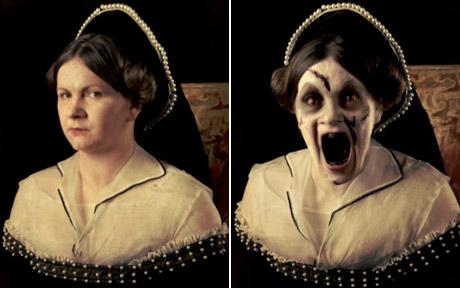
A lurid and frightening poster advertising the London Dungeons' forthcoming exhibition on the religious persecutions during the reign of Queen Mary I (r. 1553 - 1558) has been banned in London, after parents complained it was frightening their children. Understandably. Mary, who was the only child of Henry VIII and his first wife, Katherine of Aragon, earned the nickname "Bloody Mary" in the years after her reign, thanks to her government's systematic persecution of Protestant-Christians and religious dissenters.

The poster (above), which shows the 16th-century monarch transformed into a hideous zombie, plays to the old and inaccurate idea of Mary as being a psychotic and evil woman and it has understandably raised the heckles of not only the angry mothers of London, but also the biographers and historians who have recently been working on re-assessing Queen Mary's life and legacy.

I have an uneasy relationship with Catholic revisionism about this period in English history and this poster highlights the reasons why. On the one hand, it is both tasteless and absurd to have Queen Mary displayed as demonic zombie and it is a very good thing that historians are objecting to it. Recent work by people like Linda Porter, David Loades and Anna Whitelock have finally helped put Mary in her proper historical context: she ruled in an age when religious persecutions were the norm. Through their work, these excellent writers are finally beginning to make headway in persuading the reading public that Queen Mary was not so much evil as essentially misguided, as well as being highly capable in other areas of her life and reign.

However, the post on historian Stephanie A. Mann's excellent blog Supremacy and Survival about the poster controversy, raises why I am also uneasy about it. The noted historian, Leanda de Lisle, defends Queen Mary: -

“It really is an example of England’s knee-jerk anti-Catholicism and how our history of the Tudor period has been distorted by post-Reformation propaganda. What about Elizabeth? People may be aware of the executions of Catholics, but there were many more people. After the 1569 northern rebellion, Elizabeth ordered that a man was to be hung in every village associated with the rebellions. It was on a similar scale to her father."

Elizabeth ruled for forty-five years, compared to Mary's five, but de Lisle's point is a thoughtful one and a sensitively made one. However, in other arenas, the policy of trying to tear down Lady Jane Grey or Elizabeth I's historical reputation in order to rehabilitate Mary's is indicative of a worrying trend in English revisionist histories. Catholicism's past mistakes are now judged as products of a turbulent century; Protestantism's as the systematic cultural rape of Albion.


The portrait which inspired the poster: the real Queen Mary Tudor, painted by Antonio Mor, towards the end of her life (c. 1557)

Tuesday, 20 July 2010

The Finnebrogue Estates in Northern Ireland


Lord Belmont in Northern Ireland offers a fantastic account of one of the oldest and finest homes of the Protestant Ascendancy in Ulster - Finnebrogue.

The estate and the area, which lies near to my old school and was once owned by the Perceval-Maxwell family, is also famed for its production of the finest venison in the Province.

It's proved particularly interesting because I am working on a television script based on life amongst the Ascendancy in Ulster in the years surrounding the Partition of Ireland. Many of the show's characters will be real, including the designer of the Titanic, Thomas Andrews, who was himself part of the Ascendancy and various real-life politicians like Sir Edward Carson, Viscount Brookeborough, the fabulous Marchioness of Londonderry and the celebrated Jewish-Unionist, Sir Otto Jaffe, who twice served as Lord Mayor of Belfast. However, the show's main characters will be fictitious and the plan is for most of the story's fictitious families to have titles that did, in fact, once exist in the Irish aristocracy, but which had died out by the time the story commences (1911.)

In relation to Finnebrogue, one of the supporting characters - Helena FitzEustace - is the daughter of Baron Portlester (the real Portlester title died out in the reign of King Henry VII) and in the story, Helena marries Lord Wingfield Cromwell, the heir to the earldom of Ardglass. The Earls of Ardglass were Cromwells (from Thomas's side, not Oliver's) and the real family founded the area on which my school now stands. However, in reality, the Ardglass earldom died out in the reign of King James II, when the last earl, Lord Vere Essex Cromwell, died without heirs. However, in my script, the long-dead Vere did have children and so the Earls of Ardglass are still alive and flourishing in County Down into the 1900s.

The courtesy title enjoyed by the earl's heir was that of "Viscount Lecale" (Lecale was one of my school houses) and the Finnebrogue Estate actually came into existence partly through the generosity of the real Earls of Ardglass in the 17th century and their sons, the Viscounts Lecale.

As with many members of the Ascendancy class, the residents of Finnebrogue House played an important role in the life of Northern Ireland after the country was formally created in 1921, as Lord Belmont relates of the last of the Perceval-Maxwell to live on both house and estates: -

"Major John Robert Perceval-Maxwell DL, of Finnebrogue (1896-1963), was a farmer, a breeder of Shorthorns and Herefords and an active figure in the political and cultural life of Northern Ireland. He was a member of both the House of Commons and the Senate, and from 1945 to 1949 was Parliamentary Secretary in the Ministry of Commerce. He was also a founder member of the Northern Ireland Regional Committee of the National Trust (NT) in 1936 and for a time the Government of Northern Ireland's nominee on the Council of the NT in London. He was appointed a Deputy Lieutenant of County Down in 1935, and was High Sheriff in 1937."

Saturday, 17 July 2010

Sixteen Nuns Slaughtered on the Steps of the Guillotine


"I learned from a person who was a witness to their martyrdom that the youngest of these good Carmelites was called first and that she went to kneel before her venerable Superior, asked her blessing and permission to die. She then mounted the scaffold singing Laudate Dominum omnes gentes. She then went to place herself beneath the blade allowing the executioner to touch her. All the others did the same. The Venerable Mother was the last sacrificed. During the whole time, there was not a single drum-roll; but there reigned a profound silence."
- The Superior General of the Sisters of Charity of Nevers (1794) writing of the execution of sixteen Carmelite nuns by the French Republic

Despite having promised universal equality and freedom of religion, in 1794, during its official "Reign of Terror," the French Revolution ordered the execution of sixteen Carmelite nuns, the day after their Order's high feast day - the Feast of Our Lady of Mount Carmel. The evidence used to bring the nuns to the guillotine was a picture of the Sacred Heart of Jesus, a devotional device beloved by French Catholic royalists. An image of the Sacred Heart was found within their convent and was thus "proof" of their treasonous intentions against the new Republic.

The nuns were executed showing commendable bravery, singing hymns and kneeling to receive the blessing of their Reverend Mother, who was beheaded last. The crowd watching was mostly silent, out of respect, save for a few zealous republicans in the front rows. Not since the execution a few months earlier of the late King's sister, 29 year-old Princess Elisabeth, had the Parisian crowd seen such a heroic and deliberately Christian death. (The Princess had led the other dozen or so people sentenced to die with her in prayer, including a condemned mother and her son, as they mounted the steps of the scaffold. Like the nuns, who bowed before their Reverend Mother, those sentenced to die before the Princess, bowed or curtsied to her, as she was forced to sit next to the guillotine and watch them die, before she herself was beheaded.)

The blog Laudem Gloriae recounts the story of the Carmelite sisters' death, which I came across via Tea at Trianon.
Related Posts with Thumbnails