Friday, 4 November 2011

The Kings and Queens of Spain


So, after posting on the Kings of France and England, here's a list of the Kings and Queens of Spain which, it has to be said, is a pretty complicated and tumultuous list.

THE HOUSE OF TRASTAMARA AND THE ORIGINS OF THE SPANISH KINGDOM

Tuesday, 1 November 2011

November 1st, 1894: The death of Tsar Alexander III


"God, God, what a day! The Lord has called to Him our adored, our dear, our tenderly loved Papa. My head turns, it isn't possible to believe it." - Alexander III's son and successor, Tsar Nicholas II (1894)

Alexander III, forty-nine year-old Emperor of All the Russias for the last thirteen years, had ignored the advice of his doctors concerning his frequent insomnia, headaches and sore legs. They had advised their imperial patient to go and rest at Livadia, the Imperial Family's summer palace by the sea in the beautiful Crimea region in the south. Tsar Alexander, obstreperously distrustful of doctors and adverse to any sign of weakness, insisted upon sticking to the traditional schedule and instead went to Spala, his isolated hunting lodge in Russian-occupied Poland. There, the six-foot-four emperor continued to deteriorate and eventually his wife, the Empress Marie, summoned a medical expert from Vienna, Professor Leyden. The professor's diagnosis was grim and uncompromising. His Imperial Majesty had incurable nephritis, an inflammation of the nephrons of the kidneys, which would eventually prove fatal. Conceding defeat, Alexander left Spala to make the one thousand-mile journey to Livadia. 

Friday, 28 October 2011

A woman out of legend: The Life of Eleanor of Aquitaine, Queen of France and Queen of England (Part 2)


After a very long delay to this blog's Lives of the Queens of England series, here is part II of the three-part life of Eleanor of Aquitaine. Part I - Daughter of Riches - can be read here.

"My life, when it is written, will read better than it lived. Henry Fitz-Empress, first Plantagenet, a king at twenty-one, the ablest soldier of an able time. He led men well, he cared for justice when he could and ruled, for thirty years, a state as great as Charlemagne's. He married out of love, a woman out of legend. Not in Alexandria, or Rome, or Camelot has there been such a queen."- Henry II in the play The Lion in Winter by James Goldman (1966)

History loves a good romance. Some of its most famous couples, like Tsar Nicholas II and the Empress Alexandra, are remembered because of the intensity of their love for one another. Others, like Marc Antony and Cleopatra or Henry VIII and Anne Boleyn are remembered not so much for the nature of their love, but because of the melodrama that surrounded them. On 18 May 1152, a newly married couple emerged from the cathedral of Saint Pierre in the city of Poitiers in modern-day France (below). They were Henry of Anjou, nineteen year-old heir-presumptive to the English throne, and Eleanor of Aquitaine, the twenty-something ex-wife of the King of France. Henry and Eleanor emphatically belong to the latter category of famous historical couples. With them, it’s the drama, not the sentiment, which entices. Their marriage, celebrated less than two months after Eleanor’s divorce from her first husband, was born from political expediency, but it ended in civil war, rebellion, mutual recriminations, heartbreak and imprisonment.

Tuesday, 25 October 2011

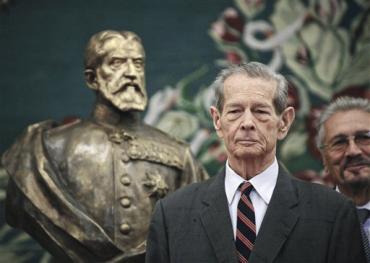
The King of Romania addresses Parliament on his 90th birthday


Looking remarkably good considering today was his ninetieth birthday, His Majesty King Michael I of Romania gave a strong and confident speech to the Romanian parliament in Bucharest, in which he begged the people of Romania to keep faith in the democratic institutions that had replaced the Communist dictatorship in 1989. The King spoke of the importance of remembering history and its complexities, but also warned politicians to look to the future and to serve the people in all that they did: "Tomorrow's world cannot exist without morals, without faith and memory. Cynicism, narrow interests and cowardice mustn't occupy our lives. They remind us too much of the years before 1989."

This was the first time in sixty-five years that His Majesty the King addressed the Romanian parliament. Michael I was forced to abdicate by the Soviet-backed Communist regime in 1947, when he was twenty-six years-old. When the King initially refused to co-operate, the Soviet occupiers threatened to shoot one thousand Romanians until he did so. Since 1989 and the fall of Communism, King Michael and his French wife, Queen Anne, have made frequent visits to Romania and from 1997, the republican Romanian government lifted all restrictions on the royal family's right to enter and reside in Romania. The King is a very popular figure in Romania and there are ongoing discussions about the possibility of restoring the monarchy in the country. Yesterday's speech by the King was thus boycotted by several republican politicians and by the President of Romania, Traian Basescu, a member of the Democratic Liberal Party who caused great controversy a few years ago by accusing King Michael of complicity in the Holocaust. Since Michael was technically Head of State during the Nazi occupation of Romania during the Second World War, President Basescu, who was suspended from office in 2007 amidst allegations of electoral fraud, claims he bears responsibility for the many Romanian deaths in the Nazi concentration and death camps. Paradoxically, President Basescu, a former member of the pre-1989 Communist party himself, also called the King "a slave to the Russians," in reference to Michael's abdication under pressure from the Soviets, who occupied the country at the end of the Second World War. The King did not respond to the accusations, but the president was fiercely criticised in the press at the time. 

A newspaper report on King Michael's birthday and speech can be read HERE.

Sunday, 16 October 2011

Remembering Marie-Antoinette


Today is the two hundredth and eighteenth anniversary of the terrible execution of Marie-Antoinette. The thirty-seven year-old Queen was beheaded by guillotine in what is now the Place de la Concorde just after noon on 16th October 1793. 

The Death: Here is my post on her execution from last year.

Marie-Antoinette the Christian: Professor de Oliveira defends Marie-Antoinette and discusses the strength of her Catholic faith (via Tea at Trianon)

Marie-Antoinette and fashion: my post on the young Marie-Antoinette's fashion tastes

Defending Marie-Antoinette: novelist Elena Maria Vidal discusses why she never said "Let them eat cake"

A one-man woman: Elena Maria Vidal gives an excellent discussion of the rumours regarding Marie-Antoinette and count von Fersen, as dramatised in the 2006 movie Marie Antoinette, starring Kirsten Dunst.

Birth: my post on Marie-Antoinette's birth in Vienna and her christening

Sunday, 9 October 2011

"Scathingly witty": Elena Maria Vidal's review of "Popular"


Regular readers of this blog may have read my reviews of Trianon and Madame Royale by American writer, Elena Maria Vidal. Now, Elena has very kindly posted her review of my novel Popular, which you can read in full by clicking HERE.

"Released in July 2011, Popular by Northern Irish writer Gareth Russell, is a scathingly witty and humorous romp dealing with privileged teenagers in Belfast. Now I must admit that before meeting Gareth and reading his novel I had a quite different picture of Belfast than I have now. Most of what I knew about Northern Ireland were the news stories of civil strife and terroristic violence which I heard throughout my life, and which made me resolve never to go there.
... It would be a mistake to classify Popular as another piece of trite teen fiction or chick-lit; it is much more. Popular, although it is a novel, has much in common with a comedy of manners, a drama which satirizes the manners and affectations of a particular social class with the emphasis on comic and witty dialog. It follows in the tradition of Molière's Le Misanthrope, Goldsmith's She Stoops to Conquer, Sheridan's School for Scandal and even the novels of Jane Austen. Most especially, Popular reminded me of such works of Oscar Wilde as The Importance of Being Earnest for its sheer entertainment quality and unapologetic aristocratic flair. Not surprisingly, Popular has already made the transition from book to stage play." 

Tuesday, 4 October 2011

October 5th, 1789: The revolution reaches Versailles

"At first only women showed themselves; the latticed windows of the palace were closed, and the Bodyguard and Flanders regiment were drawn up in the Place d'Armes... General consternation and disorder reigned throughout the interior of the palace... The insurrection was directed against the Queen in particular; I shudder even now at the memory of the fishwives, or rather Furies, who wore white aprons, which they screamed out were intended to receive the bowels of Marie-Antoinette... They mixed the most obscene expressions with these horrible threats." - Extract from the memoirs of Jeanne-Louise Campan, lady-in-waiting to Queen Marie-Antoinette
"The splendour falls on castle walls
And snowy summits old in story:
The long light shakes across the lakes
And the wild cataract leaps in glory.
Blow, bugle, blow, set the wild echoes flying,
Blow, bugle; answer, echoes dying, dying, dying." 
- From The Splendour Falls by Alfred, Lord Tennyson

Versailles, not just the political and administrative centre of France's absolute monarchy for the last century, but also its living, breathing cultural embodiment, fell early to the forces of the Revolution. A full four years and ten days before the guillotine blade sliced through the neck of its last queen, the legendary palace was breached and defiled. Today, it stands as a busy, bustling, slightly soulless museum, with little outward sign of the drama and trauma which swept over it at sunset on October 5th, 1789.
Related Posts with Thumbnails