Showing posts with label Communism. Show all posts

Monday, 22 April 2013

The weakness of Tsar Nicholas II


Ask any schoolchild or anyone with a passing knowledge of history to come up with one adjective they associate with Russia's last emperor and the majority of them will produce the word "weak." Nicholas II's weakness is as enduring an image in history as Cleopatra's sex appeal, Marie-Antoinette's frivolity and Winston Churchill's bullish patriotism. The idea that Nicholas was a weak-willed idiot was current in his own lifetime and eagerly encouraged by his enemies - particularly Leon Trotsky, the darling of the Bolshevik Left after they excused him for his complicity in the genocide of 1918 - 1921 in order to loudly proclaim that there would have been no genocide in the 1930s, had he, rather than Stalin, taken control of the Soviet Union after 1924. It was Trotsky who memorably proclaimed that Nicholas II had not had the intellectual capabilities necessary to run a village post office, let alone an empire. Anecdotes - like diary entries revealing that he played dominoes on the eve of the February Revolution or burst into tears in front of his cousin Sandro at the thought of inheriting the throne - are endlessly trotted out to prove that this was not only a man who couldn't rule, but who didn't want to, either. Louis XVI, the king whose rule ended in the French Revolution, is supposed to have made a similarly uninspiring start to his reign, when he and his wife Marie-Antoinette fell to their knees in prayer and asked God to guide them, because they were too young and inexperienced to reign. At the time, everyone saw the couple's actions as pious and humble; it was only once both of them perished on the steps of the guillotine that hindsight decided to endow their earlier prayer with a more ominous tinge - a clear sign that, even then, Louis XVI had known he was not up the job. In much the same way, in 1894, Nicholas's tears on becoming emperor seemed understandable in the context that his father had died very suddenly after a short illness and only an idiot would have looked upon the awesome task of ruling one-sixth of the Earth without reflecting on his personal capacities. By 1918, those tears had been re-written, even by Sandro, the main witness, who now claimed to have experienced an uneasy moment of foresight when he saw his cousin-tsar crying in front of him.

Nicholas II's weakness - his stupidity, his inability to make a decision, his incompetence - are often juxtaposed by the sympathetic assertion that allow he was a bad monarch, he was a good man. His devotion to his wife and their five children, coupled with the fact that hundreds of family photographs and letters managed to survive the revolution, are used to draw a clear distinction between his public failings and private virtues. Nicholas's love of physical exercise - even chopping wood and shoveling snow in winter - are subtly woven in by biographers to suggest that here was a man too simple, almost too good, to be tsar. After all, what kind of sovereign would enjoy such unkingly activities? Edward II, the English king deposed and murdered in 1327, enjoyed brick-laying and digging ditches; Louis XVI famously enjoyed working in a blacksmith's forge and was apparently a talented amateur locksmith. All three were unsuccessful rulers, but it seems an unhelpful and reductive dichotomy to suggest that a political, and specifically a royal, leader cannot execute their vocation properly if they happen to be interested in pastimes that are less-than-regal. Abraham Lincoln got his start splitting rails; Elizabeth I liked to do maths problems, linguistic translations and check her own household accounts; Frederick IX enjoyed conducting an orchestra; Prince Heinrich of Prussia could book-bind and Tsar Boris III of Bulgaria could drive steam engines. Equally, although many of history's great rulers were appalling family men, it does not necessarily follow that a being a faithful husband and attentive father with an interest in manual hobbies should equate with a dereliction of public duty.


The irony of the pervasive view that Nicholas II was chronically weak and indecisive is that it completely misrepresents Russian history - both the downfall of four hundred years of tsarism and the rise of eight fraught decades of Communism - because had Nicholas II been as malleable as Trotsky, Sandro and popular historiography suggests, his reign and the fate of the Russian monarchy would have been very, very different. In 1894, Nicholas dismissed calls for democracy in Russia as the agenda of "senseless dreamers." For an entire decade, despite mounting pressure, he maintained that position. It was only thanks to the near-total collapse of law and order during the riots of 1905, the assassination by nail bomb of his uncle Sergei and numerous government ministers, defeat in the war with Japan and the impassioned advice of his finance minister, Count Witte, that Nicholas gave way and granted Russia a constitution, a parliament and elections. He did so after much thought and under the assurance that this sacrifice would bring the uprising to an end. It did not and Nicholas never forgave Witte or the liberals for what he saw as an humiliating trick. Nonetheless, from 1906 until 1914, Nicholas stuck with the bastardized version of a constitutional monarchy that he and Witte had created. He was certainly as far to the Right as it was possible to go without actually being the wall, but he did not budge from that position. When it came to the matter of Rasputin, his wife's spiritual adviser ludicrously alleged to be her lover, Nicholas stuck to a middle course of allowing Rasputin access to the palace in order to pray over his haemophiliac son Alexei, which pacified the Empress and her clique, but refused to listen to Alexandra's increasingly-pious belief that Rasputin was in touch with the true will of the Russian people. Nicholas knew that his wife was on the verge of a near-permanent mental breakdown because of their son's health and that she blamed herself; her belief that Rasputin was a saintly, practically virginal, peasant man of God plucked from Siberia like the shores of Galilee was unshakable and although Nicholas did not agree with her, he always seemed to regard Rasputin as absurd but inoffensive and slightly quaint. He allowed Alexandra to talk about him, but until the final months of imperial rule, he never, ever listened to her too seriously.

It was only in the last two years of his rule, between assuming direct control of the imperial armies in 1915 and his abdication in 1917, that Nicholas began to show signs of being unfit to rule. The overwhelming impression that emerges from his surviving letters is here was a man suffering from war fatigue, exhaustion and nervous distress. The patriotic fervour of 1914 had given way to the horrifying realization that Russia was fighting two, and then three, and then four, enemies on the Eastern Front, single-handedly. The casualty figures were astronomical and, with little sleep and no way out apart from surrender to Germany, Nicholas seems to have shattered under the unheard-of pressure. That may not have been how his father would have reacted, but the point of this article is not to argue that Nicholas II was a great tsar. He wasn't. But he was, for the most part, an adequate one.

Had Nicholas been as spineless as he is so often presented, the Russian autocracy might have died in 1894 or 1906. It did not. Nicholas did everything he could to keep as much of it alive as possible. That decision turned out to be a disastrous one, but it was one he stuck to devotedly, even as it cost him much of his physical and mental health. He had neither the charisma nor chutzpah of earlier Russian sovereigns like Catherine the Great or Alexander I, but he was dedicated to his office and tireless in the amount of work he put into it. The image of a man caring for the devoted and unwell Alexandra, four beautiful daughters and one sickly son as his archaic empire fell apart around him is arresting, but it is also misleading. Nicholas II loved his wife, he loved his children, but he also loved his country and his dynasty and he did his best for them. 

Nicholas II was strong in his beliefs. Perhaps too strong. He ignored the advice of family members, even, at times, Alexandra's and his mother's, both of whom he's often accused of being dominated by. He was an ultra-conservative, who only moved briefly into the liberal camp because he believed it was best for Russia. He cracked under the pressure of the First World War, but before that he had defended and supported very talented men in his government - chief amongst them Peter Stolypin. It was that strength, bordering on obstinacy, which brought about some of the successes and many of the failures of Nicholas II's reign, which should not solely be remembered by the final two months that brought it to an end. So often reduced to a simplistic dismissal - "good man, bad tsar, weak and unprepared" - Nicholas II's reign deserves to be understood as far more complicated and far more nuanced than either his romantic defenders or his most vicious critics allow. Nicholas II's successes and failures are a reminder that all history is more complex than it's usually given credit for.


Friday, 28 September 2012

Missing Royals and Murder Mysteries: Anastasia and the allure of romance


The story of Anastasia Romanov is one of the great melodramas of royal history. In life, the real Grand Duchess Anastasia was the teenage daughter of Russia’s deposed emperor, Nicholas II. Her father had lost his throne during the revolution of 1917 and the entire family had subsequently been deported to Siberia. In July 1918, they were herded into a cellar and shot by local Communists. Their bodies were then stripped, doused in acid, hurled down a mineshaft and buried in a forest. In 1991, geologists announced they had discovered the bodies and surviving releatives of the Romanovs - including Britain's Prince Philip - were asked to provide DNA samples to help with the identification.

But between 1918 and 1991, no one knew, for sure, what had really happened to the Romanovs. The dishonesty and habitual secretiveness of the Soviet Union, the absence of the family’s corpses and rampant media speculation led to rumours that one, or more, of the Imperial Family had survived the massacre. By the 1920s, attention had narrowed to a single candidate – the youngest of the Tsar’s daughters, Anastasia, who had been seventeen at the time of her alleged murder. 

Why Anastasia became the centre of the greatest conspiracy theory of the twentieth century is hard to say. Maybe it was because the name ‘Anastasia’ has links to the theme of resurrection in the Russian language or maybe because it was the unconscious allure of the youngest princess (a favourite phrase in fairy stories.) For whatever reason, it was Anastasia who became fixed in the public’s mind as the 'one who got away,' whilst her three sisters faded into the history books as victims of the October Revolution. 

In time, the most famous of all the pretenders was a woman who travelled under the false name of ‘Anna Anderson,’ and who had first made the claim that she was Anastasia when she was recovering in a German mental asylum after a failed suicide bid in 1920. Anderson’s claim attracted global attention and she prosecuted the longest court case in European history trying to have her claim legally recognised. Some of her supporters included the Duke of Leuchtenberg, the Kaiser’s aging daughter-in-law Crown Princess Cecilia, the children of the doctor who had died alongside the royals in 1918, Anastasia’s childhood playmate who was now a wealthy American socialite called Xenia Leeds, the famous composer Sergei Rachmaninoff, the real Anastasia’s cousin Grand Duke Andrei, and, later, several prominent historians. However, there were notable dissenters – not least amongst them Prince Felix Yusupov, who called Anderson ‘an adventuress’ and ‘a horrible creature,’ the real Anastasia’s godmother the Grand Duchess Olga Alexandrovna, the real Anastasia’s cousin Princess Irina, several of the Tsarina’s surviving ladies-in-waiting, the real Anastasia’s French tutor Pierre Gilliard, the real Anastasia’s nursemaid Shura Tegleva, and the real Anastasia’s uncle Ernest, the deposed Grand Duke of Hesse. Ernest in particular became so incensed by Anderson that he spent years obsessively tracking down who she might really be instead. Eventually, he put forward the theory that Anna wasn’t a Russian princess at all, but a missing Polish factory worker called Franziska Schanskowska.


Anderson’s claim, and her court case, helped ensure Anastasia’s place in popular legend. The myth spawned several plays and movies – including the magnificent Oscar-winning Anastasia in 1956 (above), in which Anderson was played by Ingrid Bergman and her Danish grandmother was played by the ‘queen of Broadway,’ Helen Hayes; there was also a 2-part television movie in 1986, Anastasia: The Mystery of Anna, which had an impressive all-star cast that included first-time-actor Christian Bale (as Anastasia’s younger brother, Alexei), Amy Irving as Anna Anderson, Rex Harrison (in his last movie) as Grand Duke Cyril Romanov, Gone with the Wind’s Olivia de Havilland as Anastasia’s royal grandmother, Brideshead Revisited’s Claire Bloom as the Tsarina Alexandra and Oscar-winner Omar Shariff as Tsar Nicholas II. And, of course, there was the romantic 1997 musical cartoon Anastasia (below), with the voices of Meg Ryan, Kelsey Grammer, Angela Lansbury, Christopher Lloyd, John Cusack, Hank Azaria, Bernadette Peters and Kirsten Dunst. 


However, it is now absolutely impossible for any rational human being to persist in the belief that Anastasia Romanov lived beyond the massacre of 17th July, 1918. If she did survive the initial gunfire, she did so only by a matter of hours. When the bodies of the Romanovs were first unveiled to the world in 1991, it did admittedly seem as if Anna Anderson (below) might have been telling the truth, because two were missing. Scientists eventually confirmed that the absent corpses belonged to one of the Tsar’s daughters and to his only son, Alexei. Even by the time the bodies were ceremonially reburied in the Romanovs’ splendid Saint Petersburg crypt in 1998, the two missing skeletons had still not been found. Admittedly, many scientists insisted that the real Anastasia’s body was actually one of those being buried and that the missing princess was her elder sister, 19 year-old Maria. Supporters of Anderson responded by claiming that Maria and Anastasia had been so close in age and physical appearance that the scientists had mistaken Maria’s body for that of her younger sister – who, they believed, had survived the massacre, lived under the name Anna Anderson and died in Virginia at the age of eighty-three in 1984. 


But ten years later, in 2008, the last two royal bodies were discovered near the original burial pit. One of the Romanovs’ executioners had left records indicating that they had desperately tried to burn two of the bodies and, eventually, scientists were able to confirm his testimony. The bodies of Maria and Alexei Romanov were discovered near the site of the fire and at some point they will presumably rejoin their family in their Saint Petersburg tomb. In a final twist, DNA tests on a surviving scrap of intestine left from an operation undergone by Anna Anderson in the 1970s confirmed that Anastasia’s seemingly-paranoiac uncle Ernest had been right all along. Anderson wasn’t related to the Romanovs, but she was related to the Schanskowska family. Anna Anderson may have ended her life claiming to be the daughter of a tsar, but she had started it as the daughter of a penniless Polish factory worker.

Anderson’s claims have therefore been conclusively debunked and the body of the real Grand Duchess Anastasia rests inside the Peter and Paul Fortress of Saint Petersburg. But, incredibly, there are still those who refuse to accept that Anastasia died alongside the rest of her family in 1918 or that Anderson was nothing more than an extraordinarily gifted fraudster. What they're arguing is logically impossible, so why continue to cling to a belief that science and history have both debunked?

Part of the reason, I suspect, is that Anastasia was the last of a trinity of royal mysteries that have exercised and excited our curiosity for centuries. The other two are the missing Princes in the Tower and the ‘lost king of France,’ little Louis XVII, who disappeared at the height of the French Revolution. They died centuries apart, but there are similarities in their cases and in why they should still be studied today.


I don't believe that the princes in the Tower (above) survived or that they ever left its walls after 1483. If Richard III had shown unexpected clemency by allowing one, or both, to leave in the months after he became king, then it’s hard to see why he wouldn’t have paraded them through the streets when his regime was slowly being eroded by claims that he had murdered them. Furthermore, why would their mother agree to a scheme that would place Henry Tudor on the throne if she knew that her sons were still alive? There is, above all, absolutely no evidence – none whatsoever – that points to them having lived beyond 1483. There is plenty of passionate speculation, but nothing else. Bodies that are almost certainly theirs were discovered within the Tower’s walls in exactly the place that Saint Thomas More had said they were in, in his excoriating biography of their uncle. It’s too big a coincidence to dismiss. And, finally, if they did leave the Tower then where did they go after 1483? Narnia?


Louis XVII (above) died in horrible conditions, after months of physical and psychological abuse. He was ten years-old at the time and both his parents, Louis XVI and Marie-Antoinette, had already gone to the guillotine. He was autopsied in the prison but then he was almost certainly hurled into a mass grave. We have no idea where and probably never will. It is only because his heart was removed during the autopsy that tests were able to be performed in the twenty-first century that confirmed that Louis had indeed died in prison in 1795. 

And as for Anastasia: if eyewitness accounts of the Imperial Family’s murder are to be believed, she died towards the end of the massacre, after being repeatedly beaten and stabbed by Bolshevik soldiers. 

These are the awful, hideous, heartbreaking facts behind the three greatest mysteries in royal history and a million miles removed from the fairy tales they have spawned.

All four of these young royals – Edward V, his brother Richard of Shrewsbury, Louis XVII and Grand Duchess Anastasia of Russia – disappeared in times of turmoil and secrecy. Richard III could not reveal what he had done with the boys, or allowed to be done to them, without fears of toppling his own regime. The French Republic felt that drawing attention to the appalling treatment the little boy had suffered in jail would only inflame royalist sympathies and the fledgling Bolshevik movement were concerned that Kaiser Wilhelm II would back-out of his recent truce with them if he discovered what had happened to his cousins. The myths about their survival are therefore perfectly explicable by a process of historical logic: initially, no one knew exactly what had happened to them which led to them speculating about possible explanations. I suspect, of course, that it’s more than that and that the reason why so many people believed, or believe, in these fantastic tales of  imperial survival is because the allure of fairy stories never quite leaves us – however hard we try. We want to believe in royal glamour, excitement, danger and happily-ever-afters. We want to believe, I suppose, in some form of magic. 

What do we do with these stories, though, once we know they’ve been disproved? (In Anastasia’s case, and Louis XVII’s, definitively; in the case of Edward V and Richard of Shrewsbury, by all laws of probability.) Well, as a writer, I see nothing wrong in continuing to dramatize them. As long as you don’t get so caught up in your own fiction that you try to mislead people, I still think there’s a place for stories of lost princes and princesses. And why not? When I think of Edward, Richard, Louis and Anastasia, I often hear the words of poor Briony Tallis in Ian McEwan’s Atonement: ‘What sense of hope or satisfaction could a reader derive from an ending like that? So in the book I wanted to give Robbie and Cecilia what they lost out on in life. I’d like to think this isn’t weakness or evasion, but a final act of kindness.’ Robbed of a real life by their families' enemies, I suppose that there is a kind of kindness in giving these children a fictional afterlife. 

But the historian in me wants people to see that the real stories of these children are important in their own right. They are celebrity poster-children against what we are capable of, but shouldn’t be. They’re what happens when politics runs amok. Edward V and his little brother perished at the end of a brutalising century, in which political corruption and ruthless communal ambition had warped the moral fabric of an entire generation. Louis XVII and Anastasia Romanov died because their very existence was inconvenient to a new form totalitarian form of politics. The children did not ‘fit’ into the revolutions’ grand new vision of the world. As a result, in a world without compromise, they were expendable. Leon Trotsky himself dismissed Anastasia’s murder with a shrug, boasting that the horror it had caused would help unite the Red Army in fear behind the Communist cause. What we should be doing now is not focusing too much on what might have happened, but on what did happen. These dead children matter because their fates illuminate the fates of so many others who we now know only by statistics; they give us warnings, not just about politics but about the nature of humanity. Reflecting on the death of Louis XVII, one French royalist lamented that the child had been cut down ‘on the threshold of life.’ These four children died horribly, they died unfairly and they died illegally. Their stories should remind us that we should never go too far in the name of politics, to never cheapen our respect for the sanctity of human life and to remind us that we should never turn our backs on protecting the weak and the vulnerable.


Tuesday, 17 July 2012

17th July 1918: The Execution of the Imperial Family


"Remember that the evil which is now in the world will become yet more powerful, and that it is not evil which conquers evil, but only love." - Grand Duchess Olga of Russia, four months before her death in 1918.
In the early hours of 17th July 1918, eleven people were brutally murdered in the cellar of a house that stood near the centre of Yekaterinburg, a medium-sized city in the middle of Russia's Ural mountains that drew most of its employment from the local mining industry. The deaths of eleven people in the summer of 1918 is hardly remarkable. Millions of young men were still dying on the battlefields of the First World War; the Spanish influenza pandemic was about to claim the lives of nearly seventy million people worldwide and for the last fifteen months, Russia had lurched from one political crisis to another. It was now in a state of civil war, political terror and social unrest. The downfall of the Russian monarchy in February 1917 and the collapse of the democratic republic set-up to replace it after only ten months had resulted in the world's first Communist regime coming to power in Russia. Led by Vladimir Lenin and the Bolshevik party, Communism would continue to rule over Russia until 1991, but in 1918 it was faced by a formidable cabal of enemies.  It was by no means certain that it would survive. Hatred of Communism had led to monarchists, democratic republicans, moderate socialists and liberals allying with one another in the shared common goal of destroying Communism's hold over Russia. Communism had responded with an official policy known as "the Red Terror," which saw mass arrests, intimidation, widespread torture, spying, the suspension of civil liberties, numerous executions, assassinations and punishment beatings. By July 1918, thousands were perishing as a result of the Red Terror and many more were dying because of the civil war between the new Communist government (known as the "Reds") and its opponents (known as the "Whites".)

Amidst all this carnage, why were the deaths of those eleven people in Yekaterinburg considered so important? Well, it was because seven of the eleven were members of Russia's deposed imperial family - 50 year-old Tsar Nicholas II, his British-German wife Alexandra, their four daughters - Olga (22), Tatiana (21), Maria (19) and Anastasia (17) - and their 13 year-old brother, Alexei. As with most things associated with royalty, the symbolic significance attached to them went far beyond the issue of personality or an individual life. For three hundred years, the House of Romanov had been regarded by millions of Russians as the living embodiment of the Russian nation. The Tsar had been appointed by God to rule over one of the largest empires in history and as head of the government, army, church and court, the Romanov emperors were believed to stand far closer to God than to the rest of humanity. The savage execution of the last of the Romanov tsars was intended to cripple the Russian monarchist movement and to rob them of their most valuable figurehead - the same rationale justified the execution of Nicholas's teenage son, Alexei. It was also designed to shatter the mystique of three hundred years of monarchy. However, it was not the execution of the ex-emperor and his son which caused the most comment - then or now. It was the decision to murder his four daughters - without a trial, in secret and when none of them had any political power. Lenin's right-hand man, Leon Trotsky, later admitted that the girls were murdered because it would send a psychological message to the Russian people: it would show that there was no turning back and that anything that stood in the way of Communist victory in Russia would be ruthlessly eliminated. In a nutshell, it was terror for terror's sake.

Ever since the collapse of the monarchy, the Tsar and his family had been living under house arrest. As time had gone on, the conditions of their detention had deteriorated. Immediately after the first revolution, they had lived in their former home at the Alexander Palace near Saint Petersburg, where they still had access to many of their servants and where there had initially been plans to send them abroad to live in Britain, France, Switzerland or Spain. For their own safety, they were then moved to the town of Tobolsk in Siberia, where they lived in a former governor's mansion. In April 1918, they were moved to Yekaterinburg, where they were imprisoned in the Ipatiev House, a merchant's home which was heavily fortified and where the family were guarded by a local division of the Cheka - the feared Communist secret police. For the last few weeks, the Cheka had been making preparations to kill the entire family and their four remaining servants. The White armies were closing in on the area and Lenin had signed off on the idea, telegraphing the local branch of the Communist party from Moscow giving his firm and unequivocal approval that all the Romanovs now in captivity should die. The task of organising the logistics of the execution fell to a man called Yakov Yurovsky, a forty-year old member of the Cheka who was in charge of security at the Ipatiev House. The meetings had taken place in the town's local "American Hotel." It was decided to murder the family in the Ipatiev House's cellar, disfigure their bodies with sulphuric acid and then hide the remains in the nearby forest.

At half-past one in the morning of 17th July, Yurovsky went upstairs and woke Dr. Eugene Botkin, the imperial family's private doctor and a staunch monarchist who had chosen to share imprisonment with his employers. The doctor was asked to wake the family; Yurovsky fed him the lie that because of fighting in the area, the Soviet government had decided to move the family to another location. In the meantime, artillery fire had been heard in the forest and Yurovsky thought it best if the family took shelter in the cellar downstairs. Botkin knocked on the Imperial Family's doors, informing the Tsar first - as protocol demanded. Nicholas II dressed quickly and efficiently, before turning his attention to waking his son. The Tsarina Alexandra and her four daughters took a lot longer to get ready - Yurovsky later estimated it taken them over half an hour - perhaps because Alexandra's bad back required her to be dressed slowly and with great care. Eventually, they emerged from their rooms and Yurovsky noticed that Nicholas was carrying his thirteen year-old son in his arms. Alexei (above) suffered from haemophilia, a rare genetic blood disease that meant his blood had an inability to clot properly. He had recently suffered another spate of ill-health and without constant exercise, he was finding it difficult to walk. 

As they walked down the stairwell and through the house, the Imperial Family stuck rigidly to the etiquette which demanded they walk in order of precedence. Nicholas and Alexei went first, followed by Alexandra, who was in a great amount of pain and leaning on the arm of her eldest daughter, Olga. One of the other guards, Victor Netrebin, remembered later that he was struck with how thin and tired the Tsarina and her eldest daughter looked. Twenty-two year-old Olga's dramatic weight loss and intermittent bouts of depression had been remarked upon by other eyewitnesses, who had also noted that the stress of captivity had aged the young Grand Duchess prematurely. Coming up behind her were her three younger sisters, Tatiana, Maria and Anastasia, whom Netrebin would later contrast with Olga by saying how pretty they all looked - moments from death. The youngest of the princesses, Anastasia (17), was carrying her sister Tatiana's pet Pekinese dog, Jemmy. After that came the family's four servants - Doctor Botkin, the Tsar's valet Alexei Trupp, the family's private chef Ivan Kharitanov, and the Tsarina's maid, a tall blonde called Anya Demidova. Demidova was carrying pillows to alleviate the Tsarina's chronic backache.

Contrary to later Hollywood dramatisations of the execution, the family did not go straight into the cellar. The basement of the house was actually separated from the main body by a small courtyard and so the group momentarily stepped outside for one last time, into the warm July night air. Then they re-entered the house by a second door and descended a flight of twenty-three stairs. The room that they were told to wait in was a cross between a storage facility and a traditional cellar. There were double doors at the back, leading to more storage space, which Yurovsky had cleverly locked beforehand. There was also a barred window and a single harsh light-bulb, casting a cold, brutal light over the room. Alexandra (above), who suffered from terrible migraines, heart palpitations, intermittent dizziness and excruciating sciatica, immediately expressed her incredulity that there were no chairs for her to sit on. Later the Communist guards were to mock her for her imperious demand, but given the level of physical agony the Empress was in, it was surely an understandable request. Her health had not been good since the birth of her youngest daughter in 1901 and the stress of the revolution, coupled with what she saw as the humiliation of imprisonment, had nearly killed her. For the last year, she had been administered a substantial number of opiates and even cocaine-laced medication by Dr. Botkin. They were standard early twentieth century treatments for her many ailments, but with medical supplies dwindling, the Tsarina was likely suffering some kind of withdrawal symptoms now, as well. The guards, who hated her more than any other member of the family, reluctantly brought in two chairs. The Tsar lowered his son onto a chair and then stood protectively in front of him, whilst the four girls and their maid helped Alexandra sit on the other one. The three eldest daughters then stood behind their mother's chair, whilst the youngest, Anastasia, stood in the back corner, chatting to the servants. Yurovsky then left them all alone for about half an hour, whilst he went upstairs to go over the final preparations. In the meantime, the execution squad were getting nervous and many of them tried to calm their nerves with numerous shots of cheap vodka. A Fiat truck was brought round to the courtyard. Hearing the noise from the basement, the family must have assumed it had come to take them out of Yekaterinburg. In reality, it was to transport their bodies for dismemberment and burial.

After half an hour, the double doors into the cellar swung open, to reveal Yurovsky standing with ten other men. The official justification for the execution was to be the support that some of the Romanovs' foreign royal relatives were giving to the White armies (Britain was supporting them and Nicholas II was King George's cousin.) Yurovsky cleared his throat and read out a brief statement: -

In view of the fact that your relatives in Europe are continuing their assault on Soviet Russia, the presidium of the Ural Soviet had sentenced you to be shot. In view of the fact that the Czechoslovaks are threatening the red capital of the Urals - Yekaterinburg - and in view of the fact that the crowned executioner might escape the people's court, the presidium of the Regional Soviet, fulfilling the will of the Revolution, has decreed that the former Tsar Nicholas Romanov, guilty of countless bloody crimes against the people, should be shot.

There were some words of incoherent, stunned protest from the Tsar and Dr. Botkin. The Tsarina and Olga, the two most intensely religious members of the family, immediately crossed themselves and began to pray. Yurovsky then calmly pulled out his Colt pistol and shot Nicholas II directly in the heart. Eager to claim that they too had played a part in killing the last Tsar, three other men then turned their guns on Nicholas and fired into his corpse. 

A hail of bullets was then unleashed upon the screaming people in the cellar. The Tsarina died almost instantly, mid-prayer, when she was struck on the left side of the skull. The valet and the cook - Alexei Trupp and Ivan Kharitanov - received multiple gunshot wounds in the first few minutes and died either from a direct hit or from heavy bleeding shortly after. There is some confusion over what happened to the Grand Duchess Olga (left), whose corpse was later shown to have a bullet wound in the jaw. The trajectory of the impact would indicate that the bullet hit her when her head was thrown back and upwards, perhaps indicating that she, too, died very quickly and was quite possibly knocked backwards by the collapsing bodies of either her father or mother. As she stumbled backwards, one of the stray bullets shot upwards through her jaw and killed her instantly.

The room had by now filled with smoke and visibility was poor. It almost certainly stank, too, as the bodies expelled their fluids as they went into their death-throes. Yurovsky ordered a temporary halt and took the men back outside to re-load their weapons and fetch some rifles with bayonets, which could be used to stab any victims who survived the next attack by gunfire. Re-entering the cellar, Yurovsky saw that Dr. Botkin, who sustained several bullet wounds to the abdomen, was crawling along the ground to lie next to the body of his emperor. Yurovsky shot him twice in the head, before turning his attention to the rest of the room. The two youngest girls - Maria and Anastasia - were huddled in the corner of the room, shrieking hysterically and Maria was trying desperately to claw at the doors in the hope of escape. Tatiana, their twenty-one year-old sister, was generally considered the most beautiful and elegant of the Romanov sisters. Innately conscious of her royal rank, she had been the most right-wing member of the imperial family, after their mother. Now, she was shielding her two younger sisters with her own body and today, Tatiana's remains are the most badly damaged of all the Romanovs'. Seeing Yurovsky approach her, the Grand Duchess dragged herself to her feet to face him and was shot point-blank through the head. She died standing. A very brave young lady. 


Maria and Anastasia (above) were then dispatched by being beaten, shot and stabbed to death by the remaining guards. One of them, a local Communist called Peter Ermakov, admitted to lunging at them like a wild beast and some of the guards allegedly vomited or fled the room at the sound of the girls' screams. Their little brother, Alexei, was repeatedly beaten as he clawed pathetically at his father's coat. Yurovsky intervened to stop the beating; he shot the boy twice through the ear, ending his life. The family's screaming maid, Anya Demidova, was the last to die - apparently from repeated stab wounds from the company's rifle bayonets. It had taken nearly half an hour to massacre the entire family; as Yurovsky would later remark in a stunning under-statement - "It is not easy to kill people."

The bodies of the Imperial Family and their servants were then pumped with the remaining bullets, to ensure that they really were all dead. They were then stripped and taken out to the truck. Yurovsky had them driven into the forest, where they were all doused in sulphuric acid to disfigure them, dismembered and set on fire. Then, they were hurled down a mine-shaft.

It had been a horrible, violent, lawless death - carried out in secret, without a trial or without justice. It was a fate that was to befall millions of ordinary Russians in the years under Communist rule - a system of government which has still, inexplicably, managed to escape the historical condemnation it so richly deserves. The Soviet Union was a depraved and genocidal regime, which even on its best days bore all the qualities of a sociopath. It was devoid of morality or respect for human life. It was infinitely worse than any regime in Russian history. And although it had technically come to power in October 1917, it was the events in Yekaterinburg on 17th July 1918 that should arguably be seen as the Soviet Union's true birth-date. Everything that defined it and everything that it was prepared to resort to was contained in how it executed the Romanovs. As Trotsky so rightly pointed out, with his chilling disinterest in human suffering - it proved that there was no going back. It defined what was to come.

Thursday, 24 November 2011

Extraordinary scenes of devotion to the Virgin Mary in Russia


An ancient relic, long venerated as a girdle or belt which belonged to the Virgin Mary, has completed its ten city-tour of Russia, after being loaned to the Russian Orthodox Church by the famous Mount Athos monastery in Greece, where it is usually kept and guarded. 

In an extraordinary display of the strength and vitality of Christianity in Russia after the downfall of the Soviet system, nearly half a million people queued for days in sub-zero temperatures to see the relic when it made its final stop in Moscow. The Church authorities were forced to extend its display in the cathedral by three days, whilst the secular authorities had to introduce fifteen hundred more police onto the street and re-route traffic.


The relic was displayed at the Cathedral of Christ the Saviour (above) which has special significance for Christianity's struggle against Communism in Russia. Originally created to give thanks for Imperial Russia's victory over the French invasion led by Napoleon Bonaparte in 1812, it was remodelled several times and went through extensive renovations, before finally being consecrated as the largest Orthodox church ever built on the same day as the penultimate Romanov tsar to date, Alexander III, underwent his coronation. The cathedral had a long and extensive gallery honouring the war-dead from the wars of 1812. After the Revolution, the Soviet regime decided to destroy the cathedral in order to replace it with a building called "the Palace of the Soviets," a modernist monument to the October Revolution. In 1931, on Stalin's orders, the cathedral was dynamited and reduced to rubble. The "palace of the Soviets" was never completed due to lack of funds and time, with Stalin presumably being kept busy with the business of genocide. In the 1950s, the site was turned into a public swimming pool.

After the fall of Communism, a replica of the cathedral was faithfully rebuilt as a symbol of the resurgence of Russian Orthodoxy after seven decades of hardship.

You can watch the desecration and demolition of the original, HERE.
And The Daily Telegraph has an excellent article on the veneration of the relic at Christ the Saviour, HERE. 

Tuesday, 25 October 2011

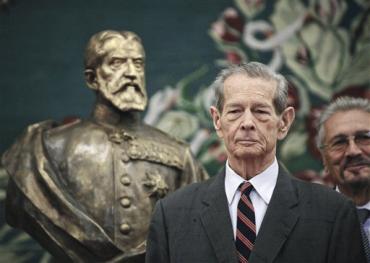
The King of Romania addresses Parliament on his 90th birthday


Looking remarkably good considering today was his ninetieth birthday, His Majesty King Michael I of Romania gave a strong and confident speech to the Romanian parliament in Bucharest, in which he begged the people of Romania to keep faith in the democratic institutions that had replaced the Communist dictatorship in 1989. The King spoke of the importance of remembering history and its complexities, but also warned politicians to look to the future and to serve the people in all that they did: "Tomorrow's world cannot exist without morals, without faith and memory. Cynicism, narrow interests and cowardice mustn't occupy our lives. They remind us too much of the years before 1989."

This was the first time in sixty-five years that His Majesty the King addressed the Romanian parliament. Michael I was forced to abdicate by the Soviet-backed Communist regime in 1947, when he was twenty-six years-old. When the King initially refused to co-operate, the Soviet occupiers threatened to shoot one thousand Romanians until he did so. Since 1989 and the fall of Communism, King Michael and his French wife, Queen Anne, have made frequent visits to Romania and from 1997, the republican Romanian government lifted all restrictions on the royal family's right to enter and reside in Romania. The King is a very popular figure in Romania and there are ongoing discussions about the possibility of restoring the monarchy in the country. Yesterday's speech by the King was thus boycotted by several republican politicians and by the President of Romania, Traian Basescu, a member of the Democratic Liberal Party who caused great controversy a few years ago by accusing King Michael of complicity in the Holocaust. Since Michael was technically Head of State during the Nazi occupation of Romania during the Second World War, President Basescu, who was suspended from office in 2007 amidst allegations of electoral fraud, claims he bears responsibility for the many Romanian deaths in the Nazi concentration and death camps. Paradoxically, President Basescu, a former member of the pre-1989 Communist party himself, also called the King "a slave to the Russians," in reference to Michael's abdication under pressure from the Soviets, who occupied the country at the end of the Second World War. The King did not respond to the accusations, but the president was fiercely criticised in the press at the time. 

A newspaper report on King Michael's birthday and speech can be read HERE.

Monday, 4 July 2011

Obituary: Otto von Hapsburg, Crown Prince of Austria (1912 - 2011)

I was saddened to hear today of the death of His Imperial and Royal Highness Crown Prince Otto of Austria, Hungary, Croatia and Bohemia. His Imperial Highness was the eldest son of the last Emperor of Austria, to date, Karl I, who ruled the Austro-Hungarian Empire during its final traumatic years from 1916 to 1918. Despite Karl's heroic attempts to end the carnage of the First World War, the chaos and unrest which swept Europe in 1918, coupled with American hostility to the idea of negotiating with a semi-absolute monarchy, eventually swept the Hapsburgs off the throne they had held for nearly eight centuries and their vast empire disintegrated into eleven smaller nations and a generation of instability. Karl, his wife Zita and their children, including six year-old Otto, were banished and despite various attempts to restore the monarchy in Hungary, Emperor Karl died in exile on the Portuguese island of Madeira in 1922. His widow, now Dowager Empress, endured an extraordinarily long widowhood, dying in 1987. In recognition of the late emperor's devotion to the cause of peace, his abhorrence of violence and the strength of his devotion to the Christian faith, he was beatified by Pope John Paul II in 2004. 

In deference to the politics of the time, Otto, who was ten years old when his father died, chose not to adopt the title of "emperor" in exile and instead settled on being referred to as Crown Prince, showing that he very much considered himself to be an emperor-in-waiting. He relied very much on his close relationship with his mother and his large brood of siblings, all of whom showed characteristic Hapsburg determination in carving out new lives for themselves in the modern era. The Crown Prince's younger sister, Archduchess Charlotte, for instance, became a welfare worker in East Harlem.

Thursday, 29 July 2010

Ritual Shaming of the North Korean Football Team

As if any more proof was needed, the sheer horror of living in a Communist country is shown by this news story, in which the North Korean football team was subjected to a 6-hour long public shaming by the regime as punishment for their failure in the recent World Cup.

The story is reported here.

Saturday, 17 July 2010

July 17th, 1918: The Execution of the Romanovs


"The decision was not only expedient but necessary. The severity of the summary justice showed the world that we would continue to fight on mercilessly, stopping at nothing. The execution of the Tsar's family was needed not only in order to frighten, horrify, and dishearten the enemy, but also in order to shake up our own ranks to show that there was no going back."
- Leon Trotsky (1879 - 1940)

"With the saints give rest, O Christ, to the soul of your servant where there is neither pain, nor sorrow, nor suffering but life everlasting."
- A Russian Orthodox prayer for the dead, contained within the last Church service the Romanovs ever attended on Sunday July 14th 1918. The officiating priest, Father Storozhev, reported that the Tsar's daughters had tears in their eyes as they said the prayer.

Today is the 92nd anniversary of the execution of the Imperial Family of Russia by their Communist captors, acting on the orders of Vladimir Lenin and the Moscow Soviet, in 1918.

Those slaughtered on that terrible night were Nicholas II, the former Emperor of All the Russias, his German-born but British-educated, the Empress Alexandra, their four daughters, 23 year-old Grand Duchess Olga, 21 year-old Grand Duchess Tatiana, 19 year-old Grand Duchess Maria, 17 year-old Grand Duchess Anastasia and the Emperor's 13 year-old son, Alexei, who, had things gone differently, might one day have reigned as Tsar Alexei II. Also killed on that night was the Imperial Family's faithful physician, Dr. Botkin, the Tsar's valet, Alexei Trupp, their cook, Ivan Kharitanov and Anna Demidova, the Grand Duchesses' maid.

I had wanted to blog about this terrible event in detail, but with several writing deadlines, I unfortunately do not have the time to do it justice. So, I shall return to the topic next year. However, one thing occurred to me recently and I would like to share it today, since it is particularly relevant.

The Emperor and Empress's second daughter, Grand Duchess Tatiana, was the tallest and most beautiful of the four Romanov sisters. A courtier, who knew her, said: "One never forgot she was the daughter of an Emperor." It is clear from the horrific physical wounds revealed by the examination of Tatiana's remains and the memoirs of those who helped kill her that she used herself as a sort of human shield, to protect her two younger sisters, during the first and second hail of bullets fired upon the family.

It is clear however that Tatiana died, eventually, from a single bullet wound to the head. Yakov Yurovsky, who was in charge of the execution that night, delivered the fatal gunshot and he recorded that as he marched towards her, Tatiana struggled to her feet from the corner where her eldest sister lay dead, her youngest lay unconscious and another lay in hysterical convulsions after sustaining a bullet wound to the leg. It is often assumed that Tatiana was attempting to run away from her executioner - a perfectly natural assumption, but one which Yurovsky himself did not suggest. There was, in fact, nowhere for her to run. She was backed into a corner - the bodies of her parents and eldest sister were in front of her, her two youngest sisters were cowering in a corner behind her and there were eleven men (so to speak) blocking the only exit from the cellar. Moreover, Yurovsky does not record her attempting to move, but rather pulling herself to her feet, using the blood-soaked wall for support.

The Grand Duchess chose to die standing. Death was coming and rather than weep on her knees in the corner, she hauled herself to her feet. She was relatively calm, under the circumstances, as Yurovsky fired a bullet through her head. And it is perhaps the perfect way to look at the disgusting, hideous massacre of Ekaterinburg. Those who were degraded were not the bleeding or the dying, the sobbing or the maimed, but those wielding the guns.

The firing squad revealed in that moment what Communism would mean to the people of Russia, what it would mean thirty million times over in the century to come. Thomas Jefferson once said that, every now and then, the “tree of Liberty” needed to be watered by a little blood. Perhaps he would not have been so quick to say something so stupid if he had seen what transpired in the name of progress in the early morning hours of July 17th, 1918. Then again, he might have been. The future President said those words as the streets of Paris were almost literally running with the blood of those who had not embraced the French Revolution. Why should Mr. Jefferson have felt any more charitably about those who perished a century later in Russia?

Needless to say, I am not one of those people who think Thomas Jefferson was a genius, nor am I one of those people who think that an ideology, however grand or however pleasing its platitudes of equality, merits being watered by the blood of innocent people. Instead, I prefer to take heart from the image of a 21 year-old princess, clawing herself to her feet, to face Death with a courage that shamed that of the "brave" Communist soldiers who were currently hacking her family to pieces.

Tuesday, 1 June 2010

An Inconvenient Truth?: The Crimes of Communism and why people prefer to forget they ever happened


Via Tea at Trianon comes a fascinating article about why so many people in the West today seem to prefer to ignore the horrors revealed by the archives of the Soviet Union

To quote from Claire Berlinski's article: -

"In the world’s collective consciousness, the word “Nazi” is synonymous with evil. It is widely understood that the Nazis’ ideology—nationalism, anti-Semitism, the autarkic ethnic state, the Führer principle—led directly to the furnaces of Auschwitz. It is not nearly as well understood that Communism led just as inexorably, everywhere on the globe where it was applied, to starvation, torture, and slave-labor camps. Nor is it widely acknowledged that Communism was responsible for the deaths of some 150 million human beings during the twentieth century. The world remains inexplicably indifferent and uncurious about the deadliest ideology in history."
Related Posts with Thumbnails