.jpg)
For most of the eighteenth century, the power of the Russian monarchy had been wielded by women. When his mother Catherine the Great died in 1796, the new emperor, Paul, introduced a set of succession laws which, in the future, barred women in the Romanov family from inheriting the throne - or from transmitting that claim to their children. The Empress Anna had married abroad and when she unexpectedly inherited the throne in 1730, it was felt by many that her government became the puppet of her German in-laws. Female monarchs, like Anna, could therefore apparently be weak and easily dominated by their male advisers. If they weren't weak, then the dominant misogynist logic of the time held that they would be devious and manipulative. Both the Empress Elisabeth and Catherine the Great had seized the throne by overthrowing weak male monarchs in order to achieve their goals. After a century of such behaviour, Emperor Paul, who loathed his mother and had mortified Marie-Antoinette on a state visit to Versailles by the things he said about her, was determined to make sure that a female coup didn't happen again. From 1797 on wards, the succession to the Russian throne could only proceed directly through the male line.
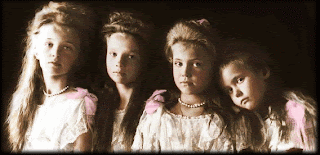
By 1904, Tsar Paul's great-great grandson, Nicholas II, was beginning to feel the pressure of his ancestor's decision. So far, he and his Anglo-German wife, Alexandra, had produced four children - 8 year-old Olga, 7 year-old Tatiana, 5 year-old Maria and 3 year-old Anastasia. All girls. (Below) Whilst the birth of Olga, a fat and healthy baby, had been greeted with undisguised joy in 1895, the birth of Maria in 1899 had been described by her own grandmother as a crushing disappointment and when Anastasia was born in 1901, the Tsar had gone for a long walk in the palace gardens, before putting on a brave face to greet his wife and child.
Alexandra was more than aware that people expected her to deliver. (Quite literally.) And she felt the pressure keenly. When her second daughter, Tatiana, was born in 1897, the young Empress had apparently burst into tears, asking, "What will the nation say?" There were also signs that Alexandra's delicate build could not cope with many more pregnancies. She did not have a strong heart, or back, and even during her second pregnancy, she had spent most of her time in a wheelchair or in bed. She repeatedly fainted during her pregnancy with Maria and the birth of Anastasia had been difficult. Increasingly desperate, Alexandra had turned to her religion and she formed a close friendship with another member of the Imperial Family, the Grand Duchess Militsa, a woman known for her interest in the quack fringes of Christianity. On her advice, the Empress had made visits to a dubious French mystic called Philippe Nazier-Vachot; she had also gone on pilgrimage and bathed in holy springs. At one point, not too long after Anastasia's birth, the Tsarina thought she might be pregnant again, but it was a false alarm.
In early 1904, Alexandra knew for certain she was pregnant again. She was under pressure not just from her own body, which physically could not take any more pregnancies, but also from the nation, who had been anything but responsive when yet another daughter had been born in 1901 - despite the Tsar's attempts to celebrate Anastasia's birth by granting amnesty to certain prisoners. As with Anastasia's birth three years earlier, the Imperial Family stuck to their usual annual routine and decided to spend part of the summer at Peterhof (below), a magnificent eighteenth century summer palace near Saint Petersburg, built by Peter the Great and sometimes nicknamed "the Russian Versailles."

The weather was very hot that summer and the breeze coming off the bays near the palace helped alleviate the court's discomfort. On 12th August, the Tsar and Tsarina sat down to luncheon together, as usual. The Empress was nine months pregnant. She made it to the soup course before excusing herself and hurrying to her rooms, with her servants and doctors. After all the pain and panic that had gone into hoping for a boy, and all the pain and panic that would follow this particular little boy, Alexei Romanov's birth was actually surprisingly easy. Labour lasted less than an hour and in the early afternoon, the guns at Peterhof fired out to announce the birth of another imperial child. Protocol demanded three hundred shots for a boy and one hundred and one for a girl. By the time the one hundred and second shot was fired, the nearby imperial naval base at Kronstadt had started their own salute. The population of the country's capital, Saint Petersburg, heard the news when the enormous cannons of the Peter and Paul Fortress began thundering out across the city and the cathedral of Our Lady of Kazan led the city's churches in a bell-ringing cacophony.
The child had been christened Alexei, after Nicholas II's favourite ancestor, the seventeenth century Tsar Alexei the Just. He inherited the Romanovs' proverbial good looks and the delicate complexion of his mother's family. Nicholas described it as a "great, never-to-be-forgotten day" in his diary and attributed his son's birth to "the mercy of God." Alexandra wept hysterically: "Oh, it cannot be true! It cannot be true! Is it really a boy?" The Empress's lady-in-waiting, Anna Vyrobouva, described him as "beautiful ... healthy, normal." He was beautiful, yes, but he was not healthy.
Some of the first official visitors to see the future tsar in his cradle were his four sisters, who were allowed to tiptoe in once the baby had been washed and dressed. His full name and title was His Imperial Highness Alexei Nicholaivich, Sovereign Heir and Tsarevich, Grand Duke of Russia, Hetman of All Cossacks, Knight of the Order of Saint Andrew, Head of the Siberian Infantry, Head of the Horse Battalion Infantry and Head of the Cadet Corps. His godparents were his grandmother, the Dowager Empress Marie (Nicholas's Danish mother and one of the most popular members of the Romanov family with the public); King Edward VII of Britain, Kaiser Wilhelm II of Germany and the Tsarina's brother, Grand Duke Ernest of Hesse. It would be six weeks before his parents began to notice dark purple bruises on his arms and legs and the awful realisation that he had haemophilia - the same disease which had killed Alexandra's uncle, Leopold, and her little brother, Frederick.
Desperate to hide the truth about her son's illness, lest it weaken respect for the dynasty, and crippled by guilt that it had been her genetics which gave him the sickness which could kill him, Alexandra turned to the same dubious religious solutions she had used when trying to fall pregnant in the first place. When doctors couldn't do anything for her, she sought an answer from God and she believed she had found it in the form of a smelly, eccentric Siberian peasant called Grigory Rasputin. His soothing voice and prayers were the only thing that seemed to stop Alexei's terrible fits of bleeding and, having witnessed these miracles with her own eyes, Alexandra became convinced Rasputin had been touched by the hands of God. To preserve her son's life, she ignored all the evidence which proved that, once he left her presence, Rasputin was not submissive and holy, but wild, drunken and belligerent. Even when she (ludicrously) was accused of being his lover, Alexandra refused to abandon the man who could cure her son. Nicholas, who found Rasputin bizarre and slightly irritating, loved Alexandra so much that he could not bring himself to shatter the only mechanism she had to cope with their child's disease: religion, represented by Rasputin. She defended Rasputin, even when everyone around her knew that his unpopularity was damaging the monarchy. Since the public knew nothing of Alexei's illness, they could not understand why Alexandra was so attached to Rasputin and, naturally, many of them therefore assumed the worst. The repressed trauma of Alexei's illness would eventually set in motion a catalogue of disasters that would shatter the prestige of the Romanov dynasty, claim dozens of political careers, split the church, end Rasputin's life and drag Alexandra's reputation through the mud. Thirteen years later, when the Russian Empire Alexei was born to inherit vanished in revolution, many people, even Alexandra's own friends and family, blamed her dependence on Rasputin and the secret grief she had carried for years, which had led her to put her son's health, his happiness and (above all) his privacy above everything else.